
Author: Emma

  • Why Does My Bank Account Say I Have Money When I’m Still Broke?

    Why Does My Bank Account Say I Have Money When I’m Still Broke?

    You check your bank account and see $600.

    For about three seconds, that feels pretty good.

    Then you remember the electric bill comes out tomorrow.

    Car insurance is due Friday.

    You bought groceries yesterday, but that charge is still sitting there as pending.

    And at least some of that money needs to stay right where it is because rent is coming.

    So, yes. There is $600 in your account.

    That does not mean you have $600 to spend.

    This is one of those money problems that gets much easier once somebody explains what is actually happening. Your bank balance is giving you useful information. It just is not giving you the whole picture.

    Let’s sort out the rest of it.

    What Does My Bank Balance Actually Tell Me?

    Your bank balance tells you how much money is in the account according to the transactions your bank has processed.

    That’s important.

    But your bank does not know your plan.

    It does not know that you need $150 of that money for the electric bill.

    It does not know that you need enough gas to get through next week.

    It definitely does not know that the $100 sitting there is the beginning of the money you are setting aside for your car registration.

    You know those things.

    That’s why I don’t want you making spending decisions based only on the big number at the top of your banking app.

    That number answers:

    How much money is in my account?

    What we really need to know is:

    How much of that money is actually available for me to spend?

    Those are not always the same number.

    What Is the Difference Between My Current Balance and Available Balance?

    Your banking app may show you a current balance and an available balance.

    They sound like they should make everything perfectly clear.

    Naturally, they do not.

    Your current balance generally reflects the transactions that have already posted to your account.

    Your available balance usually does a little more work for you. It may account for pending transactions or holds the bank already knows about.

    So if you spent $60 at the grocery store this morning and that transaction is still pending, your available balance may give you a better picture of what is actually left.

    That’s helpful.

    But there is still a problem.

    Your bank only knows about the things your bank knows about.

    If your $175 utility bill is due Thursday but has not been paid yet, your bank cannot reserve that $175 for you.

    If you need $80 for groceries until payday, your bank does not set that aside.

    If your car registration is due next month, your banking app is not going to tap you on the shoulder and say, “Emma, maybe leave some of this alone.”

    That’s your part of the job.

    Why Can I Have Money in the Bank and Still Be Broke?

    Because some of that money may already belong to something else.

    Let’s say you have $600 available right now.

    Before you get paid again, you need:

    • $175 for utilities
    • $125 for car insurance
    • $100 for groceries
    • $60 for gas
    • $75 for another bill

    That’s $535.

    You still have $600 in the bank.

    But $535 already has somewhere to go.

    That leaves $65 that is not already committed.

    Now imagine looking at that $600 balance and deciding a $100 purchase is fine because you have plenty of money in the account.

    You do have enough to make the purchase.

    You just don’t have enough to make the purchase and do everything else that money needs to do.

    That’s the part that gets us.

    The purchase works today.

    The problem shows up Friday.

    How Do I Know How Much Money I Can Actually Spend?

    We can make this pretty simple.

    Start with the money you have available.

    Then subtract the money you need before more income comes in.

    Money available now − money already needed = money that is not committed

    Let’s try it.

    You have $900.

    Before your next paycheck, you need:

    • $500 for bills
    • $150 for groceries and gas
    • $100 for an expense you already know is coming

    So:

    $900 − $500 − $150 − $100 = $150

    That $150 is much more useful to me than the $900 at the top of the banking app.

    I think of it as safe-to-spend money.

    It is the money left after we have accounted for the things that need to happen first.

    Does that mean you need to immediately spend the whole $150?

    Of course not.

    It means you now know what you’re actually working with.

    And knowing is a lot easier to work with than hoping.

    Don’t Forget the Expenses That Don’t Happen Every Month

    Monthly bills usually aren’t the hardest ones to remember.

    Rent has a way of reminding us it exists.

    So does the electric company.

    It’s the other expenses that like to disappear for a while and then wander back into our lives asking for $300.

    Car registration.

    School expenses.

    Annual memberships.

    Holiday spending.

    Vet visits.

    Insurance premiums.

    Birthdays.

    Home repairs.

    Car maintenance.

    Medical copays.

    None of these is necessarily unexpected.

    We just don’t pay them every month, so they’re easy to leave out when we’re thinking about what our money needs to do.

    If this keeps happening to you, I talked more about why a budget can fail even when the math works.

    One simple thing you can do is start turning those larger future expenses into smaller current ones.

    Suppose you know you’ll need $300 six months from now.

    Finding $300 all at once might hurt.

    Setting aside $50 a month for six months may be much easier.

    Same $300.

    Much less drama.

    What If I Use Cash Instead of a Banking App?

    Good.

    This still works.

    You do not need an app, spreadsheet, online bank account, or fancy budgeting system to know what your money needs to do.

    If you use cash, envelopes can actually make this idea very easy to see.

    Maybe you have:

    • $200 in the rent envelope
    • $100 in groceries
    • $60 in gas
    • $75 in utilities
    • $50 in savings
    • $40 in spending money

    Altogether, you have $525.

    But you wouldn’t dump all six envelopes onto the table, count the money, and decide you have $525 available for dinner and shopping.

    The labels matter.

    Your rent money is still rent money.

    Your gas money is still gas money.

    And your $40 of spending money is the part you can spend without stealing from something else.

    A budget is doing the same job.

    You can keep yours on paper, in envelopes, on your phone, in a spreadsheet, or wherever it makes sense to you.

    I care much more about whether you know what the money is supposed to do than where you write it down.

    What If My Safe-to-Spend Number Is Negative?

    Let’s say you do the math and get this:

    Money available: $700

    Money you need before payday: $850

    Difference: -$150

    Well, that’s not the answer we were hoping for.

    But I would much rather you know about that $150 shortage now than discover it three days before payday.

    A negative number is information.

    It tells us we have a problem to solve.

    Now we can ask useful questions.

    What absolutely has to be paid before payday?

    What can wait?

    Is there a bill due date that can be moved?

    Is there an expense we can reduce this time?

    Is this a one-time problem, or are we coming up short by roughly the same amount every month?

    That last question matters.

    If this happens once because three unusual expenses landed in the same week, we solve this week.

    If you’re $150 short every single month, we have a bigger problem to work on.

    Neither problem gets easier by refusing to look at the number.

    Finding it early gives you time to make decisions.

    Do I Need a Complicated Budget to Do This?

    No.

    And I really don’t want you building a complicated budget just because somebody told you a “real” budget needs 47 categories and a color-coded spreadsheet.

    If you love spreadsheets, wonderful.

    Use one.

    If you would rather use a notebook and a pen, use those.

    If cash envelopes make sense to your brain, get the envelopes.

    Your budget needs to help you answer a few questions:

    What money is coming in?

    What needs to be paid?

    When does it need to be paid?

    What expenses do I know are coming later?

    What can I safely spend after I account for those things?

    If your system can answer those questions, we have something useful.

    We can make it prettier later.

    Your Bank Balance Needs Context

    I don’t want you to stop checking your bank balance.

    Please check it.

    We just aren’t going to ask that one number to do a job it cannot do.

    If your account says $600, then yes, you have $600 in the account.

    But your budget may tell you:

    $175 is for utilities.

    $125 is for insurance.

    $100 is for groceries.

    $60 is for gas.

    $75 is for another bill.

    And $65 is left.

    Now that $600 means something.

    That’s the difference.

    Instead of looking at your account and asking:

    “Do I have money?”

    Try asking:

    “What does this money need to do before I get paid again?”

    That question will tell you a lot more.

    Want Help Building a Budget That Actually Makes Sense?

    If you’ve tried budgeting before and it always seems to turn into a pile of numbers telling you what you can’t do, I wrote Let’s Talk About Budgeting to approach it differently.

    We start with your real money.

    Your real bills.

    Your real paydays.

    Your irregular expenses.

    Your goals.

    And, yes, the fact that sometimes life completely ignores the budget you carefully made for it.

    Then we build a system around that.

    Because the goal isn’t to make you good at budgeting.

    The goal is to make your money easier to understand and manage.

    Friendly conversations. Practical tools. Clear explanations.
    Share This Conversation
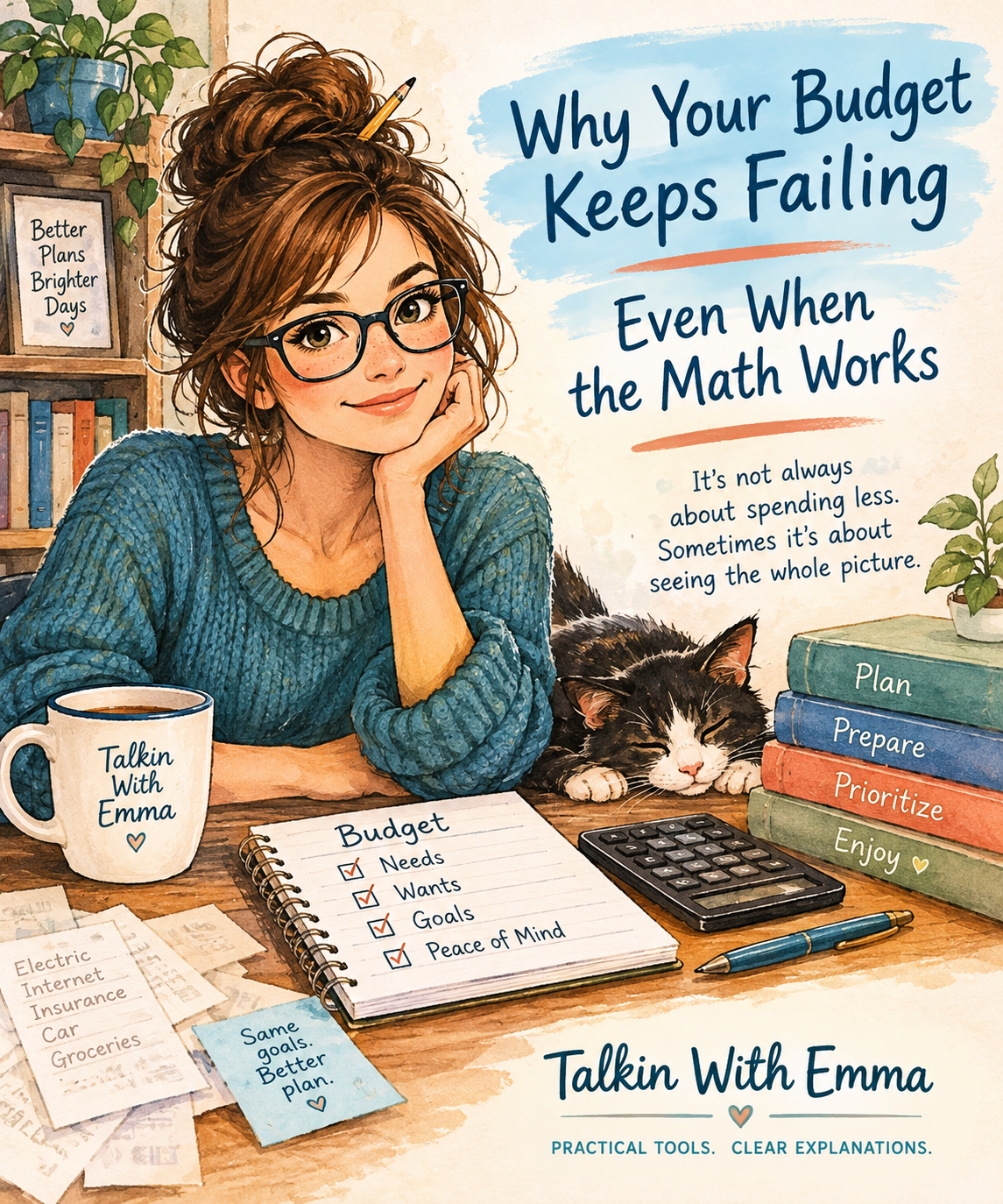
  • Why Your Budget Keeps Failing Even When the Math Works

    Why Your Budget Keeps Failing Even When the Math Works

    You sit down, add everything up, give every dollar somewhere to go, and the numbers work.

    Then real life gets involved.

    A bill shows up that you forgot about. Groceries cost more than you planned. You pull cash from an envelope and forget what it was for. Three subscriptions renew in the same week. By the middle of the month, the budget that looked perfectly reasonable on paper is already wobbling.

    That does not automatically mean you need more discipline. Sometimes the math is fine. The problem is that the budget is not describing your real life closely enough.

    Before you throw it away and start over, let’s figure out what actually broke.

    1. Your budget may be missing real expenses

    Monthly bills are easy to remember because they keep showing up. The expenses that happen every few months—or once a year—are easier to forget.

    Car registration. School costs. Gifts. Annual subscriptions. Vet visits. Holiday spending. A yearly membership. Replacing worn-out shoes. The repair you know the car will eventually need.

    None of those expenses becomes an emergency just because it did not happen last month.

    Look back through the last year if you can. What expenses showed up that were not part of an ordinary month? Divide annual costs by 12, or start setting aside whatever amount you realistically can. The goal is not mathematical perfection. The goal is to stop being surprised by expenses you already know are coming.

    2. The problem may be timing, not spending

    Here is one that trips people up: your monthly income can cover your monthly expenses and you can still run short of money.

    Why?

    Because bills do not care what your monthly total looks like.

    If most of your bills are due during the first week of the month but your income arrives throughout the month, you can have enough money overall and still have a miserable first week.

    That is a cash-flow problem.

    Put your paydays and due dates on the same calendar. If one stretch is overloaded, see whether a company will move a due date. You can also gradually build a small buffer so this paycheck is not responsible for every bill that arrives before the next one.

    Sometimes the budget does not need a cut. It needs better timing.

    3. Cash still counts

    You do not need digital accounts, budgeting software, or an app to have a working budget.

    If you prefer cash, an envelope system can work perfectly well. The important part is knowing what the cash is supposed to do.

    You might have envelopes for groceries, gas, household expenses, fun money, or anything else that makes sense for you. When you spend from an envelope, you do not need to record every purchase in an app unless that helps you. You can simply subtract the amount, keep the receipt in the envelope, or write the purchase on the back of the envelope.

    The envelope itself can be the record.

    What causes trouble is pulling $40 from one envelope, spending $18, putting the change in your pocket, and eventually having no idea which category that money belonged to.

    Cash is not outside the budget. It is simply another place your budget lives.

    4. Your numbers may be too optimistic

    This is one of the easiest budgeting mistakes to make because it feels productive.

    You normally spend $700 on groceries, so you write $450 in the new budget.

    Great. You just saved $250.

    Except you did not.

    You changed a number on paper.

    If you want to lower a category, start with what you actually spend and decide what will make the lower number possible. Maybe you change where you shop, plan more meals, reduce takeout, use what is already in the freezer, or lower the category gradually.

    A goal can stretch you a little. It should not require an entirely different person to live your life.

    5. Your budget may only be paying obligations

    Before deciding what every category should look like, ask one more question:

    What do you want this budget to make easier?

    Maybe you want fewer late fees and less panic between paydays. Maybe you want room for time with friends, a gym membership you actually use, travel, a class, or a goal you have been putting off. Maybe you simply want annual bills to stop feeling like emergencies.

    A budget works better when it is helping you move toward something—not only telling you what to stop doing.

    Write down one or two things you want your money plan to support. Those priorities matter when you decide what to keep, cut, and redirect.

    There is nothing wrong with having a fun category. There is nothing irresponsible about planning for something you enjoy.

    The point of managing money is not to become exceptionally good at paying bills until you die.

    It is to make your money support your actual life.

    6. Find what broke before you start over

    When a budget stops working, it is tempting to delete everything, make a prettier spreadsheet, choose new category amounts, and declare Monday the beginning of a new financial era.

    Before you do that, ask what happened to the last one.

    Was an expense missing?

    Were the numbers unrealistic?

    Did the timing of your bills cause trouble?

    Did cash spending disappear from the plan?

    Were there so many categories that keeping up with them became a second job?

    Did you build a budget for the month you wished you had instead of the month you actually have?

    You do not need to diagnose yourself as “bad at budgeting.” You need to identify the part of the system that failed.

    Systems can be changed.

    Try this today

    Find the last budget or money plan that did not work and finish this sentence:

    My budget became difficult to follow when ____________________.

    Do not fix it yet.

    Name the problem first.

    Then ask what one change would make that specific problem less likely next month.

    Maybe you need to add an annual-expenses category. Maybe you need to move a due date. Maybe groceries need a realistic number. Maybe your cash envelopes need a simple way to track what leaves them.

    One useful correction is better than rebuilding the entire budget because you think you failed.

    A better budget should make life clearer

    Your budget does not have to be impressive.

    It does not need 40 categories, a complicated spreadsheet, or an app that sends you notifications every time you buy toothpaste.

    It needs to tell you the truth about the money coming in, the money going out, the things that do not happen every month, and the things you want your money to help you do.

    If the math works but the budget keeps failing, look beyond the math.

    The problem may be sitting somewhere else entirely.

    Let’s Talk About Budgeting is coming soon from Talkin With Emma. We’ll build a practical budget around real expenses, real timing, and real priorities—including ways to make the system work whether you manage your money digitally, on paper, or with cash.

    Share This Conversation
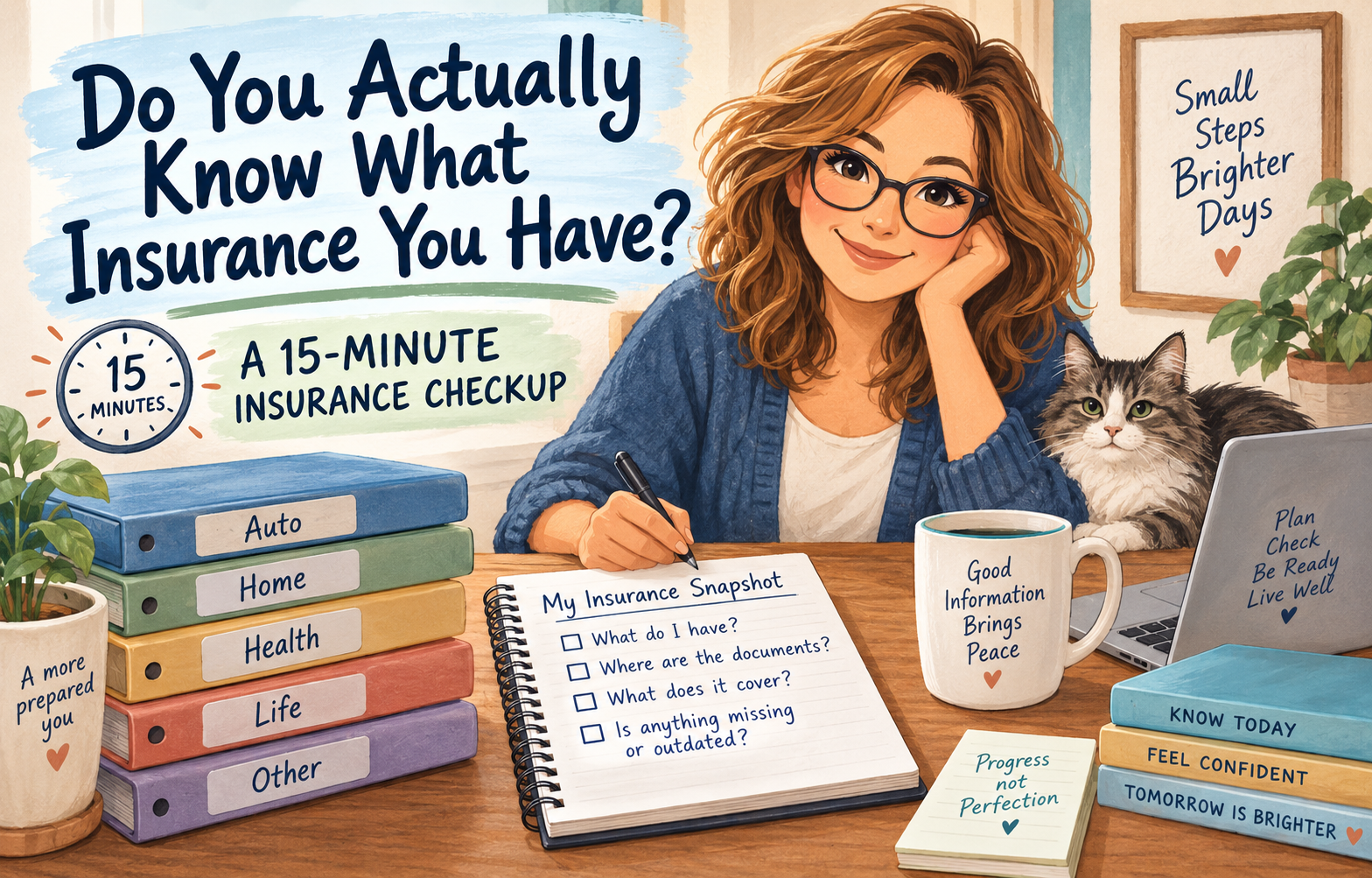
  • Do You Actually Know What Insurance You Have? A 15-Minute Insurance Checkup

    Do You Actually Know What Insurance You Have? A 15-Minute Insurance Checkup

    If I asked you right now what insurance you have, could you tell me?

    Not just, “I have car insurance.”

    Could you tell me who the company is? When the policy renews? What your deductible is? Where you would find the policy if you needed it tonight?

    How about renters or homeowners insurance? Life insurance? Health insurance?

    If your answer is somewhere between “mostly” and “I think so,” you’re in good company.

    Insurance is one of those things we tend to set up and then stop thinking about. We pay the bill, renew the policy, and move on with our lives.

    Until we actually need it.

    So today, we’re not shopping for insurance. We’re not comparing quotes. And we’re definitely not spending hours reading policy documents.

    We’re just figuring out what you already have.

    Set a timer for 15 minutes.

    Step 1: Make a Quick List

    Start with the insurance policies you know you have.

    Your list might include:

    • Auto insurance
    • Homeowners or renters insurance
    • Health insurance
    • Life insurance
    • Disability insurance
    • Dental or vision coverage
    • Insurance through your employer
    • Any other specialty coverage you carry

    Don’t worry if you aren’t sure whether something belongs on the list. Write it down anyway.

    The goal isn’t to create a perfect insurance inventory. It’s to get everything out of your head and into one place.

    Step 2: Find the Policies

    Now see how many of those policies you can actually locate.

    That might mean finding a paper copy, opening an insurance company’s app, logging into an online account, checking your email, or looking through your employee benefits portal.

    For each policy, try to find four basic things:

    • Who is the insurance company?
    • What is the policy number?
    • When does the policy renew or end?
    • Where can you find the full policy information if you need it?

    You don’t need to memorize any of this. You just need to know where it is.

    That’s a surprisingly important distinction.

    If a tree falls on your house, your car gets hit in a parking lot, or someone in your family ends up in the emergency room, that’s not the moment you want to start searching old emails for an insurance policy you haven’t looked at in two years.

    Step 3: Check the Big Numbers

    If you still have a few minutes, look at the basic numbers on each policy.

    Depending on the type of insurance, that could include:

    • Coverage limits
    • Deductibles
    • Monthly or annual premiums
    • Life insurance benefit amounts
    • Health insurance copays or coinsurance
    • Out-of-pocket maximums

    You don’t need to understand every number yet. You’re simply taking inventory.

    If you see something you don’t understand, make a note of it. That’s something you can investigate later.

    Step 4: Look for the Obvious Gaps

    Now ask yourself a few simple questions.

    Has anything important changed since you bought these policies?

    Maybe you moved. Bought a house. Got married or divorced. Had a child. Bought a new car. Started working from home. Changed jobs. Started a side business. Bought expensive electronics, jewelry, tools, collectibles, or other property.

    Or maybe nothing dramatic happened—but you haven’t looked at your coverage in five years.

    None of those things automatically mean you need different insurance. They simply mean it’s worth checking.

    Step 5: Put Everything Somewhere You Can Find It

    This may be the most useful part of the entire exercise.

    Pick one place for your basic insurance information.

    It could be a folder in a filing cabinet, a secure digital folder, a notes app, or another system that works for you.

    You don’t necessarily need every giant policy document sitting together.

    You do want to be able to answer:

    What insurance do I have, who provides it, and where do I go when I need it?

    That’s your insurance snapshot.

    You’re Done

    Really.

    You don’t have to call three insurance companies today. You don’t have to request quotes. You don’t have to become an insurance expert.

    You spent 15 minutes figuring out what you already have.

    And now you have something much more useful than a vague feeling that you’re probably insured.

    You have a starting point.

    From there, you can decide whether anything deserves a closer look.

    Maybe your coverage is perfectly fine. Maybe you discover a policy you’ve been meaning to update. Maybe you find a deductible you didn’t realize was so high. Or maybe you discover one question you want to ask your insurance company or agent.

    That’s progress.

    Insurance gets much easier to deal with when you stop trying to understand everything at once.

    Start with what you have. Then take the next step when you’re ready.


    This article is for general educational purposes and isn’t individualized insurance, financial, legal, or tax advice. Coverage, policy terms, and insurance requirements vary.

    Share This Conversation
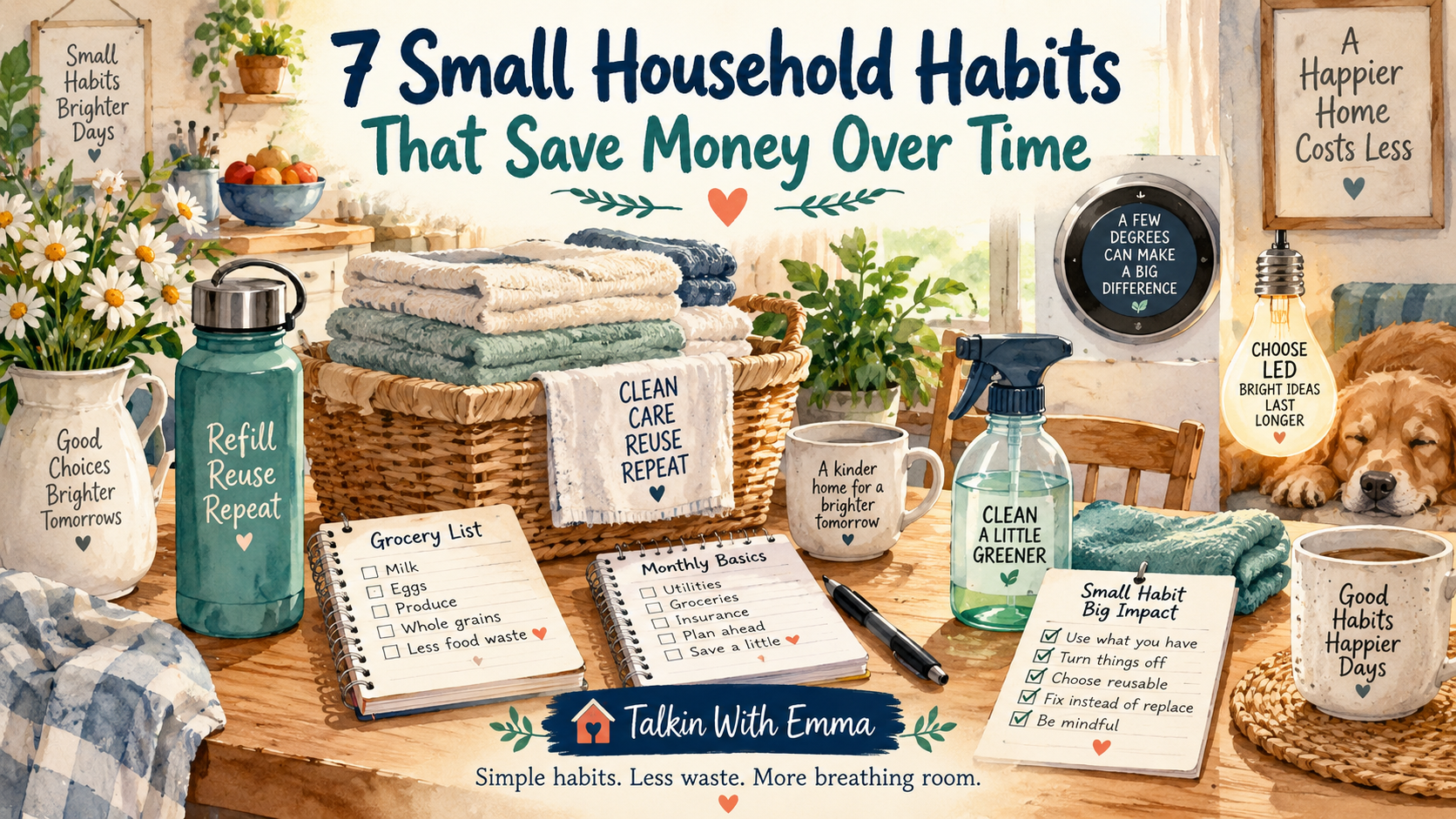
  • 7 Small Household Habits That Can Save You Money Over Time

    7 Small Household Habits That Can Save You Money Over Time

    Saving money at home does not always mean making a big change.

    Sometimes it is the small things you do over and over that make the biggest difference.

    A few dollars here and there may not feel important in the moment. But when the same small savings happen every week or every month, they can add up.

    Here are seven household habits that can help you spend a little less without turning your life upside down.

    1. Check Recurring Charges Once a Month

    Subscriptions are easy to forget because they happen automatically.

    Once a month, take a few minutes to look at the recurring charges coming out of your bank account or credit card.

    Ask yourself:

    • Do I still use this?
    • Has the price changed?
    • Am I paying for two services that do almost the same thing?
    • Is there a cheaper plan that would work just as well?

    You do not have to cancel everything. The goal is simply to notice what you are paying for.

    2. Make a Short Grocery List Before You Shop

    You do not need a complicated meal plan to save money on groceries.

    A short list can help.

    Before you leave for the store, look through the refrigerator, freezer, and pantry. Then write down what you actually need.

    This can help prevent buying duplicates, forgetting ingredients, and making extra trips later in the week.

    It also makes it easier to use food you already have before it goes bad.

    3. Use Appliances in Full Loads When You Can

    Running the dishwasher or washing machine for only a few items can use nearly as much water and energy as a fuller load.

    You do not need to pack appliances so tightly that they stop working properly. Just try to avoid running them half-empty when waiting a little longer would be easy.

    It is a small habit, but over time it can mean fewer cycles and less wasted water and electricity.

    4. Give the Thermostat a Little Attention

    Heating and cooling can be a large part of a household utility bill.

    You do not need to make your home uncomfortable to save money.

    Instead, pay attention to small changes. A slightly different thermostat setting when you are asleep or away may help reduce energy use.

    Also check simple things that affect how hard the system has to work, such as:

    • dirty air filters,
    • doors or windows left open,
    • sunlight heating a room you are trying to cool, and
    • vents blocked by furniture.

    Little adjustments can matter when they happen every day.

    5. Maintain Things Before They Break

    Routine maintenance is not exciting, but repairs are usually even less exciting.

    Changing filters, cleaning dryer vents, checking appliance hoses, keeping gutters clear, and following basic maintenance schedules can help household equipment last longer.

    Not every breakdown can be prevented. But taking care of what you own can reduce avoidable problems and help you notice trouble earlier.

    A small maintenance cost today may be much easier to handle than a major repair later.

    6. Review Bills and Renewals Instead of Letting Them Roll Over

    It is easy to let insurance, internet, phone service, and other household bills renew without looking at them.

    Before a renewal or contract change, take a few minutes to check:

    • what you are paying now,
    • whether the price increased,
    • whether you still need all the features or coverage included, and
    • whether another option is worth comparing.

    You do not need to switch companies every year. Sometimes the current option is still the best one.

    The useful habit is checking instead of assuming.

    7. Do a 10-Minute Weekly Money Check

    A weekly money check does not have to be a full budgeting session.

    Set aside about 10 minutes and look at what is coming up.

    You might check:

    • your current account balance,
    • bills due in the next week,
    • automatic payments,
    • any unusual charges, and
    • whether you need to move money before something is due.

    This habit can make money feel less surprising.

    It is often easier to deal with a small issue when you notice it early rather than after a payment is missed or an account is overdrawn.

    Small Habits Work Because They Repeat

    None of these habits will magically cut your household expenses in half.

    That is not really the point.

    The goal is to make a few useful choices often enough that they start working in the background.

    Check what you are paying for. Use what you already have. Take care of the things you own. Give upcoming bills a quick look.

    You do not need to do everything perfectly.

    A small habit that you actually keep is usually more useful than a perfect money plan that lasts for three days.

    — Emma

    Share This Conversation
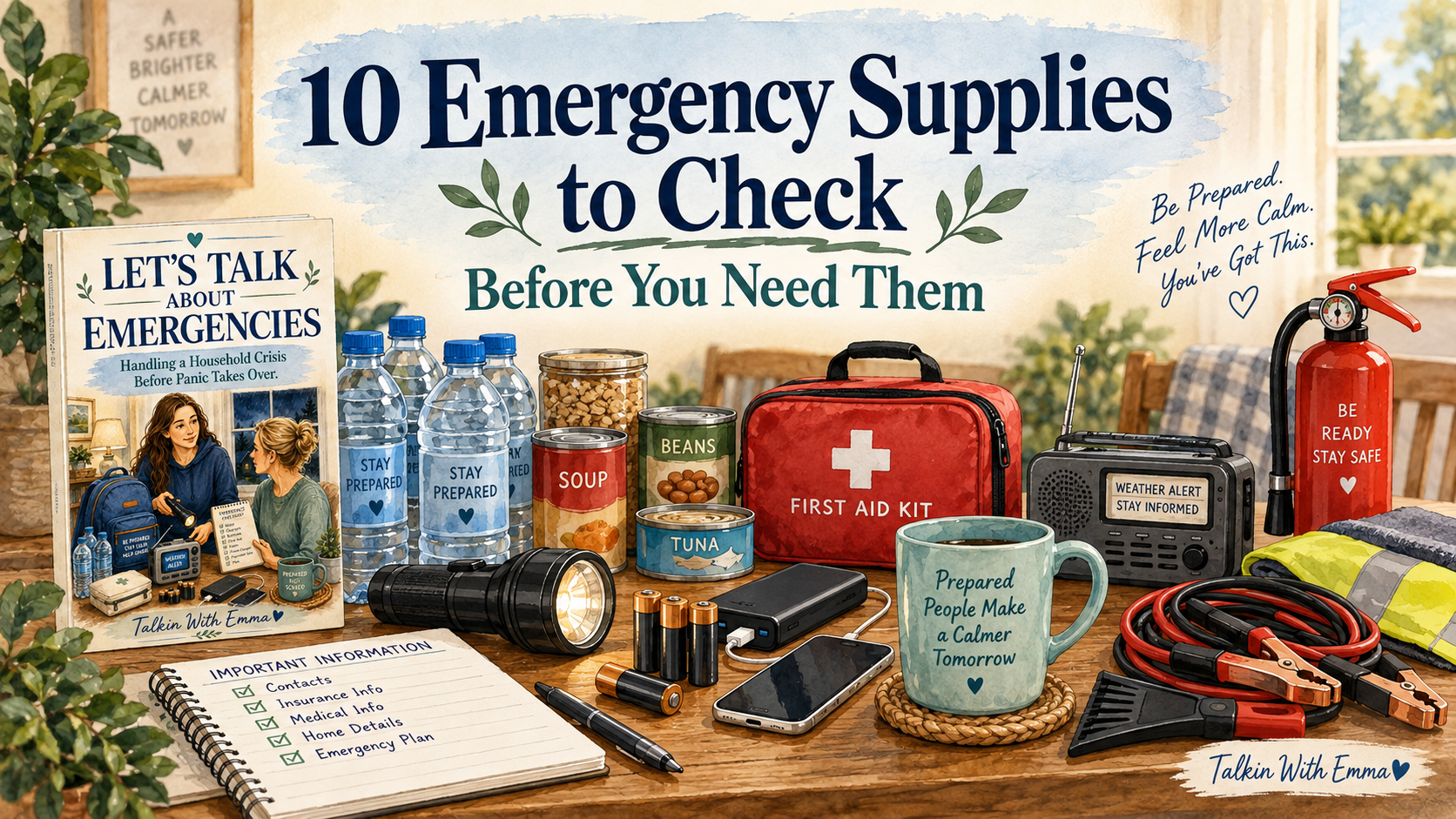
  • 10 Household Emergency Supplies You Should Actually Check Before You Need Them

    10 Household Emergency Supplies You Should Actually Check Before You Need Them

    Buying emergency supplies feels productive.

    Checking them later is the part people forget.

    A flashlight can sit in a drawer for two years and still look perfectly fine right up until the moment you need it and discover the batteries are dead.

    A backup charger is useful only if it is charged.

    A first-aid kit is helpful only if the things inside it are still usable.

    That is why emergency preparedness is not just about owning things.

    It is about knowing they work.

    Here are ten household emergency supplies worth checking before you need them.

    1. Flashlights

    Start simple.

    Find the flashlights you would actually reach for during a power outage.

    Turn them on.

    If they are dim, flickering, or dead, replace or recharge the batteries.

    It is also worth checking whether everyone in the household knows where the flashlights are.

    A working flashlight is not much help if nobody can find it in the dark.

    2. Spare Batteries

    Loose batteries have a habit of migrating into junk drawers.

    Then, when you need them, you have no idea which ones are fresh.

    Check the batteries you keep for emergency items and make sure you have the right sizes for the things you actually own.

    If you use rechargeable batteries, make sure the charger works too.

    3. Backup Phone Chargers

    A portable battery pack can be incredibly useful during a power outage, severe weather event, or car problem.

    But only if it has power in it.

    Check the charge level.

    Recharge it if needed.

    If you keep charging cables with it, make sure they still fit the phones and devices your household currently uses.

    Technology changes. Your emergency kit should keep up.

    4. First-Aid Supplies

    You do not need a giant medical bag for normal household preparedness.

    You do need the basics to be usable.

    • Bandages
    • Gauze
    • Medical tape
    • Antiseptic supplies
    • Gloves
    • Thermometer
    • Any other basic items you rely on

    Replace anything damaged, missing, dried out, or expired where expiration dates apply.

    And if your first-aid kit is buried behind six boxes in a closet, consider moving it somewhere easier to reach.

    5. Emergency Radio

    If you keep a battery-powered or hand-crank radio, test it.

    Make sure it turns on.

    Check the batteries.

    Make sure you know how to switch between normal radio and weather alerts if your model has that feature.

    This is one of those items people can own for years without ever turning on.

    The middle of a storm is not the best time to learn how it works.

    6. Drinking Water

    Check your emergency water supply.

    Look for leaks, damaged containers, or supplies that need to be rotated.

    Also think realistically about how much you have.

    A couple of bottles may help for a short interruption.

    A longer water problem can require considerably more.

    You do not have to build a bunker.

    Just make sure the amount you keep matches the kind of emergency planning you are trying to do.

    7. Shelf-Stable Food

    Emergency food does not have to be fancy.

    It does have to be edible.

    Check dates and packaging on the food you keep for outages or severe weather.

    Rotate older items into normal meals before they become unusable and replace them with fresh ones.

    It is much easier to manage emergency food when it is food you already eat.

    8. Fire Extinguishers

    Look at your household fire extinguishers.

    Make sure they are still where they belong, easy to reach, and showing the correct pressure if your extinguisher has a gauge.

    If one looks damaged, discharged, or questionable, replace or service it according to the manufacturer’s instructions.

    Also make sure the people in your household know where the extinguisher is.

    That is worth repeating because emergency supplies have a strange tendency to disappear behind coats, boxes, and furniture.

    9. Important Information

    Some emergency supplies are not physical equipment.

    Check your list of important phone numbers, insurance information, medication details, emergency contacts, and household information.

    Is it current?

    Would you still be able to find it if your phone were dead?

    A paper copy of a few important details can be surprisingly useful.

    You do not need to print your entire life.

    Just keep the information you would really need if things became stressful.

    10. The Supplies in Your Car

    Household emergency planning should not stop at the front door.

    Take a quick look at what is in your vehicle.

    • Flashlight
    • Phone charger
    • Jumper cables or jump pack
    • Basic first-aid supplies
    • Water
    • Blanket
    • Tire tools
    • Reflective warning equipment

    What you carry will depend on where you live, how far you drive, and the weather you deal with.

    Someone driving rural roads in winter may need a very different setup from someone who rarely leaves town.

    The point is to prepare for your actual life.

    Emergency Supplies Are Only Useful If They Work

    You do not need to check everything every week.

    That would get old quickly.

    A better approach is to pick a couple of times a year to go through your emergency supplies.

    You might do it before storm season.

    Or when the clocks change.

    Or at the beginning of summer and winter.

    Choose something you will remember.

    Then test, recharge, replace, and rotate what needs attention.

    Preparedness does not have to be complicated.

    Sometimes it is as simple as discovering the flashlight batteries are dead on a normal Tuesday instead of during a midnight power outage.

    That is a win.

    If you want a broader, practical guide to handling outages, severe weather, water problems, car trouble, and other everyday emergencies, Let’s Talk About Emergencies walks through those situations in plain English, one step at a time.

    — Emma

    Share This Conversation
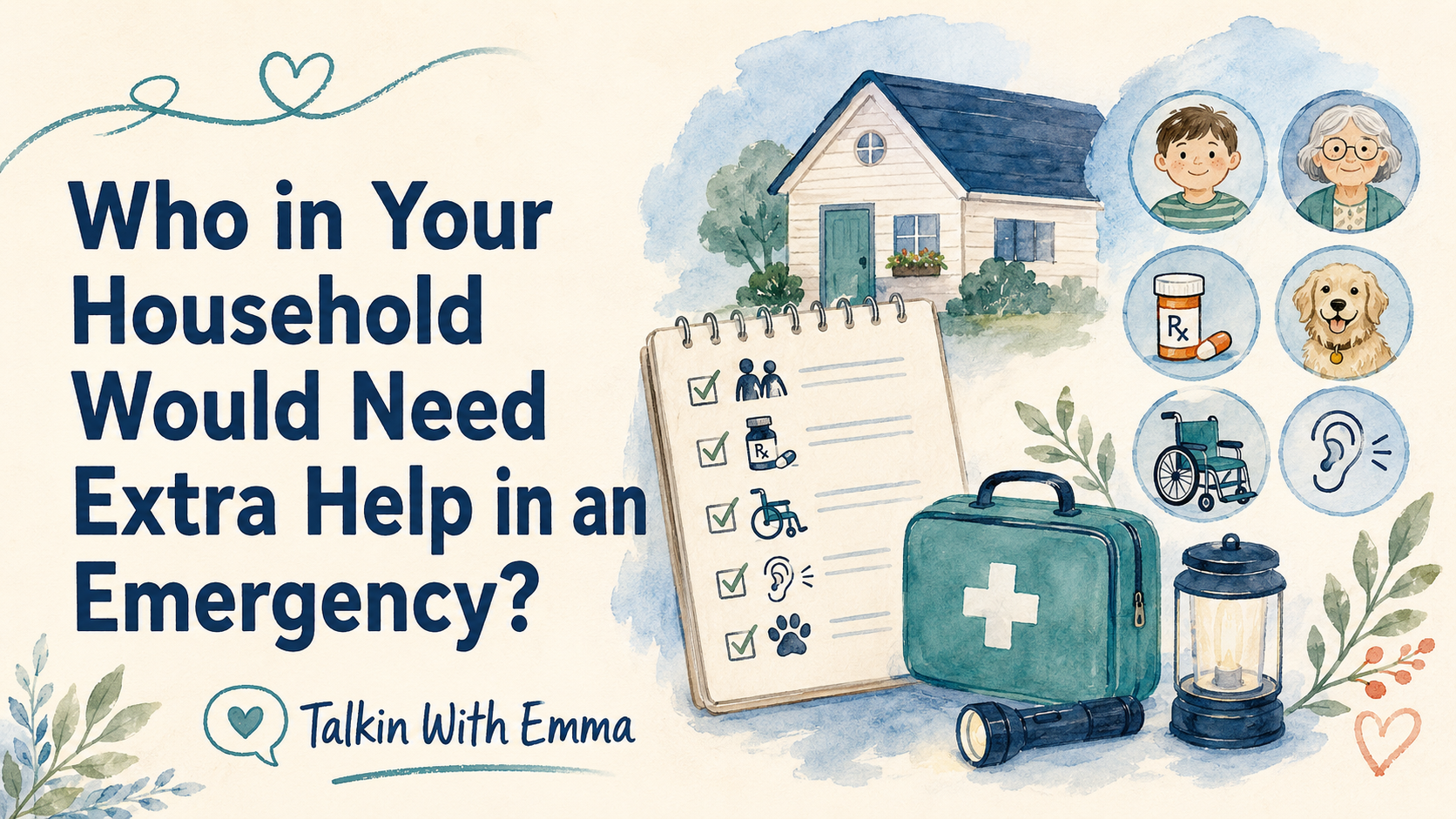
  • Who in Your Household Would Need Extra Help in an Emergency?

    Who in Your Household Would Need Extra Help in an Emergency?

    Here’s a question I think is worth asking before anything goes wrong:

    If something happened at home tonight, who would need you first?

    Not who is the most organized.

    Not who has the emergency app.

    Not who bought the flashlight with seventeen settings.

    Who would actually need help?

    Because emergency plans have a funny way of sounding very neat on paper.

    Everybody hears the alarm.

    Everybody knows where to go.

    Everybody remembers the plan.

    Everybody grabs what they need.

    Real households are usually a little messier than that.

    Someone is asleep.

    Someone cannot find their shoes.

    Someone is trying to get the dog out from under the bed.

    Someone left their medication in the other room.

    Someone is confused.

    Someone is scared.

    And somebody is standing there thinking, Okay. Who do I need to take care of first?

    That is the part I want you thinking about.

    Start with the people who may need more time

    Think about the people who live with you.

    Would anyone have a harder time moving quickly?

    That might be a young child.

    An older adult.

    Someone who uses a cane, walker, wheelchair, or other mobility equipment.

    Someone who would need help getting out of bed.

    Someone who may not hear an alarm easily.

    Someone who gets overwhelmed when things happen fast.

    You do not need to turn this into a medical chart.

    Just be realistic.

    If getting everybody out of the house would take longer than getting yourself out of the house, that belongs in the plan.

    Think about medication and equipment

    This is one of those things that is easy to overlook because, most of the time, everything is sitting right where it belongs.

    Then the power goes out.

    Or you need to leave quickly.

    Or you are away from home longer than expected.

    Does anyone in your household rely on medication they may need to take with them?

    Medical equipment?

    A charger?

    Batteries?

    Supplies?

    I am not saying you need to drag the medicine cabinet to the front door.

    I am saying it helps to know what actually matters before you are trying to remember it under pressure.

    Children need a plan they can understand

    A five-year-old does not need a twelve-step emergency procedure.

    Honestly, neither do most adults.

    For kids, simple usually wins.

    Where do we go?

    Who do we stay with?

    Who do we listen to?

    What do we do if we cannot find Mom, Dad, Grandma, or whoever normally takes care of us?

    You do not have to make the conversation scary.

    You are just giving them a few familiar answers before they need them.

    Do not forget the person who will not be home

    This one gets missed a lot.

    What if somebody in the household is at work?

    At school?

    At the store?

    Driving home?

    You may have a perfectly reasonable plan for the people inside the house and no idea what everyone else is supposed to do.

    Pick a meeting place.

    Pick an out-of-area contact if that makes sense for your household.

    Make sure people know where to go if they cannot get back home right away.

    Again, nothing fancy.

    Just enough that everybody is not making up a different plan at the same time.

    And yes, the pets count

    I know.

    The cat did not attend the household meeting.

    The dog did not review the evacuation route.

    They remain completely uncooperative members of the emergency-planning committee.

    They still count.

    If you have pets, think about what it would take to move them quickly.

    Where is the leash?

    Where is the carrier?

    Do you have food, medication, or anything else they would need if you had to leave?

    And if your pet tends to hide when something gets loud or strange, that is useful information too.

    You already know your animal.

    Plan for the animal you actually have, not the one who behaves beautifully in your imagination.

    Roommates and other adults can still need a conversation

    Adults are very good at assuming another adult knows the plan.

    Sometimes nobody has actually talked about it.

    If you live with roommates, adult children, parents, relatives, or anybody else, ask a few basic questions.

    Where would we meet?

    Who checks on the pets?

    Who has the important numbers?

    Does everybody know where the emergency supplies are?

    You may discover that the “household plan” currently exists only inside your head.

    That is useful to know now.

    Here is the question I would use

    You do not have to sit down tonight and build a full emergency plan.

    Just walk through your household one person at a time and ask:

    If something happened tonight, what would this person need from me?

    Maybe the answer is nothing.

    Great.

    Maybe they need a little more time.

    Maybe they need medication.

    Maybe they need help moving.

    Maybe they need instructions kept very simple.

    Maybe they need you to remember the leash.

    Write down what matters.

    That is enough to start.

    Because a useful emergency plan is not really about having the perfect checklist.

    It is about the people who actually live in your house.

    And those people are probably not going to react exactly the way a checklist says they should.

    That is okay.

    Plan for your real household.

    You will be much better off.

    I’ll be talking more about this next week when Let’s Talk About Emergencies arrives, because this is one of the big ideas behind the book:

    A useful plan has to fit the people who actually live there.

    — Emma

    Share This Conversation
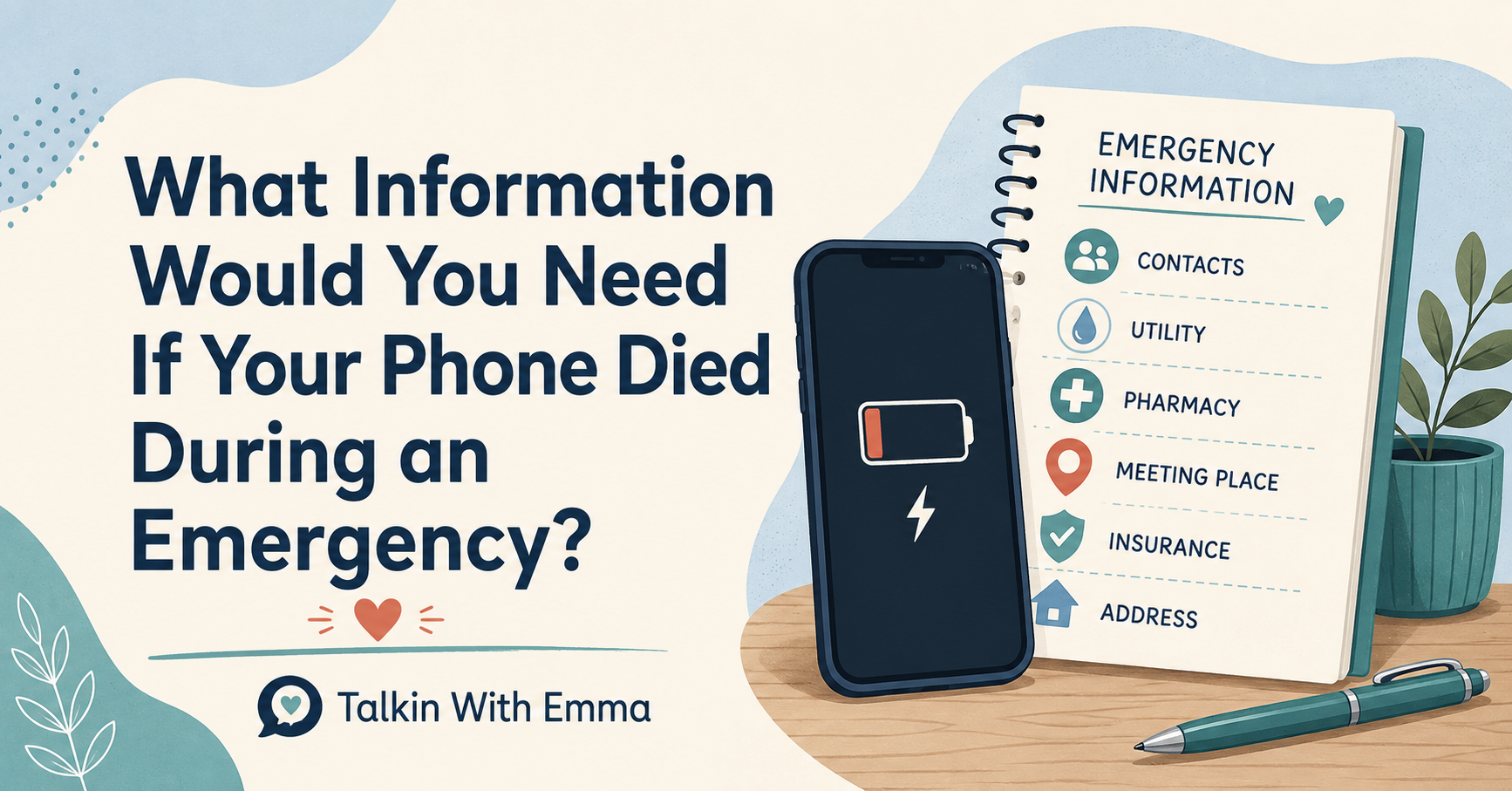
  • What Information Would You Need If Your Phone Died During an Emergency?

    What Information Would You Need If Your Phone Died During an Emergency?

    Let me ask you something.

    If your phone died right now, how much important information would disappear with it?

    I don’t mean gone forever. I mean gone at the exact moment you might actually need it.

    Your contacts are in your phone. Your insurance app is in your phone. Your pharmacy number is in your phone. The address you were supposed to meet at? Probably in a text somewhere.

    Most days, that works just fine.

    Then the battery dies.

    Or the power is out.

    Or you can’t get a signal.

    Or you’re standing there thinking, I know I have this information somewhere.

    That is not the best time to start hunting for it.

    You do not need an emergency command center

    I am not suggesting you create a three-inch binder with tabs, laminated maps, and seventeen backup plans.

    If that makes you happy, carry on.

    For the rest of us, I’d start with one simple question:

    What information would I be annoyed, stressed, or stuck without if my phone stopped working?

    Write that down on paper.

    That’s the whole idea.

    Start with the people you would actually call

    Who would you need to reach first?

    Maybe that is your spouse, your adult child, your parent, your neighbor, or the friend who somehow always answers the phone.

    Write down the numbers for the people who matter most.

    And here’s one I really like: choose one person who lives outside your immediate area.

    If something is affecting your whole neighborhood or town, it can help to have one person farther away who everyone knows to contact.

    You do not need twenty names.

    You need the few names you would actually use.

    Write down the numbers you usually look up

    This is where people tend to say, “Oh, I can just Google that.”

    Usually, yes.

    But we are talking about the moment when “usually” may not be cooperating.

    Think about the numbers you would want if something went wrong at home.

    Your electric company.

    Gas company, if you have one.

    Water utility.

    Landlord or property manager, if that applies.

    Your insurance company or agent.

    Your pharmacy.

    Your veterinarian, if there is an animal in the house who thinks emergency planning is beneath them.

    You do not have to collect every number connected to your life. Just the ones that would be a pain to find when you are already dealing with something else.

    Keep the addresses that matter

    We rely on maps so much now that a lot of us barely remember addresses.

    I am including myself in that sentence.

    If your household has a meeting place, write down the actual address.

    If there is a relative’s house you might go to, write that down too.

    If your child, parent, or another household member has a place you would need to reach, include it if it makes sense for your situation.

    The point is not to create a directory.

    The point is to keep yourself from having to reconstruct basic information while you are stressed.

    Add the information that belongs to your household

    This is the part that will look a little different for everybody.

    You might want:

    • insurance policy or claims contact information
    • important medical or pharmacy contacts
    • pet information
    • building or landlord contacts
    • an emergency meeting place
    • an out-of-area contact

    Notice what I did not say.

    I did not say put passwords, Social Security numbers, bank account numbers, or a pile of sensitive personal information on a sheet of paper and leave it on the kitchen counter.

    Useful is good.

    Useful and sensible is better.

    Then put the paper somewhere you can actually find it

    This part matters more than it sounds.

    If you make the list and tuck it into a mystery drawer behind old batteries and takeout menus, we have not improved much.

    Keep it somewhere your household knows to look.

    Maybe that is with your emergency supplies.

    Maybe it is inside a cabinet door.

    Maybe you keep one copy at home and another in your go-bag.

    Use whatever makes sense for your household.

    Just make sure the people who may need it know it exists.

    One last thing: update it

    A beautiful emergency list with your old pharmacy, your former landlord, and the phone number your sister changed two years ago is not especially helpful.

    You do not need to review it every Thursday at 7:15 p.m.

    Just look at it when something changes.

    You move.

    You change insurance companies.

    You switch pharmacies.

    Someone gets a new phone number.

    Take thirty seconds and fix the list.

    Here’s where I’d start

    Grab one piece of paper.

    Write down:

    • three people you would want to reach
    • one out-of-area contact
    • your main utility numbers
    • your insurance contact
    • your pharmacy or other important household contact
    • your emergency meeting place and address

    That is enough for today.

    You can make it prettier later if you want.

    For now, you have taken something that lived only inside your phone and made it available even when the phone is not.

    That is the kind of emergency preparation I like.

    Simple. Useful. And actually possible to do before lunch.

    I’ll be talking more about practical household preparedness next week because a new Talkin With Emma guide is almost here.

    Until then, maybe go write down the one phone number you are absolutely certain you know by heart.

    Then check whether you were right.

    — Emma

    Share This Conversation
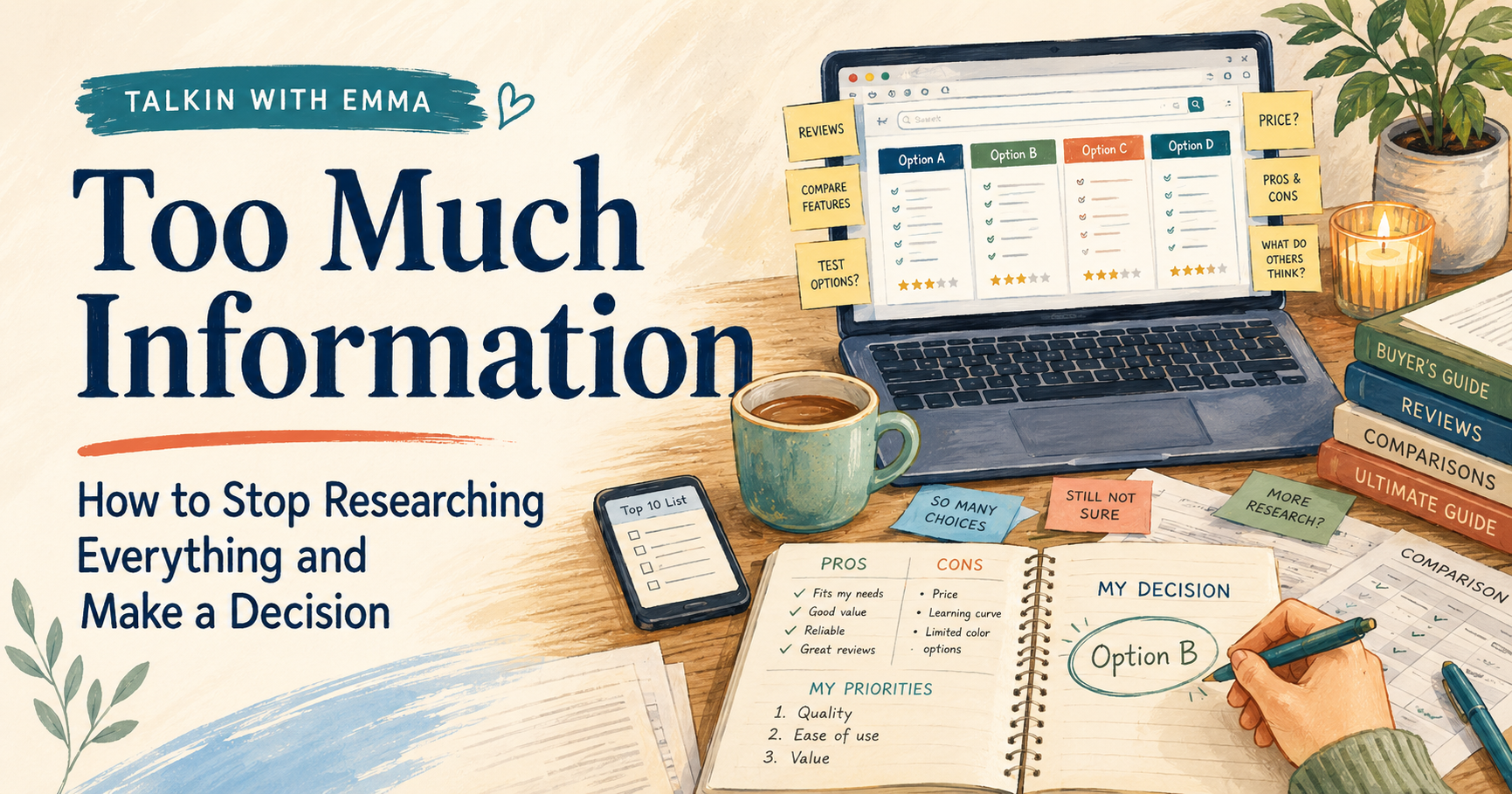
  • Too Much Information: How to Stop Researching Everything and Make a Decision

    Too Much Information: How to Stop Researching Everything and Make a Decision

    You need to make a decision.

    Nothing dramatic.

    Maybe you’re comparing insurance.

    Buying a laptop.

    Planning a vacation.

    Or you just need a new vacuum cleaner.

    So you do the responsible thing.

    You research.

    Twenty minutes later, you have nine browser tabs open.

    An hour later, you’ve watched three videos, read four reviews, and discovered a Reddit thread written by people who apparently have very strong feelings about vacuum cleaners.

    Now you know more.

    You are also somehow less sure what to do.

    That is the part nobody warns you about.

    More Information Isn’t Always More Helpful

    Having access to information is useful.

    Want to know whether a hotel is clean? Read reviews.

    Want to compare insurance companies? Look at quotes, coverage details, ratings, and complaint information.

    Want to know which air fryer makes the crispiest chicken wings?

    I promise you, someone has conducted this investigation.

    The problem isn’t having information.

    It’s knowing when the information has stopped helping.

    There is a point where another article doesn’t make the decision clearer. It just gives you another opinion to sort through.

    Then another.

    And another.

    Eventually, you’re not researching the decision anymore.

    You’re postponing it.

    Start With the Decision, Not the Research

    Before you open another tab, ask yourself one question:

    What am I actually trying to decide?

    This sounds obvious.

    It isn’t.

    It’s easy to start with, “I need car insurance,” and somehow end up reading about claims ratings, state rules, six optional coverages, and a stranger’s terrible experience from seven years ago.

    Some of that may matter.

    Some of it probably does not matter to the decision you’re making today.

    Make the question smaller.

    Instead of:

    “Which insurance company is best?”

    Try:

    “Which of these policies gives me the coverage I need at a price I can afford?”

    Instead of:

    “What’s the best laptop?”

    Try:

    “Which laptop in my price range will handle the things I actually use it for?”

    A clear question gives your research somewhere to go.

    Otherwise you’re just collecting information.

    Decide What Matters Before You Compare

    Pick the few things that matter most to this decision.

    Not every possible feature.

    Not every opinion you found online.

    The things that actually matter to you.

    Let’s say you’re booking a hotel. Maybe your priorities are location, cleanliness, and price.

    Now you have a filter.

    A hotel that’s $40 cheaper but 45 minutes from everything you want to do may not actually be the better choice.

    One with a beautiful rooftop pool but a pile of recent reviews mentioning dirty rooms may not survive the cleanliness test.

    The rooftop pool will survive without us.

    Your priorities do not have to match somebody else’s.

    That’s the point.

    You’re making a decision for your life, not trying to win an imaginary contest for choosing the objectively perfect option.

    Separate Facts, Assumptions, and Opinions

    This is where a lot of decision confusion clears up.

    A fact is something you can verify.

    An opinion is somebody’s judgment or experience.

    An assumption is something you’re treating as true even though you have not actually confirmed it.

    Those three things can look surprisingly similar when they’re all sitting on the same screen.

    Maybe a product page says a laptop has 16 GB of memory. That’s a fact you can verify.

    A reviewer says the keyboard feels cheap. That’s an opinion.

    You decide the cheaper model “probably won’t last as long” even though you have not found anything supporting that. That’s an assumption.

    Opinions can still be useful. Assumptions can sometimes point to a question you need to answer.

    Just don’t let either one quietly turn into a fact.

    Give Yourself a Research Limit

    Decide when you’re going to stop researching before you start.

    Maybe it’s three quotes.

    Five products.

    Thirty minutes.

    Three reliable sources.

    The right limit depends on the decision, but having one matters.

    Without an edge, the internet will happily let you keep going forever.

    There is always another review, another comparison, another expert, and another person who bought the exact thing you’re considering and wants you to know it ruined their entire summer.

    You don’t need every available piece of information.

    You need enough useful information to make a reasonable decision.

    Not Every Decision Deserves the Same Amount of Research

    Some decisions deserve real time and careful comparison.

    Insurance coverage. A mortgage. A car. A major medical decision. Something that could seriously affect your finances or your safety.

    Those deserve more attention.

    But we sometimes bring the same research habits to decisions where the stakes are much lower.

    You don’t need a spreadsheet to choose paper towels.

    You probably don’t need six comparison videos before buying a $22 toaster.

    And if you’ve spent 45 minutes comparing $14 phone cases to save $3, we may have wandered off course.

    Ask yourself:

    What happens if I make the wrong choice?

    If the answer is, “I’ll be mildly annoyed,” that’s probably not a three-hour research project.

    Save your attention for decisions where getting it wrong actually matters.

    Use Reviews for Patterns, Not Instructions

    Reviews are useful.

    I use them too.

    But one review is one person’s experience.

    If one person mentions a problem, I notice it.

    If hundreds of people mention the same problem, I pay more attention.

    Also look at what people are actually complaining about.

    Someone may hate a hotel because it’s too quiet.

    You may be specifically looking for quiet.

    That review didn’t become wrong.

    It just means something different for your decision.

    Reviews aren’t instructions.

    They’re information.

    Watch for the Search for Certainty

    Sometimes we keep researching because we think one more article will finally make us feel completely sure.

    Most decisions do not work that way.

    You can compare insurance policies carefully and still wonder whether another company might have been better.

    You can read laptop reviews for hours and still find somebody who hates the one you chose.

    Research can reduce uncertainty.

    It usually cannot eliminate it.

    At some point, the question changes from “Do I know everything?” to “Do I know enough to make a reasonable choice?”

    That is a much more useful standard.

    Try the Three-Question Stop Sign

    When you feel yourself reaching for one more article, review, or video, stop and ask:

    1. Do I understand my main options?
    2. Do I know the important differences between them?
    3. Is more information likely to change my decision?

    If the answer to the first two is yes and the third is no, you’re probably done.

    Close the tabs.

    I know.

    All of them.

    Stop Reopening a Decision You’ve Already Made

    This one is sneaky.

    You research.

    You compare.

    You decide.

    Then two days later, you start researching again.

    Maybe there’s a better option.

    Maybe somebody posted a new review.

    Maybe you should have picked the other one.

    If nothing meaningful has changed, the decision does not automatically need to be reopened.

    You made a reasonable choice with the information you had.

    Let it be finished.

    Otherwise every decision becomes permanent homework.

    Nobody needs that.

    Need Help Sorting the Decision Out?

    If your problem isn’t that you need more information, but that you have too much of it floating around in your head, I made a simple worksheet for that.

    My Decision Reset Sheet helps you name the decision, separate facts from assumptions, compare the options that actually matter, and choose a next step.

    It is free.

    Make a Good Decision, Not a Perfect One

    Perfect decisions look wonderful in hindsight.

    Unfortunately, we have to make decisions before hindsight arrives.

    So work with what you know.

    Figure out what matters.

    Separate what you know from what you’re assuming.

    Set a reasonable research limit.

    Compare your best options.

    Then choose.

    Could another option turn out to be slightly better?

    Sure.

    Maybe the toaster you didn’t buy lasts eleven years and yours lasts nine.

    We’ll find a way to carry on.

    The goal isn’t to squeeze every possible ounce of perfection out of every decision.

    It’s to make a good decision without letting the decision take over your life.

    Sometimes the Best Thing You Can Do Is Close the Tabs

    Information is supposed to help you.

    When it stops helping, you’re allowed to stop looking.

    You don’t need every opinion.

    You don’t need to know every possibility.

    Know what you’re deciding.

    Know what matters.

    Get enough reliable information to understand your choices.

    Then make the call.

    And close the tabs.

    Seriously.

    Your computer could probably use the break too.


    This article is for general educational and informational purposes only and isn’t intended as mental health, medical, financial, legal, or other individualized professional advice. If feelings of overwhelm, anxiety, or difficulty making decisions are persistent, severe, or interfering with your daily life, consider talking with an appropriate qualified professional.

    Share This Conversation
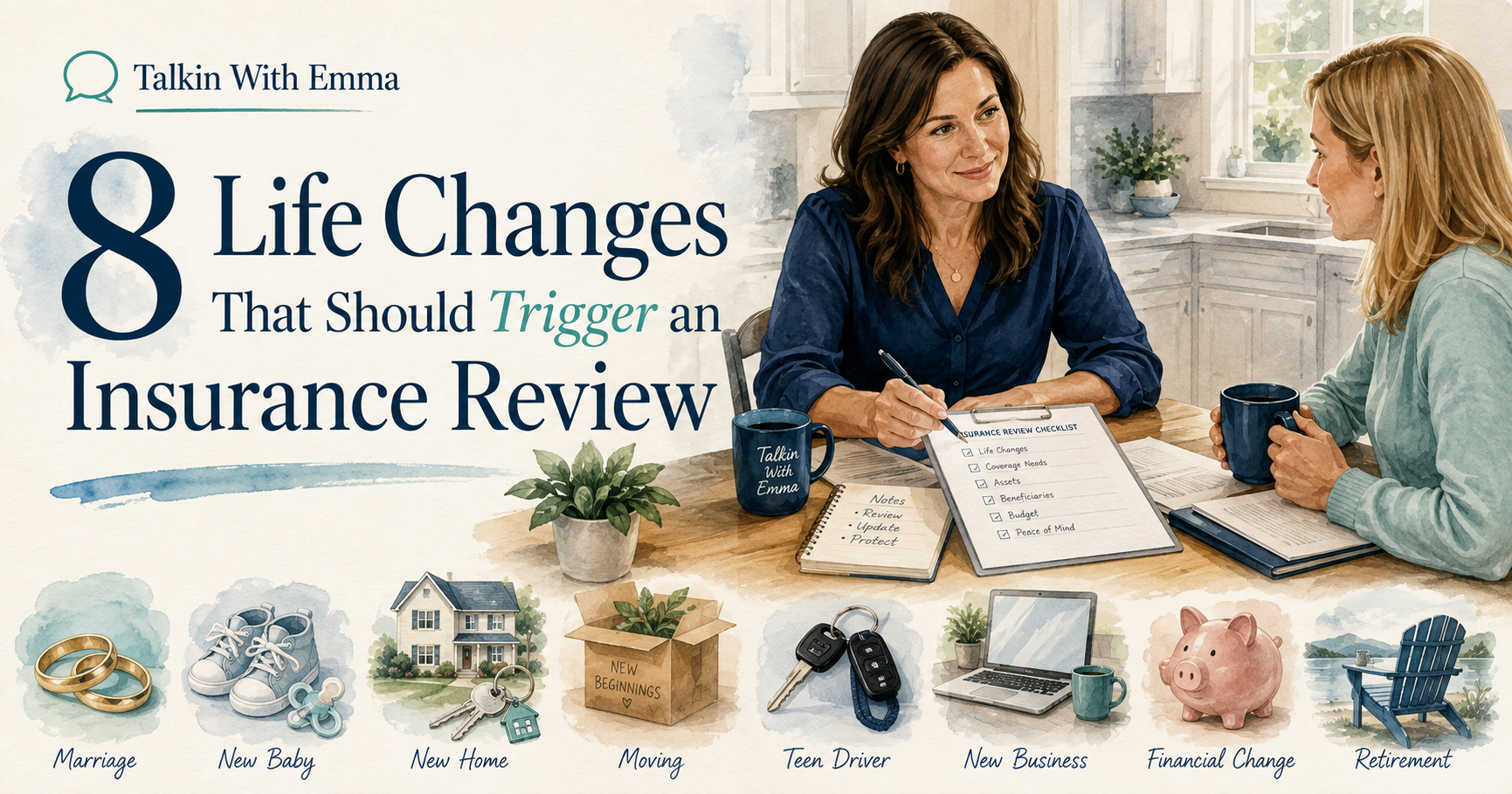
  • 8 Life Changes That Should Trigger an Insurance Review

    8 Life Changes That Should Trigger an Insurance Review

    Insurance is one of those things that is very easy to set up…

    and then completely forget about.

    You buy the policy.

    Set up autopay.

    Put the paperwork somewhere safe.

    And move on with your life.

    Which is fine.

    Until your life changes and your insurance does not.

    Because the coverage that made perfect sense three years ago may not make quite as much sense today.

    That does not mean you need to rethink every insurance policy every time something happens.

    New haircut?

    Probably safe to leave the insurance company out of it.

    But some life changes are worth a second look.

    Here are eight.

    1. You Got Married

    Marriage combines more than closets and opinions about how the dishwasher should be loaded.

    You may also be combining:

    Income.

    Assets.

    Debts.

    Vehicles.

    Homes.

    Bills.

    Financial responsibilities.

    And people who now depend on each other in ways they did not before.

    That is a good reason to look at your insurance again.

    Start with what each of you already has.

    Auto insurance.

    Renters or homeowners insurance.

    Life insurance.

    Health insurance.

    Anything else.

    Then ask:

    Are we paying for the same thing twice?

    Did anything important change?

    Is there something one of us assumed the other person already handled?

    Do any beneficiaries need to be reviewed?

    Do not assume getting married automatically updates everything.

    Insurance companies are many things.

    Wedding planners are generally not one of them.

    If the whole insurance picture still feels a little fuzzy, Let’s Talk About Insurance is a good place to start with the basics.

    2. You Got Divorced or Separated

    This deserves just as much attention as getting married.

    Maybe you are separating vehicles.

    Moving into different homes.

    Changing who owns what.

    Changing financial responsibilities.

    Changing beneficiaries.

    Changing who is covered under which policy.

    This is not the time to think:

    “I am sure that gets handled automatically.”

    Find out.

    Look at each policy and ask:

    Who is the named insured?

    Which vehicles are listed?

    Who owns them?

    Where are they kept?

    Who is driving them?

    Who should be a beneficiary where that applies?

    Who is responsible for the homeowners or renters policy now?

    Divorce can involve legal and financial issues far beyond insurance, so bring in the right professionals when you need them.

    From the insurance side, the goal is simpler:

    Make sure the policies match the life you are actually living now.

    3. You Had a Baby—or Someone New Depends on You

    Babies have a remarkable ability to change almost everything.

    Sleep.

    Schedules.

    Budgets.

    The amount of stuff required to leave the house for 45 minutes.

    And your financial responsibilities.

    If someone now depends on your income—or on work you do at home that someone else would have to replace—it is a good time to look at the protection your household has.

    Life insurance may be part of that conversation.

    But having a baby does not automatically tell you how much coverage you need.

    It gives you better questions.

    If something happened to you, what financial responsibilities would still be sitting there?

    Housing.

    Childcare.

    Everyday living expenses.

    Education goals.

    Debt.

    Other family needs.

    And if you handle a lot of unpaid work in the household, what would it cost to replace some of that?

    You are not trying to guess a magic number.

    You are trying to understand what the people depending on you would actually need.

    That is a much better place to start.

    4. You Bought a Home

    You signed approximately 4,700 pieces of paper.

    You have keys.

    Congratulations.

    Now let us talk insurance.

    Buying a home obviously changes your property insurance.

    But that is not the only thing worth looking at.

    You may have just added one of the largest assets you own.

    And probably one of the largest debts you owe.

    That can change the bigger insurance picture too.

    Homeowners coverage.

    Liability.

    Life insurance.

    Flood coverage, depending on the property and location.

    Maybe other coverage based on the home itself.

    Your mortgage company may have insurance requirements too.

    But do not stop at:

    “The bank says I have insurance, so we are good.”

    The lender is trying to protect its financial interest.

    You are trying to protect yours.

    Those goals overlap.

    They are not always exactly the same.

    A better question is:

    Now that I own this home, what else in my insurance life deserves another look?

    5. You Moved

    You do not have to buy a house for a move to matter.

    Maybe you are renting.

    Maybe you moved across town.

    Maybe across the state.

    Maybe across the country.

    Tell the appropriate insurers.

    Where you live can matter.

    For auto insurance, where the vehicle is primarily kept can affect the policy.

    For renters or homeowners insurance, you are obviously insuring a different place.

    Moving can also change your risks.

    Different weather.

    Different theft exposure.

    Different commute.

    Different state requirements.

    Different property.

    Different insurance market.

    If you moved and your insurance still thinks you live at the old address, that is something I would fix.

    Mail forwarding is useful.

    It is not an insurance strategy.

    6. Your Teen Started Driving

    One day they are learning multiplication.

    Approximately twelve minutes later they are asking for the car keys.

    Once a teenager reaches the permit or licensing stage, call your auto insurer and ask what it requires.

    The timing can vary by insurer and state.

    Ask:

    When does the teen need to be listed or added?

    How might the premium change?

    Are there discounts available?

    Good-student discount?

    Driver-training discount?

    Anything else?

    And if you are thinking about buying another vehicle for the teen, get insurance quotes before you buy it.

    A cheap used car can become considerably less cheap once insurance joins the conversation.

    For this article, the point is simple:

    New driver in the household = insurance review.

    7. You Started a Business or Side Gig

    This one is easy to miss.

    Maybe you did not launch a company with employees, offices, and a giant sign on the building.

    Maybe you started:

    Freelancing.

    Selling products online.

    Consulting.

    Working from home.

    Driving for a delivery app.

    Driving passengers.

    Pet sitting.

    Photography.

    Making products.

    Doing repair work.

    Something small.

    It is easy to think:

    “It is just a side gig.”

    Your insurance company may still care.

    Personal insurance is not automatically built to cover every business activity.

    A homeowners or renters policy may have limits involving business property or liability.

    A personal auto policy may have restrictions involving certain business, delivery, or rideshare use.

    So tell the insurer what you are actually doing.

    Then ask:

    Does my current insurance cover this activity?

    If not:

    What would I need to look at?

    That is a much nicer question to ask before something goes wrong.

    8. Your Financial Situation Changed Significantly

    This one can be less obvious.

    Maybe you got a big raise.

    Paid off major debt.

    Built up savings.

    Inherited money.

    Bought investment property.

    Accumulated more assets.

    Or maybe things went the other direction.

    Income dropped.

    Savings got thinner.

    Your financial obligations changed.

    Your emergency fund changed.

    Insurance is partly about deciding which financial risks you can handle yourself and which ones you want help transferring to an insurer.

    So if your financial situation changes a lot, some of your old insurance decisions may deserve another look.

    Maybe your liability limits no longer feel right.

    Maybe your life-insurance needs changed.

    Maybe a deductible that once felt impossible is now manageable.

    Or maybe the deductible you picked five years ago would be a serious problem today.

    This is one of my favorite questions:

    If I had to pay this deductible tomorrow, what would happen?

    Yes, I could handle it.

    It would hurt.

    No.

    I am not sure.

    All four answers tell you something useful.

    The goal is not:

    More money = buy more insurance.

    It is:

    Different financial situation = make sure the old decisions still fit.

    What About Retirement?

    Retirement can absolutely trigger a review too.

    Technically, I promised you eight.

    I am aware.

    But retirement can change enough things that I am sneaking it in anyway.

    Your commute may disappear.

    Your income may come from different places.

    Employer benefits may change.

    Health coverage may change.

    Life-insurance needs may change.

    How you use your vehicles may change.

    Where you live may change.

    Your assets and financial priorities may change.

    So yes.

    Retirement belongs on the list.

    Consider this number 8½.

    We are not changing the title.

    What About Buying an Expensive Item?

    Also worth checking.

    Jewelry.

    Art.

    Collectibles.

    Electronics.

    Special equipment.

    Other valuable property.

    Do not assume your homeowners or renters policy automatically provides unlimited coverage for everything you own.

    Certain types of property can have special limits, exclusions, or different rules.

    If you make a major purchase, ask:

    Does my current policy cover this the way I think it does?

    You may need additional coverage depending on the item and policy.

    Again:

    Ask before the loss.

    Much nicer conversation.

    A Life Change Does Not Automatically Mean You Need More Insurance

    This part matters.

    We are not saying:

    Got married?

    Buy more insurance.

    Bought a house?

    Buy more insurance.

    Got a raise?

    More insurance.

    That is not the point.

    A life change is a review trigger.

    Maybe you review everything and say:

    “This still works.”

    Great.

    Review done.

    Maybe you discover you are paying for something you no longer need.

    Also useful.

    Maybe you find a question you never answered.

    Now you know what to ask.

    Maybe you find a genuine gap.

    Now you can investigate it.

    The goal is not more insurance.

    The goal is insurance that still makes sense for your life.

    Sometimes You Just Need Better Questions

    One of the hardest parts of reviewing insurance is knowing what to look for.

    You know your life changed.

    You know the policy has been sitting there for a while.

    But then you open it and think:

    “Okay…now what?”

    Start simple.

    Do I know my coverage limits?

    Do I know my deductibles?

    Do I understand the big exclusions?

    Do I know when I last reviewed this policy?

    Did I look at it after my life changed?

    Could I handle the deductible if I had a claim tomorrow?

    Is there something I am just assuming is covered?

    That is already useful.

    Maybe your policy has not been reviewed in years.

    Maybe you bought something valuable.

    Maybe a beneficiary needs attention.

    Maybe you started using your car differently.

    Maybe your deductible no longer fits your finances.

    Maybe you simply do not know the answer.

    That gives you something real to bring to your insurer or licensed insurance professional.

    The Insurance Checkup Workbook Can Help You Organize It

    If you want more structure, the Insurance Checkup & Quote Comparison Workbook is built for exactly this kind of review.

    It helps you slow down and look at the whole picture.

    What insurance do I already have?

    What changed?

    What do I actually know about my policies?

    Could I handle the deductibles?

    What questions do I still need to ask?

    It also helps you think through the people, property, income, debts, and responsibilities you are trying to protect.

    And if your review turns into shopping, there are comparison sections for putting quotes side by side without reducing the whole decision to:

    “Which one is cheapest?”

    Because cheaper is useful information.

    It just is not the only information.

    You Do Not Need to Review Everything Every Tuesday

    Please do not turn this into another task that follows you around.

    You do not need to open every insurance policy every time your life moves slightly to the left.

    We are looking for meaningful changes.

    Ask yourself:

    Did something change about what I own?

    Did something change about who depends on me?

    Did something change about where or how I live?

    Did something change about how I use my property?

    Did something change about the financial risk I could handle myself?

    If yes?

    Probably worth a look.

    So…When Should You Review Your Insurance?

    When something big changes.

    Marriage.

    Divorce.

    A new dependent.

    Buying a home.

    Moving.

    A teen driver.

    Starting a business or side gig.

    A major financial change.

    And yes, retirement and expensive purchases deserve attention too.

    You do not need to assume something is wrong.

    You do not need to buy anything immediately.

    Pull out the policies.

    Look at what changed.

    Write down your questions.

    If you want help organizing the review, use the Insurance Checkup & Quote Comparison Workbook.

    Then talk to the appropriate insurer or licensed professional.

    Because insurance does not need your attention every day.

    But when your life changes?

    It is worth making sure the insurance you bought for your old life still makes sense for the one you are living now.


    This article is for general educational and informational purposes only and is not individualized insurance, financial, legal, tax, health, or estate-planning advice. Insurance needs, coverage, eligibility, policy terms, and requirements vary by individual circumstances, insurance type, insurer, and state. Major life events may also involve legal, tax, benefits, estate-planning, or other considerations beyond insurance. Review your own circumstances and contact the appropriate insurer, licensed insurance professional, benefits administrator, attorney, tax professional, financial professional, state insurance regulator, or other qualified professional when appropriate.

    Share This Conversation
  • Bundling Insurance: Does It Actually Save Money?

    Bundling Insurance: Does It Actually Save Money?

    You’ve seen the commercials.

    Bundle your home and auto.

    Bundle your renters and auto.

    Put everything with one insurance company and save.

    Sounds reasonable.

    One company.

    One bill—or at least fewer bills.

    A discount.

    Maybe even a very enthusiastic person on television telling you how much money everybody is saving.

    But here’s the question I want to answer:

    Does bundling insurance actually save you money?

    Sometimes.

    Maybe even a lot.

    But seeing “multi-policy discount” on your paperwork doesn’t automatically mean you got the cheapest—or best—overall deal.

    We need to look at the whole thing.

    First, What Does Bundling Insurance Mean?

    Usually, bundling means buying more than one type of insurance through the same insurance company or insurance group.

    A common example is:

    Auto + homeowners

    Another is:

    Auto + renters

    Depending on the company, there may be other combinations too.

    The insurer may offer a multi-policy discount because you’re buying more than one policy from them.

    Simple enough.

    The part I want you to remember is this:

    A discount tells you how the price was calculated.

    It does not tell you whether the final price is the best price available to you.

    That’s a different question.

    A 20% Discount Doesn’t Automatically Mean You’re Saving 20%

    Let’s say an insurer advertises a substantial bundling discount.

    Great.

    But 20% off what?

    If Company A starts higher than Company B, Company A can give you a bigger discount and still cost more.

    Imagine:

    Company A:

    Home + Auto before discounts: $4,000

    Bundle discount: $600

    Final cost: $3,400

    Company B:

    Home: $1,500

    Auto: $1,600

    Bought separately: $3,100

    Company A gave you the bigger discount.

    Company B still costs $300 less.

    That’s why I don’t want you shopping for the biggest discount.

    I want you shopping for the insurance that works for you at the best overall price.

    Compare the Total Annual Cost

    This is the easiest place to start.

    Add up what you’re actually paying for the policies.

    Let’s say your bundle includes:

    Auto: $1,850 per year.

    Homeowners: $1,420 per year.

    Total:

    $3,270

    Now get comparable quotes elsewhere.

    Maybe:

    Company B auto: $1,590.

    Company C homeowners: $1,510.

    Total:

    $3,100

    Now we’re comparing actual dollars.

    The bundle may still have other advantages.

    But at least we know:

    Bundled price: $3,270.

    Separate price: $3,100.

    Difference: $170 a year.

    That’s a much more useful conversation than:

    “But I’m getting a 17% bundle discount.”

    But Don’t Compare Price Until You Compare Coverage

    Here we go again.

    Because insurance refuses to let anything be quite that easy.

    Suppose the separate policies save $170.

    Before celebrating, compare the insurance.

    Are the auto liability limits the same?

    Collision deductible?

    Comprehensive deductible?

    Uninsured/underinsured motorist coverage where applicable?

    Rental reimbursement?

    Now the homeowners policy.

    Same dwelling coverage?

    Same personal-property treatment?

    Same liability limit?

    Same deductibles?

    Same endorsements?

    Same important limitations?

    If the $170 savings came from reducing coverage or accepting a much higher deductible, we need to know that.

    Maybe you still prefer the cheaper option.

    That’s fine.

    We just want the tradeoff to be intentional.

    This Is Exactly Why We Built the Quote Comparison Workbook

    Insurance quotes have an annoying habit of looking similar when they’re not.

    Company A:

    $287 a month.

    Company B:

    $264.

    Company C:

    $241.

    Well, Company C wins.

    Except maybe Company C has:

    Lower liability limits.

    A higher deductible.

    No rental coverage.

    Different homeowners coverage.

    And a discount that requires something you weren’t planning to do.

    Now the comparison isn’t:

    $287 vs. $264 vs. $241.

    It’s three different insurance packages with three different prices.

    The Insurance Checkup & Quote Comparison Workbook gives you a place to put those differences side by side.

    For bundling, I would compare:

    Current bundle

    against

    Alternative bundle

    against

    Best separate-policy combination

    Now we’re shopping.

    Bundling Can Still Be Really Convenient

    Price isn’t the only reason people bundle.

    Having insurance with one company can be easier.

    One place to call.

    One app.

    One agent.

    Fewer accounts.

    Potentially simpler billing.

    And one company that has a broader view of your insurance relationship.

    That convenience has value.

    How much?

    That’s up to you.

    If separate policies save $14 a year and create two extra accounts, two apps, and two companies to deal with?

    You might happily pay the $14.

    If separate policies save $900?

    Suddenly another password doesn’t sound quite so terrible.

    Convenience belongs in the decision.

    Just don’t confuse convenience with savings.

    Claims Can Be Simpler in Certain Situations

    Sometimes a single event can involve more than one type of insurance.

    Imagine a storm damages your house and your car.

    If both policies are with the same insurer, dealing with one company may make parts of the process simpler.

    That doesn’t mean every claim becomes effortless.

    Insurance has standards to maintain.

    But having one insurer involved can be convenient.

    Some insurers or policies may also have special deductible arrangements or claim features when multiple policies are affected by the same event.

    Don’t assume that’s included.

    Ask.

    If a bundle has a feature like that, it belongs in the comparison.

    Watch the Deductibles

    A bundle discount can make the premium look attractive.

    But check what happened to the deductibles.

    Suppose your current homeowners deductible is:

    $1,000.

    The competing bundle:

    $2,500.

    And your auto collision deductible changes from:

    $500 to $1,000.

    The new bundle saves $360 a year.

    Is that a good deal?

    Maybe.

    But you’re accepting significantly more out-of-pocket responsibility after certain losses.

    That’s not necessarily wrong.

    We just wrote an entire article about how your deductible and emergency savings need to work together.

    The same rule applies here:

    Don’t celebrate the premium until you’ve looked at what you agreed to pay when something goes wrong.

    Don’t Assume Every Policy Has to Be Bundled

    Maybe one insurer is fantastic for your auto coverage.

    Another is better for your home.

    That’s allowed.

    There is no insurance rule requiring all your policies to live together like a happy little family.

    You might discover:

    Company A has the best auto option.

    Company B has the best homeowners option.

    Buying separately beats every bundle you quoted.

    Fine.

    Or:

    Company C’s bundle beats everything.

    Also fine.

    We’re not Team Bundle.

    We’re not Team Separate.

    We’re Team Do the Math.

    Very exclusive club.

    Bundling Can Sometimes Hide a Bad Price

    This is one reason I like reviewing the individual policy prices.

    Suppose your bundle total looks competitive.

    But when you break it apart, you discover:

    Auto is a terrific deal.

    Homeowners is expensive.

    The auto discount has been keeping you from noticing.

    Or the reverse.

    This matters because another insurer may offer a much better price on the expensive piece.

    Then you can ask:

    If I move the home policy, how much does my auto premium change when I lose the bundle discount?

    That’s the number we need.

    Not:

    “How much is my homeowners policy?”

    Not:

    “How big is my auto discount?”

    But:

    “What happens to the total household insurance cost if I separate them?”

    Losing the Bundle Discount Matters

    Let’s say you find homeowners insurance that’s $400 cheaper somewhere else.

    Excellent.

    So you move it.

    But now your auto insurer removes a $250 multi-policy discount.

    Your actual household savings aren’t $400.

    They’re:

    $400 – $250 = $150

    Still savings.

    Just not $400.

    This is why we calculate the entire before-and-after cost.

    Otherwise you can make a change that looked brilliant one policy at a time and barely moved the total.

    A Bundle Can Become Less Competitive Over Time

    Maybe bundling was absolutely the right choice three years ago.

    That doesn’t mean it’s automatically the right choice today.

    Premiums change.

    Discounts change.

    Your vehicles change.

    Your home changes.

    Your drivers change.

    Your insurance needs change.

    Other companies change their pricing.

    You don’t need to shop your insurance every Thursday.

    But when the total price changes significantly—or your life does—it can be worth comparing again.

    The original decision may have been excellent.

    We’re just checking whether it’s still excellent.

    Don’t Forget Renters Insurance

    Bundling isn’t only for homeowners.

    If you rent and have auto insurance, ask whether adding renters insurance affects the total price.

    Sometimes the multi-policy discount can make the net cost of renters insurance surprisingly small.

    Notice I said:

    can.

    Not:

    “Renters insurance is basically free when you bundle!”

    Get the numbers.

    Maybe the auto discount offsets much of the renters premium.

    Maybe it doesn’t.

    We’re going to let the quote answer that question.

    Very boring.

    Very effective.

    Ask About Umbrella Insurance Too

    If you’re considering an umbrella liability policy, the relationship among your policies can become more important.

    Umbrella insurers may have requirements involving underlying auto, homeowners, renters, or other liability coverage.

    The insurer may require certain underlying limits.

    It may also matter which policies are with which companies.

    If an umbrella policy is part of your insurance picture, don’t rearrange everything without checking how the change affects it.

    Ask before switching.

    Much easier.

    What If One Company Is Great at Auto but Terrible at Home Claims?

    Price isn’t the only thing worth researching.

    Look at the insurers themselves.

    Are they licensed in your state?

    How do you interact with them?

    What does complaint information look like in context?

    What company and financial information is available?

    How comfortable are you with the service model?

    Maybe you love having a local agent.

    Maybe you never want to speak to another human being and would happily conduct your entire insurance life through an app.

    Different people.

    Different preferences.

    A slightly cheaper bundle with a company you hate dealing with may not feel like much of a bargain.

    Don’t Move One Policy Without Checking the Other

    This is probably the most practical bundling rule in the article.

    Before moving one policy away from a bundle, ask:

    “What will happen to my remaining policy premium if I remove this policy?”

    Get the new number.

    Then calculate again.

    Current bundle total:

    $3,270.

    New homeowners policy elsewhere:

    $1,200.

    Remaining auto after losing bundle discount:

    $1,900.

    New separate total:

    $3,100

    Actual savings:

    $170

    Now you know.

    Here’s the Comparison I’d Make

    If you’re deciding whether to bundle, get three scenarios where possible.

    Option 1: Current setup

    What are you paying now?

    Option 2: Best bundled option

    What would one company charge for both policies with comparable coverage?

    Option 3: Best separate option

    What happens if you buy the strongest auto option from one company and the strongest home or renters option from another?

    Then compare:

    Total annual premium.

    Coverage limits.

    Deductibles.

    Important optional coverage.

    Major exclusions or limitations.

    Discount requirements.

    Service.

    Convenience.

    Anything else that matters to you.

    Now you’re comparing actual choices.

    So…Does Bundling Insurance Save Money?

    It absolutely can.

    Bundling may give you:

    A lower total premium.

    Useful multi-policy discounts.

    Simpler account management.

    Potential claims convenience.

    Other insurer-specific benefits.

    But:

    A bundle discount does not prove the bundle is your cheapest option.

    That’s the part I want you to remember.

    Don’t compare discounts.

    Compare final prices.

    And don’t compare final prices until you’ve compared coverage.

    Get the bundle quote.

    Get the separate quotes.

    Put them side by side.

    Check the limits.

    Check the deductibles.

    Check what you’re getting.

    Check what you’re giving up.

    Then add everything together.

    Maybe the bundle wins.

    Great.

    Maybe separate policies win.

    Also great.

    Because the goal was never to get the biggest discount printed on the paperwork.

    The goal was to get insurance that works for you at a price that makes sense.


    This article is for general educational and informational purposes only and isn’t intended as individualized insurance, financial, legal, or tax advice. Multi-policy discounts, bundling arrangements, premiums, coverage, deductibles, policy features, eligibility and requirements vary by insurer, insurance type, policy and state. Compare complete quotes and policy terms carefully, and contact the appropriate insurer, licensed insurance professional, state insurance regulator or other qualified professional when appropriate.

    Share This Conversation