
Let me ask you something.
If your phone died right now, how much important information would disappear with it?
I don’t mean gone forever. I mean gone at the exact moment you might actually need it.
Your contacts are in your phone. Your insurance app is in your phone. Your pharmacy number is in your phone. The address you were supposed to meet at? Probably in a text somewhere.
Most days, that works just fine.
Then the battery dies.
Or the power is out.
Or you can’t get a signal.
Or you’re standing there thinking, I know I have this information somewhere.
That is not the best time to start hunting for it.
You do not need an emergency command center
I am not suggesting you create a three-inch binder with tabs, laminated maps, and seventeen backup plans.
If that makes you happy, carry on.
For the rest of us, I’d start with one simple question:
What information would I be annoyed, stressed, or stuck without if my phone stopped working?
Write that down on paper.
That’s the whole idea.
Start with the people you would actually call
Who would you need to reach first?
Maybe that is your spouse, your adult child, your parent, your neighbor, or the friend who somehow always answers the phone.
Write down the numbers for the people who matter most.
And here’s one I really like: choose one person who lives outside your immediate area.
If something is affecting your whole neighborhood or town, it can help to have one person farther away who everyone knows to contact.
You do not need twenty names.
You need the few names you would actually use.
Write down the numbers you usually look up
This is where people tend to say, “Oh, I can just Google that.”
Usually, yes.
But we are talking about the moment when “usually” may not be cooperating.
Think about the numbers you would want if something went wrong at home.
Your electric company.
Gas company, if you have one.
Water utility.
Landlord or property manager, if that applies.
Your insurance company or agent.
Your pharmacy.
Your veterinarian, if there is an animal in the house who thinks emergency planning is beneath them.
You do not have to collect every number connected to your life. Just the ones that would be a pain to find when you are already dealing with something else.
Keep the addresses that matter
We rely on maps so much now that a lot of us barely remember addresses.
I am including myself in that sentence.
If your household has a meeting place, write down the actual address.
If there is a relative’s house you might go to, write that down too.
If your child, parent, or another household member has a place you would need to reach, include it if it makes sense for your situation.
The point is not to create a directory.
The point is to keep yourself from having to reconstruct basic information while you are stressed.
Add the information that belongs to your household
This is the part that will look a little different for everybody.
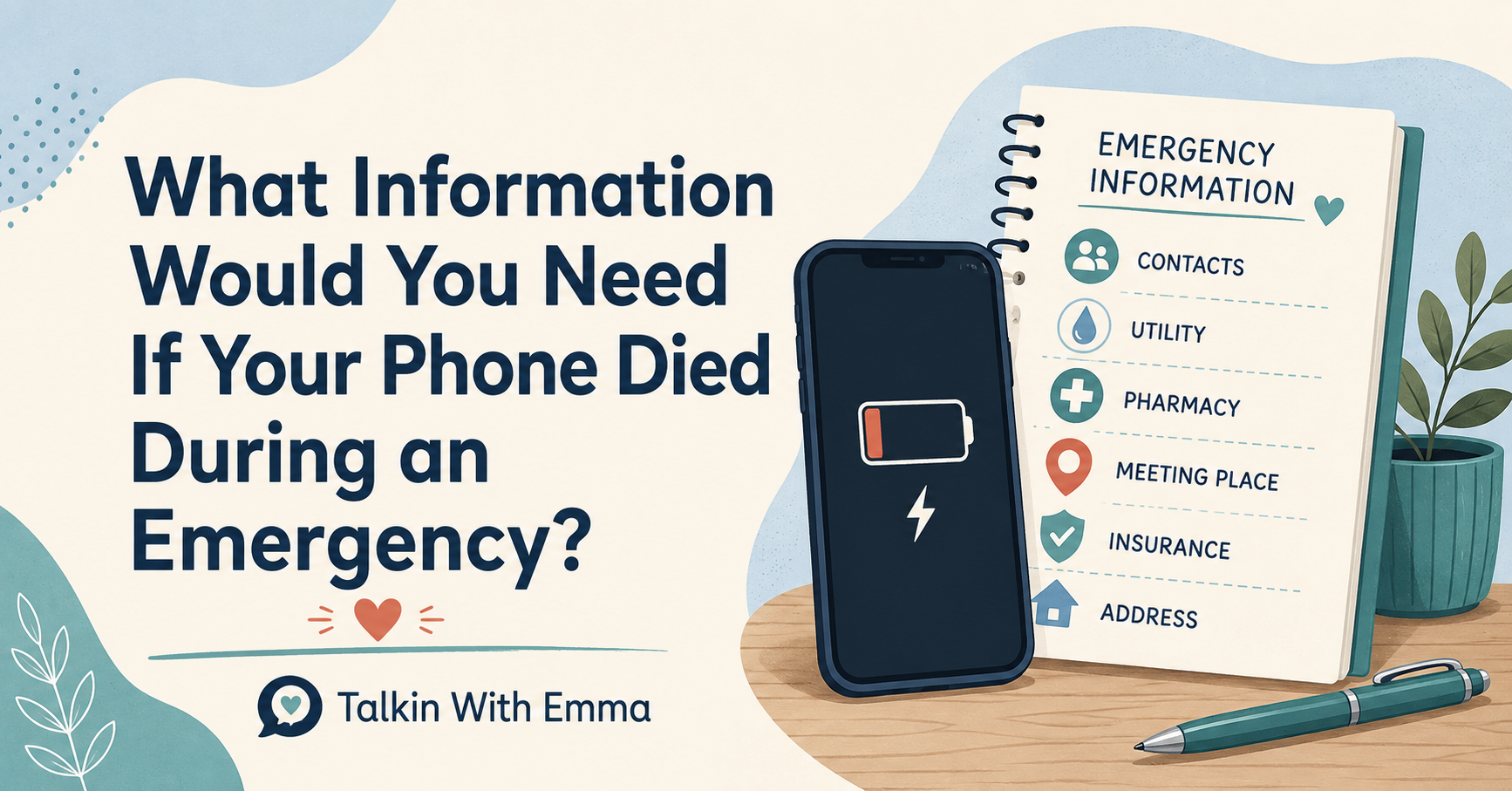
You might want:
- insurance policy or claims contact information
- important medical or pharmacy contacts
- pet information
- building or landlord contacts
- an emergency meeting place
- an out-of-area contact
Notice what I did not say.
I did not say put passwords, Social Security numbers, bank account numbers, or a pile of sensitive personal information on a sheet of paper and leave it on the kitchen counter.
Useful is good.
Useful and sensible is better.
Then put the paper somewhere you can actually find it
This part matters more than it sounds.
If you make the list and tuck it into a mystery drawer behind old batteries and takeout menus, we have not improved much.
Keep it somewhere your household knows to look.
Maybe that is with your emergency supplies.
Maybe it is inside a cabinet door.
Maybe you keep one copy at home and another in your go-bag.
Use whatever makes sense for your household.
Just make sure the people who may need it know it exists.
One last thing: update it
A beautiful emergency list with your old pharmacy, your former landlord, and the phone number your sister changed two years ago is not especially helpful.
You do not need to review it every Thursday at 7:15 p.m.
Just look at it when something changes.
You move.
You change insurance companies.
You switch pharmacies.
Someone gets a new phone number.
Take thirty seconds and fix the list.
Here’s where I’d start
Grab one piece of paper.
Write down:
- three people you would want to reach
- one out-of-area contact
- your main utility numbers
- your insurance contact
- your pharmacy or other important household contact
- your emergency meeting place and address
That is enough for today.
You can make it prettier later if you want.
For now, you have taken something that lived only inside your phone and made it available even when the phone is not.
That is the kind of emergency preparation I like.
Simple. Useful. And actually possible to do before lunch.
I’ll be talking more about practical household preparedness next week because a new Talkin With Emma guide is almost here.
Until then, maybe go write down the one phone number you are absolutely certain you know by heart.
Then check whether you were right.
— Emma
Leave a Reply