Author: Emma

  • Does Homeowners Insurance Cover a Roof Leak? What If the Roof Is Old?

    Does Homeowners Insurance Cover a Roof Leak? What If the Roof Is Old?

    You notice a brown spot on the ceiling after a heavy rain. Maybe there’s a drip near the window, or you find a damp patch in the attic. Your first thought might be, “Will homeowners insurance pay for this?”

    The answer is: sometimes. Homeowners insurance may cover damage from a roof leak when the leak was caused by a sudden event your policy covers, such as wind or hail. But it generally doesn’t pay to fix a roof that has simply worn out over time.

    What caused the roof to leak?

    Imagine two neighbors, Maria and David. Both discover water stains on their ceilings after a storm. Maria’s roof lost shingles in strong wind, letting rain enter. David’s roof has had cracked, aging shingles for years, and water has slowly worked its way inside.

    Their ceilings look similar, but their insurance claims may turn out very differently. If wind is a covered cause of loss under Maria’s policy, the resulting roof and interior damage may be covered, subject to the deductible and policy terms. David’s worn-out roof is more likely to be treated as a maintenance issue.

    That’s why an insurance adjuster will want to know not just where the water came in, but why it came in.

    Does insurance cover a roof leak caused by a storm?

    Often, yes, if the storm caused damage covered by your policy. For example, wind might tear off shingles or a falling tree might damage the roof. Water that enters through that storm-created opening may also damage insulation, drywall, flooring, or belongings.

    But coverage is not automatic. Some policies have special wind or hail deductibles, roof-payment limits, exclusions, or rules about how roof age affects the settlement. Your location and policy matter.

    What if my roof is old?

    An old roof isn’t automatically uninsured. A covered storm can damage an older roof, too. But insurance generally isn’t designed to replace a roof simply because it has reached the end of its useful life.

    Another important detail is how the insurer values the roof. Some policies pay replacement cost when their conditions are met. Others pay actual cash value, which accounts for depreciation, or use a roof-specific payment schedule. That can leave you paying much more out of pocket than you expected.

    For example, if a covered repair costs $10,000 and your policy has a $2,000 deductible, that doesn’t necessarily mean you’ll receive $8,000. Depreciation, roof endorsements, limits, and other terms can change the amount. Ask your insurer for a written explanation of the settlement.

    What about the water damage inside the house?

    Sometimes the roof repair and the interior damage are evaluated separately. Even if the roof itself isn’t covered because of wear and tear, certain resulting interior damage may be covered under some policies, depending on the cause and wording. Other policies may exclude that damage as well.

    Don’t assume that a denied roof repair means every part of the claim must be denied—or that interior damage is automatically covered. Ask the insurer to explain each decision and the policy language behind it.

    What should I do when I discover a roof leak?

    First, protect people and property. Stay away from sagging ceilings and electrical hazards. If it’s safe, move belongings out of the wet area, catch dripping water, and arrange reasonable temporary protection to prevent further damage. Don’t climb onto a wet or damaged roof.

    Next, take pictures and short videos of the leak, the stained ceiling, damaged belongings, and any visible storm damage you can photograph safely from the ground. Write down when you first noticed the problem and any recent storms.

    Contact your insurance company or agent promptly to ask about reporting the loss, your deductible, and whether emergency repairs need approval. Keep receipts for temporary work. Avoid making permanent repairs or throwing away damaged materials before the insurer has had a reasonable chance to inspect, unless safety requires immediate action.

    If you hire a roofer, get a written inspection and estimate. Be cautious of anyone who promises that insurance will definitely buy you a new roof or pressures you to sign over claim rights before you understand the paperwork.

    Should I file a claim for every roof leak?

    Not necessarily. Find out the likely cause, the estimated repair cost, and your deductible before deciding when possible. If the repair is smaller than your deductible, there may be no claim payment. And claims can affect future premiums or renewal decisions, depending on the circumstances and state rules.

    For more on that last point, read Can My Insurance Company Cancel My Policy After I File a Claim?.

    Questions to ask your insurance company

    You don’t need to know every insurance term. Start with these questions: What caused the damage according to the inspection? Is wind or hail damage covered? Is my roof settled at replacement cost, actual cash value, or on a payment schedule? Is there a separate wind or hail deductible? Is the interior water damage covered? What documents do you need from me?

    Ask for the answers in writing, especially if part of the claim is denied.

    The bottom line

    A roof leak isn’t automatically covered or excluded. The cause of the leak, the type of damage, and the wording of your policy are what matter. A sudden covered storm event is different from years of wear and neglected repairs.

    And if you’re unsure what your policy actually says, that’s a good reason to review it before the next storm. You can start with a 15-minute insurance checkup, or explore how homeowners insurance handles a broken water pipe.

    You don’t have to become an insurance expert. You just need to know what to ask, what to document, and where to find the answer in your own policy.

    Important note: This article provides general educational information, not a coverage determination. Insurance coverage depends on your policy, endorsements, exclusions, and applicable state law.
    Share This Conversation
  • Can My Insurance Company Cancel My Policy After I File a Claim?

    Can My Insurance Company Cancel My Policy After I File a Claim?

    You have a claim to file, but there’s a question in the back of your mind: Will my insurance company cancel my policy if I use it?

    It’s a reasonable thing to wonder. After all, you bought insurance to help when something goes wrong. But you’ve probably also heard stories about people losing coverage after filing claims.

    So let’s sort out what can happen, what usually doesn’t happen, and what you should check before making a decision.

    Can an insurance company cancel you for filing a claim?

    Filing a claim does not automatically mean your policy will be canceled. What an insurer can do depends on your state, the type of insurance, the reason for the claim, and where you are in the policy term.

    In many states, insurers face restrictions on canceling a policy in the middle of its term. Nonrenewal at the end of the term is a different matter, and the rules for that can be different.

    That distinction is important enough to explain first.

    Cancellation and nonrenewal are not the same thing

    Imagine your homeowners policy runs from January through December.

    Cancellation means the coverage ends before its scheduled expiration date. Common permitted reasons can include nonpayment of premiums, material misrepresentation, or certain changes in risk, subject to state law.

    Nonrenewal means the company decides not to offer another policy when your current term ends. An insurer may consider its claims experience and underwriting rules when making renewal decisions, but state protections and notice requirements still apply.

    In either situation, you should receive information about the action and its effective date as required by applicable law. Don’t assume you’re covered beyond that date without checking.

    Does one claim make you uninsurable?

    Usually, one claim does not mean you can never get insurance again. But the details matter.

    For example, an isolated storm-damage claim may be evaluated differently from repeated water-damage claims. An auto accident may be treated differently depending on fault, driving history, and state rules.

    Some states also restrict how certain weather-related or not-at-fault claims can affect insurance decisions. There isn’t one national rule that covers every situation.

    That’s why I’d be cautious about anyone telling you, “One claim always gets you dropped,” or “One claim can never hurt you.” Neither statement is reliable.

    Could your premium go up after a claim?

    Yes, it can. But a claim doesn’t guarantee a rate increase.

    Insurers may look at claim type, amount, frequency, fault, and other rating factors where permitted. Your premium may also change because of broader rate adjustments unrelated to your particular claim.

    If your renewal price changes, ask your agent or company which factors affected it. You may not get a complete pricing formula, but you can ask about claim-related surcharges, discounts, and available options.

    Should you avoid filing a small claim?

    Let’s say a repair costs $1,200 and your deductible is $1,000. If the damage is covered, the insurer’s payment might be only $200.

    It’s reasonable to consider whether a small potential payment is worth making a claim. But don’t decide based on the deductible alone.

    First, check whether the loss is covered, whether damage could be more extensive than it looks, whether another person may have been injured or suffered property damage, and whether your policy requires prompt notice of an incident. Liability situations in particular can become much more expensive than they first appear.

    You can ask your insurer or agent how its reporting and claims process works, including whether an inquiry will be recorded as a claim. Don’t assume every conversation is informal or that you can delay reporting without consequences.

    What if you receive a cancellation or nonrenewal notice?

    Don’t ignore it, even if you think it’s a mistake.

    1. Read the notice carefully. Find the stated reason, the effective date, and any instructions for disputing or correcting the issue.
    2. Contact your agent or insurer. Ask for a clear explanation and whether there is an option to keep coverage.
    3. Check your state insurance department. It can explain applicable notice requirements, consumer protections, and complaint procedures.
    4. Shop for replacement coverage early. Avoid a lapse, especially if you need insurance to drive legally or meet mortgage requirements.
    5. Keep records. Save the notice, emails, dates, and names of people you speak with.

    What would Emma do before filing a claim?

    I’d start with three questions: What actually happened? What does the policy say? And what could it cost if I handle this without insurance?

    Then I’d ask about the deductible, coverage limits, reporting obligations, and possible consequences. I wouldn’t promise someone that filing would have no effect on their renewal. But I also wouldn’t encourage them to give up a legitimate insurance benefit out of fear.

    Insurance is there to help manage financial risks. The right choice comes from understanding the facts, not guessing what the company might do.

    The bottom line

    Your insurance company generally cannot simply cancel coverage whenever it feels like it, but a claim can sometimes affect your rates or renewal options. The rules vary by state and policy type.

    If you’re unsure, read your policy, ask specific questions, and get help from your state insurance department when necessary.

    And remember: a cancellation notice and a nonrenewal notice mean different things. Knowing which one you’re dealing with is the first step toward protecting your coverage.

    Keep learning with Emma

    Want to understand your coverage before you need to use it? Start with Do You Actually Know What Insurance You Have? A 15-Minute Insurance Checkup.

    If your bill has changed, read Why Did My Insurance Premium Go Up When Nothing Changed?. And for auto coverage, see What Happens If My Car Insurance Lapses for Just a Few Days?.

    This article is general educational information, not individualized insurance or legal advice. Policy terms and state laws control.

    Share This Conversation
  • Does Homeowners Insurance Cover a Broken Water Pipe?

    Does Homeowners Insurance Cover a Broken Water Pipe?

    Usually, homeowners insurance can cover water damage from a pipe that suddenly bursts or breaks, but it may not pay to repair the pipe itself. Damage caused by a slow leak, poor maintenance, or water coming in from outside may be treated differently. The cause of the damage, the wording of your policy, and any exclusions matter.

    That sounds like a lot of “it depends,” doesn’t it? Let’s make it easier to understand.

    What Happens When a Pipe Breaks?

    Imagine you’re making breakfast when you hear water running somewhere it shouldn’t be. You open the cabinet under the kitchen sink and find water pouring out of a broken supply line. The cabinet is soaked, water is spreading across the floor, and you’re already wondering how much this is going to cost.

    There are really two separate questions: Will insurance pay for the damage the water caused? And will it pay to fix the pipe that broke? The answers are not always the same.

    What Does Homeowners Insurance Usually Cover?

    Many standard homeowners policies cover sudden and accidental water damage from a plumbing failure. Depending on your policy, that might include:

    • Damaged flooring, drywall, cabinets, or ceilings.
    • Covered personal belongings ruined by the water.
    • Reasonable emergency steps to stop additional damage.
    • Water removal and drying needed after a covered loss.
    • Additional living expenses if covered damage makes your home unlivable, subject to your policy’s limits and conditions.

    But coverage is not automatic just because a pipe broke. The adjuster will want to know where the water came from, how it happened, and how long it was leaking.

    Does Insurance Pay to Replace the Broken Pipe?

    Often, the failed pipe or plumbing part itself is not covered when it breaks because of age, corrosion, wear, or deterioration. Insurance may cover the resulting water damage even when it does not cover replacing that worn-out part.

    Some policies also cover reasonable costs to open and restore part of a wall or floor to access plumbing when the resulting water damage is covered. That does not necessarily mean the pipe repair is covered. Access-and-repair provisions vary, so ask your insurer to explain what applies.

    Here’s an example: A supply pipe breaks behind a bathroom wall. Water damages the drywall and flooring. Your policy might pay for covered water damage and certain access costs, while you pay the plumber to replace the broken pipe. Your deductible would still apply to the covered claim.

    What If the Pipe Has Been Leaking for Weeks?

    This is where the distinction gets important. Homeowners insurance is generally designed for unexpected losses, not ongoing maintenance.

    A slow leak that has been happening for a long time may be excluded, especially when damage results from repeated seepage, corrosion, or a problem that wasn’t repaired. Some policies have specific time-based seepage exclusions; others handle hidden leaks differently. Even if you didn’t know the leak was there, that doesn’t guarantee coverage.

    If you discover damp cabinets, stains, soft flooring, or a musty smell, don’t wait to see whether it gets worse. Find the source, take steps to prevent more damage, and document what you discover.

    What About Frozen Pipes?

    Damage from a frozen pipe that bursts may be covered, but many policies require you to use reasonable care to maintain heat in the home or shut off and drain the water system when the property is vacant or unoccupied. The exact requirements vary.

    If you’re leaving home during freezing weather, keeping the heat on and protecting vulnerable plumbing can matter for both safety and insurance coverage.

    Is Every Kind of Water Damage the Same?

    No. The source of the water makes a big difference.

    What happened? What to know
    A supply pipe suddenly bursts Resulting damage is often covered, subject to policy terms.
    A faucet or pipe has leaked slowly for months Long-term seepage or maintenance exclusions may apply.
    A pipe freezes and bursts Coverage may depend on precautions and occupancy conditions.
    A sewer or drain backs up into the house Often requires optional water-backup coverage or an endorsement.
    Floodwater enters from outside Generally excluded from standard homeowners policies; separate flood insurance may be needed.
    The pipe itself is old and corroded Replacing the worn pipe is often your responsibility, even if some resulting damage is covered.

    Think of it this way: Water damage is not one single coverage category. How the water got into your home can change the answer.

    What Should I Do Right After a Pipe Breaks?

    1. Protect people first. Stay away from standing water near electrical outlets or equipment. If there’s an electrical hazard, don’t enter the area; contact a qualified professional or emergency services.
    2. Stop the water if it’s safe. Turn off the nearest fixture valve or the home’s main water shutoff.
    3. Take pictures and video. Capture the broken area, the water, and affected belongings before major cleanup when safe to do so.
    4. Prevent additional damage. Move dry belongings away, arrange emergency water removal when necessary, and save receipts.
    5. Call your insurance company. Ask about coverage, documentation, approved mitigation procedures, and whether an adjuster needs to inspect before permanent repairs.
    6. Keep damaged materials or parts when practical. Ask your insurer before throwing away evidence, but don’t delay urgent steps needed to make the home safe.

    You do not need to wait for an adjuster before taking reasonable steps to prevent further damage. But avoid unnecessary permanent repairs until you’ve documented the loss and discussed the claim process.

    Should I File an Insurance Claim for a Broken Pipe?

    Not every plumbing problem is worth filing as a claim. Compare the likely cost of covered damage with your deductible, and consider whether the loss is clearly covered.

    For example, if the covered repairs are estimated at $1,200 and your deductible is $2,000, your policy generally won’t pay anything toward that loss. But if water has damaged several rooms and the cost is uncertain, contacting the insurer promptly may be important. Ask how your company handles inquiries versus formally opened claims.

    Also remember that a claim can affect future insurance pricing or eligibility, depending on your circumstances and insurer. Don’t ignore significant damage just to avoid a claim, though. Delaying mitigation can make the loss worse.

    What Questions Should I Ask My Insurance Company?

    You don’t need to know insurance terminology to have a useful conversation. Try asking:

    • Does my policy cover sudden and accidental discharge of water from plumbing?
    • Are there exclusions for long-term seepage, frozen pipes, or unoccupied homes?
    • Is the cost of opening and restoring walls or floors to reach the pipe covered?
    • Do I have water-backup coverage, and is that relevant here?
    • What is my deductible, and what documentation should I keep?
    • What can I do now to dry out the home without affecting the claim?

    Ask for the policy provision behind an answer you don’t understand. That’s a reasonable request.

    Can I Prevent This From Happening Again?

    You can’t prevent every pipe failure, but you can reduce the chances of a small problem becoming a major repair. Learn where the main shutoff valve is. Check under sinks and around water heaters for dampness. Replace aging washing-machine hoses when recommended. Protect exposed pipes from freezing. And if your water bill suddenly rises for no obvious reason, investigate.

    A few minutes of checking now may save you a very unpleasant afternoon later.

    The Bottom Line

    If a pipe suddenly breaks, your homeowners policy may help pay for the water damage it causes. It may not pay to replace the broken pipe, and it may treat slow leaks, sewer backups, and floods very differently.

    Start by stopping the water safely, documenting the damage, and checking the specific terms of your policy. You don’t have to figure out every insurance detail on your own before making that first call.

    Keep Talking With Emma

    If you’re trying to understand your coverage before something goes wrong, these articles can help:

    For a deeper explanation of home coverage, explore Let’s Talk About Homeowners Insurance in the Talkin With Emma book collection.

    Friendly conversations. Practical tools. Clear explanations.

    This article provides general educational information. Insurance coverage depends on the policy, endorsements, exclusions, facts of the loss, and applicable law.

    Share This Conversation
  • Should I Pay Off Debt or Build an Emergency Fund First?

    Should I Pay Off Debt or Build an Emergency Fund First?

    You have a little extra money. Should you put it toward your credit cards or save it for the next emergency? Let’s talk about how to decide.

    If you have high-interest debt and little or no emergency savings, the best answer is often to do some of both. A small emergency fund can help keep an unexpected expense from becoming more debt, while paying extra toward high-interest balances can reduce the amount you spend on interest.

    But how much should you save before focusing on debt? And does it make sense to keep money in savings when your credit card is charging 25% or 30% interest?

    Those are good questions. Let’s work through them.

    Why Is This Such a Difficult Decision?

    Imagine you’ve managed to put aside an extra $500. That’s good news. You have a little breathing room, and now you want to make the most of it.

    Your credit card has a $3,000 balance and charges 28% interest. You also have just $100 in savings.

    You could put the entire $500 toward your credit card. That would reduce your balance and save you some interest. Or you could put the $500 in savings. That wouldn’t reduce your debt, but it would give you some cash if your car broke down or you needed an unexpected prescription.

    Neither choice is unreasonable. The problem is that you’re trying to protect yourself from two different kinds of financial trouble. Your debt is costing you money right now. An emergency might cost you money tomorrow. The trick is finding a balance that helps with both.

    Should I Build an Emergency Fund While I Still Have Credit Card Debt?

    Usually, having at least a small amount of emergency savings is worthwhile, even when you’re paying off debt.

    Suppose you put every available dollar toward your credit card. You’re making progress, and that feels good. Then your car needs a $400 repair. You don’t have the cash, so you put the repair on your credit card. Now some of the debt you just paid off is back.

    That’s the problem an emergency fund helps prevent.

    You don’t necessarily need three or six months of expenses saved before you begin paying down expensive debt. But having some cash available can keep a manageable surprise from turning into another borrowing decision.

    If you’re starting with nothing, a first goal of $500 or $1,000 may be useful. Those are starting points, not universal requirements. Your actual target depends on your household, income, and likely emergencies.

    Someone with a stable paycheck and few unexpected expenses may need a different starting cushion than someone whose income changes every month or who depends on an older vehicle to get to work.

    But Doesn’t Saving Money Cost Me More in Credit Card Interest?

    It can. And this is where the numbers matter.

    Let’s use a simple example: a $3,000 credit card balance at 28% interest, $100 in emergency savings, and an extra $500 available.

    If you put that $500 toward your credit card, you could avoid roughly $140 in interest over a year, assuming that $500 would otherwise remain outstanding for the entire year at the same rate.

    If you put the $500 into a savings account earning 4%, it would earn approximately $20 over a year, assuming the rate stayed the same.

    From a strictly mathematical standpoint, paying the credit card wins. But if you have no emergency savings and something goes wrong, you may have to borrow again. Depending on your available credit and circumstances, you might not even be able to borrow when you need to.

    The goal isn’t just to pay the least interest possible. It’s to make your finances more stable so you can keep making progress.

    What Should I Do First If I Have No Emergency Savings?

    1. Can You Cover a Small Unexpected Expense?

    Could you pay for a flat tire? A minor plumbing repair? A prescription? An urgent trip to help a family member? If even a relatively small expense would force you to borrow, building a starter emergency fund deserves attention.

    2. How Expensive Is Your Debt?

    A credit card charging 29% interest is very different from a promotional credit card charging 0%. If you have several debts, list their balances, interest rates, and minimum payments. That makes it easier to see which balances are costing you the most.

    3. How Reliable Is Your Income?

    If your income is predictable and your essential bills are manageable, you may feel comfortable keeping a smaller emergency cushion while paying down debt aggressively. If your hours change, your income is seasonal, or your job situation is uncertain, having more cash available may be especially important.

    Should I Split My Extra Money Between Savings and Debt?

    You can, especially while you’re building your first emergency cushion.

    Let’s say you have an extra $200 each month after covering essential expenses and minimum debt payments. You might put $100 into savings and $100 toward your highest-interest credit card until you’ve built a starter emergency fund.

    Once you’ve reached that first savings goal, you could direct most or all of the extra $200 toward expensive debt. Some households may need to build cash savings faster. Others may already have enough savings to focus entirely on debt repayment.

    And remember, you still need to make at least the required minimum payments on your debts.

    Can I Use a Credit Card or Line of Credit as My Emergency Fund?

    If you have available credit, it may seem unnecessary to keep cash sitting in savings. Sometimes available credit can be a useful backup. But it isn’t the same as emergency savings.

    A lender may reduce your credit limit, freeze an account, or change borrowing terms under the agreement. And borrowing to handle an emergency creates a payment obligation that may come with interest.

    Cash savings don’t require approval, don’t add to your debt, and don’t create another monthly payment. I wouldn’t treat access to borrowed money as a complete replacement for money you already have.

    What If I’m Already Behind on My Bills?

    If you’re having trouble paying your mortgage, rent, utilities, insurance, or minimum debt payments, your priorities may need to change.

    Before putting extra money toward a credit card, make sure you’re protecting essential needs and addressing urgent payment problems. A missed housing payment or interruption in essential services can have consequences that are more immediate than credit card interest.

    If you can’t afford your credit card minimum, contact the issuer as soon as possible. You may be able to discuss a hardship arrangement or other payment options. This isn’t the time to follow a rigid savings percentage or debt payoff formula.

    A Simple Way to Decide What to Do With Your Next $100

    1. Am I current on my essential bills and required debt payments? If not, start there.
    2. Do I have enough cash to handle a small emergency? If not, consider building a starter cushion.
    3. Am I paying a high interest rate on debt? If so, reducing that balance can save money.
    4. Would paying down debt leave me without cash for something I know is coming? If so, make room for that expense first.

    You don’t have to make a perfect decision with every dollar. You need a decision that makes your next month a little more manageable.

    What Happens After I Pay Off My High-Interest Debt?

    Once you’ve reduced or eliminated expensive debt, you may be able to put more money toward a larger emergency fund.

    A commonly suggested long-term goal is three to six months of essential living expenses, although the right amount depends on your circumstances. If essential expenses are $2,500 per month, that means $7,500 to $15,000.

    You might start with $500, build toward $1,000, then work toward one month of expenses. From there, keep increasing your cushion as your budget allows.

    And don’t forget expenses you know are coming. Annual insurance premiums, car maintenance, and holiday spending aren’t really emergencies. Setting money aside for them separately helps protect your emergency fund.

    So, Should You Save or Pay Off Debt?

    If you have no emergency savings, building a small cash cushion may be a sensible first step. If you already have enough cash for a small emergency and you’re carrying high-interest debt, directing extra money toward that debt may be the better next move.

    If your income is uncertain, you may need a larger cushion. And if you’re struggling with essential bills, those needs come first.

    You don’t have to choose between being responsible with your debt and protecting yourself from emergencies. You can work toward both, even if you have to do it a little at a time.

    The important thing is to know what your money needs to do next. And once you’ve made that decision, you can stop second-guessing every dollar and start building a little more breathing room.

    Keep Talking With Emma

    If you’re working through debt, savings, or a budget that never seems to leave enough money, these resources can help:

    Explore the Talkin With Emma books on money, budgeting, and credit, or sign up for Emma’s Mailbox on our homepage for more everyday answers.

    Friendly conversations. Practical tools. Clear explanations.

    This article is for general educational purposes and is not individualized financial advice.

    Share This Conversation
  • Does Paying Off a Credit Card Improve Your Credit Score Immediately?

    Does Paying Off a Credit Card Improve Your Credit Score Immediately?

    Short answer: Paying off a credit card can help your credit score, especially if it lowers your credit utilization. But the improvement usually isn’t immediate, and it isn’t guaranteed. Your card issuer generally has to report the updated balance before a credit scoring model can use it.

    Imagine you just made the last payment on a credit card. You open your credit monitoring app the next morning, expecting a celebration. Instead, your score hasn’t moved.

    That can be frustrating. But it doesn’t necessarily mean your payment made no difference. Let’s look at what happens between paying the card and seeing a possible score change.

    Why Doesn’t My Credit Score Change Right Away?

    Your credit card company knows about your payment when it posts to your account. The credit bureaus may not know yet.

    Many card issuers send updated account information to the credit bureaus about once a month, often around the statement closing date. The exact timing varies by issuer, and the bureaus and credit monitoring services may update on different schedules.

    So your account might show a zero balance while your credit report still shows last month’s balance. A score calculated from that older report won’t reflect the payment yet.

    How Can Paying Off a Card Help Your Score?

    One important factor in many credit scoring models is credit utilization: how much of your available revolving credit you’re using.

    For example, if your card has a $2,000 limit and a $1,000 reported balance, you’re using 50% of that card’s limit. If the reported balance drops to $200, you’re using 10%. If it drops to zero, you’re using none of that card’s limit.

    That lower reported balance may help your score. But scoring models also consider payment history, other debts, account age, recent applications, and the rest of your credit report. There’s no universal number of points you’ll gain from paying off a card.

    How Long After Paying Off a Credit Card Will My Score Update?

    Often, the updated balance appears after the issuer’s next reporting cycle. That may take several weeks, depending on when you paid and when your card reports. Your credit monitoring app may take additional time to display a new score.

    Here’s the distinction I want you to remember: your payment date, your statement date, your credit-report update, and your score refresh are not necessarily the same date.

    If those dates are confusing, I explain them in Should I Pay My Credit Card Before the Statement Date or the Due Date?

    What If My Score Doesn’t Go Up?

    First, check whether the new balance has actually been reported. If it hasn’t, give the normal reporting cycle time to finish.

    If the lower balance is showing and your score still hasn’t increased, remember that different scoring models weigh information differently. Another change on your credit report may also be affecting the result. A credit score is a snapshot of the information available to that particular model at that moment.

    Also, don’t confuse a paid-off card with a card that was closed. Those are separate events, and closing a card can change the amount of available credit used in utilization calculations.

    Should I Close the Card Once It’s Paid Off?

    Not automatically. Keeping an account open may preserve available credit, which can be useful for utilization. But there may be practical reasons to close a card, such as an annual fee or difficulty managing the account. Consider the full picture rather than assuming that paid off means it should be closed.

    What Should I Do After Paying Off My Credit Card?

    1. Confirm that the payment posted and the account balance is what you expected.
    2. Check your next statement and allow time for the issuer’s usual credit reporting cycle.
    3. Review your credit reports for the updated balance. You can access free reports through AnnualCreditReport.com.
    4. If a balance remains incorrect after the normal reporting period, contact the issuer and consider disputing inaccurate credit-report information.
    5. Keep paying other bills on time. One card balance is only part of your credit picture.

    A Final Word From Emma

    Paying off a credit card is meaningful progress, even when a number on your screen doesn’t change the next morning. You’ve reduced a debt, and if that debt was charging interest, you’ve also reduced or eliminated that interest cost going forward.

    Give the reporting process time, check the facts, and don’t let a delayed score update take away from what you’ve accomplished.

    Keep the Conversation Going

    Want to understand more about the timing? Read Should I Pay My Credit Card Before the Statement Date or the Due Date?. You can also explore more practical money and credit topics at Talkin With Emma.

    This article provides general educational information, not individualized financial advice. Credit scoring results vary by model and individual credit history.

    Share This Conversation
  • Does Renters Insurance Cover Water Damage? What About a Leaking Pipe?

    Does Renters Insurance Cover Water Damage? What About a Leaking Pipe?

    You come home from work, open the apartment door, and hear something dripping.

    That’s not a sound you want to hear.

    You follow it into the bedroom and find water coming through the ceiling. Your comforter is soaked, the rug is wet, and there’s a suspicious puddle forming beside your dresser.

    Now you’ve got two questions: How do I stop the water? And who’s going to pay for all this?

    Let’s talk about the second question. But first, make sure you’re safe and notify your landlord or emergency maintenance contact. If water is near electrical outlets or equipment, stay clear of the hazard.

    The Short Answer: Sometimes, Yes

    Renters insurance may cover water damage to your personal belongings when the damage results from a sudden, accidental event covered by your policy.

    For example, if a pipe suddenly bursts inside the wall and damages your furniture, clothing, or electronics, your renters insurance may help pay to repair or replace those belongings.

    But not every kind of water damage is covered. The source of the water, how the damage happened, and the wording of your policy all matter.

    What If a Pipe Bursts in My Apartment?

    Suppose a pipe breaks behind the bathroom wall while you’re at work. By the time you get home, water has reached the bedroom carpet and soaked several boxes of belongings you had stored on the floor.

    In many renters policies, sudden and accidental water damage from a plumbing problem is a covered cause of loss. That means your policy may help with the damaged belongings, subject to your deductible, coverage limits, and other policy conditions.

    Notice I said belongings. That’s an important distinction.

    Renters insurance generally protects your personal property. The landlord’s insurance generally addresses the building itself.

    So if the water damages your mattress and dresser, you would look to your renters insurance for possible coverage. If the water damages the walls, ceiling, or flooring that belong to the property owner, those repairs are generally the landlord’s responsibility.

    There can be exceptions, especially if someone’s negligence caused the damage or your lease creates additional responsibilities. But that’s the basic division.

    What If the Pipe Has Been Leaking for Months?

    Now let’s change the situation. Instead of a pipe suddenly bursting, imagine there’s been a small leak under the kitchen sink for several months.

    You didn’t notice it at first. Eventually, you discover damp cabinets, a musty smell, and damaged belongings.

    That can be a different insurance question. Many renters policies exclude damage caused by ongoing seepage, repeated leakage, deterioration, or maintenance problems. Some policies use specific time periods or definitions when describing these exclusions.

    So the question isn’t simply whether a pipe leaked. It’s whether the damage happened in a way your policy covers.

    Don’t assume the answer based on how long you think the leak existed. Ask the insurance company to explain the applicable policy language. And report a leak to your landlord as soon as you discover it.

    What If Water Comes From the Apartment Upstairs?

    You didn’t leave a faucet running. You didn’t break a pipe. But water from the apartment above yours came through the ceiling and ruined your belongings.

    Does that mean the upstairs neighbor has to pay? Not necessarily.

    Your own renters insurance may cover your damaged belongings if the cause of the water damage is covered under your policy. Whether the upstairs neighbor or landlord is legally responsible is a separate question.

    Your insurance company may investigate whether another party should reimburse the loss. Don’t assume you must settle the responsibility question yourself before reporting the damage.

    What If My Apartment Is Too Damaged to Live In?

    Suppose maintenance tells you the apartment isn’t safe to occupy until the damage is repaired. Now where are you going to stay?

    Many renters insurance policies include additional living expenses, sometimes called loss-of-use coverage.

    If a covered event makes your rental unfit to live in, this coverage may help pay certain necessary extra expenses while you’re temporarily displaced. Depending on the policy, those costs might include temporary lodging or additional meal expenses.

    But there are limits and conditions. The coverage usually applies only when the reason you cannot live in the apartment is a covered loss. It also generally pays qualifying expenses above your normal living costs, not every expense you incur.

    Before booking an extended hotel stay, contact your insurer and ask what is covered, what documentation you need, and whether there are spending or time limits. Keep your receipts.

    Does Renters Insurance Cover Flooding?

    Here’s another important distinction: a burst pipe and a flood are not necessarily the same thing for insurance purposes.

    Standard renters insurance generally does not cover flood damage caused by rising water from outside, such as overflowing rivers, storm surge, or certain types of surface-water flooding. Flood insurance is usually separate.

    That matters if you live in a ground-floor apartment or an area where heavy rain can cause water to enter buildings. And you don’t have to live next to a river to have a flood risk.

    If flooding is a concern where you live, ask specifically about coverage for your belongings.

    What Should I Do If I Discover Water Damage?

    1. Make sure you’re safe. Stay away from electrical hazards, unsafe ceilings, and contaminated water.
    2. Contact your landlord or emergency maintenance. Report the problem so the source can be addressed.
    3. Prevent additional damage when it’s safe. Move undamaged belongings out of the water’s path if you can safely do so.
    4. Take pictures. Photograph the affected rooms and damaged belongings before cleanup when practical.
    5. Contact your renters insurance company. Explain what happened and ask about the claims process.
    6. Keep records. Save maintenance messages, receipts, photographs, and a list of damaged items.

    You don’t have to know whether the damage is covered before asking your insurance company. And please don’t put yourself in danger trying to save a television or take one more photograph.

    How Much Will Renters Insurance Actually Pay?

    Even when water damage is covered, that doesn’t automatically mean the insurance company pays the full cost of everything you lost.

    Your deductible: The amount you may have to pay toward a covered property loss before insurance pays its share.

    Your personal property limit: The maximum coverage available for your belongings, subject to the policy’s terms and any special limits.

    How your belongings are valued: Replacement cost and actual cash value coverage can produce very different payments.

    For example, an older television may be worth considerably less today than it would cost to buy a comparable new one. Your policy’s valuation method affects how that difference is handled.

    One Question Worth Asking Today

    You don’t need to spend your afternoon studying every page of your renters insurance policy. But I would encourage you to find the section that explains water damage.

    Look for terms such as accidental discharge or overflow of water, seepage, flood, and additional living expenses.

    Then ask yourself: If a pipe broke in my apartment tonight, would I know what my insurance might cover and who I should call?

    If the answer is no, you’ve found a useful question to get answered. That’s enough for today.

    You don’t have to become an insurance expert. You just want fewer surprises when something goes wrong.

    — Emma

    Keep Learning With Emma

    Want to understand more about what renters insurance protects, how deductibles work, and what questions to ask before buying or renewing coverage? Explore our beginner-friendly guides at Talkin With Emma, including Let’s Talk About Renters Insurance.

    You can also visit our Free Book Companion Worksheets for practical tools to organize your insurance information.

    Sources and Places to Verify

    Important note: This article provides general educational information. Coverage depends on your policy language, the cause of damage, applicable exclusions, and state rules. Your insurer or licensed insurance professional can explain your specific coverage.

    Share This Conversation
  • Does Car Insurance Follow the Car or the Driver?

    Does Car Insurance Follow the Car or the Driver?

    Usually, car insurance follows the car first, but the driver matters too. If someone borrows your car with your permission and causes an accident, your auto policy may provide the primary coverage. Whether it pays, how much it pays, and what happens next depend on your policy, the driver, the type of loss, and state law.

    That sounds simple until your neighbor asks to borrow your car for an afternoon. You have insurance. They have a driver’s license. So everything should be fine, right?

    Maybe. Before you hand over the keys, there are a few things worth knowing.

    Does Car Insurance Cover the Car or the Person Driving?

    For many personal auto policies, liability coverage is tied to the insured vehicle and can extend to someone driving it with your permission. That’s why people often say insurance follows the car. But that phrase is a shortcut, not a promise that every driver and every situation is covered.

    Policies can limit coverage for excluded drivers, household members who should have been disclosed, certain uses of the vehicle, or drivers who do not meet the policy’s conditions. State rules can also change the result.

    What Happens If a Friend Borrows My Car and Causes an Accident?

    Imagine your friend Dana borrows your car to pick up groceries. At an intersection, Dana rear-ends another vehicle. If Dana is a covered permissive driver, your auto liability insurance will often respond first to covered injuries or damage Dana caused to other people, up to the applicable limits.

    That does not mean every expense disappears. If the claim exceeds your available liability limits, other coverage or personal responsibility may come into play. Dana’s own insurance might provide additional coverage in some circumstances, but you should not assume it will.

    And because the claim involves your policy, it could affect your insurance costs later, depending on the insurer and state.

    Will My Insurance Pay to Repair My Own Car?

    Liability coverage generally pays for covered harm to other people, not collision damage to your own car. If Dana crashes your car, collision coverage may help pay to repair it, subject to the deductible and policy terms. If you do not carry collision coverage, you may have to pay for your own repairs even when liability coverage pays for the other driver’s damage.

    That’s an important distinction. Having car insurance does not automatically mean every kind of damage to your car is insured.

    What If the Person Lives With Me?

    Someone who regularly drives your car, especially a household member, is different from a friend who borrows it once. Insurers commonly ask about licensed household residents and regular drivers when you apply for coverage or renew it.

    If a household driver is missing from the policy, coverage may be limited or disputed depending on the circumstances and state rules. If your spouse, adult child, roommate, or another resident drives your car, ask your insurer how that person should be listed. Do not wait until after an accident to find out.

    What If I Specifically Excluded That Driver?

    A named-driver exclusion can change the answer significantly. Where permitted, a policy may exclude coverage when a particular person drives your vehicle. Some states restrict or prohibit certain exclusions.

    If someone is listed as excluded, don’t assume giving them permission overrides the exclusion. Check the exact wording and your state’s rules.

    Does It Matter Why Someone Borrowed the Car?

    Yes. An occasional personal errand is not necessarily treated the same way as using your vehicle for delivery work, ridesharing, or other business activity. Standard personal auto policies may exclude or limit certain commercial uses.

    Likewise, taking your car without permission can raise very different questions from lending it willingly. These situations need a policy-specific review.

    What If I Borrow Someone Else’s Car?

    The same general principles can work in reverse: the vehicle owner’s insurance may respond first for a covered permissive driver. Your own policy might offer some protection, depending on its terms, the vehicle, and the circumstances.

    But your insurance is not a universal pass to drive any vehicle with full coverage. Rental cars, cars available for your regular use, and vehicles owned by people in your household may be treated differently. Before relying on your own policy, ask your insurer about the specific vehicle and use.

    What Should I Check Before Lending My Car?

    You don’t need to turn a quick favor into an insurance seminar. But a short conversation can prevent an expensive surprise.

    • Make sure the driver has a valid license and your permission.
    • Confirm the person is not excluded from your policy.
    • Ask your insurer about regular drivers or household members.
    • Check whether the intended use is personal or business-related.
    • Know your liability limits, collision coverage, and deductible.
    • If anything is unclear, call your insurer before handing over the keys.

    Here’s a question you can use: “If this person drives my car with my permission and has an accident, which parts of my policy would apply, and are there any restrictions?”

    So, Does Insurance Follow the Car or the Driver?

    In many everyday borrowing situations, the car owner’s policy is the first place to look. But the complete answer depends on who is driving, whether they had permission, what they were doing, the coverages purchased, and the rules where the accident happens.

    My advice is simple: don’t make an insurance decision based only on the phrase “insurance follows the car.” Ask about your actual policy. Five minutes checking today can save a lot of confusion later.

    Want a Little More Help?

    If this question has you looking more closely at your auto policy, start with whichever resource would be most useful.

    Want to know what to ask your insurance company?
    Get the free Insurance Questions Checklist.

    Want a clearer explanation of your auto coverage?
    Explore Let’s Talk About Auto Insurance.

    Want more practical answers about insurance, money, and everyday life?
    Join Emma’s Mailbox.


    Important: This article provides general educational information, not individualized insurance or legal advice. Coverage depends on the policy, endorsements, exclusions, facts of the loss, and applicable state law. Ask your insurer or an appropriately licensed insurance professional about your specific situation.

    Share This Conversation
  • What Happens If My Car Insurance Lapses for Just a Few Days?

    What Happens If My Car Insurance Lapses for Just a Few Days?

    You open an email from your insurance company and realize your car insurance ended three days ago.

    Maybe a payment didn’t go through. Maybe the renewal date slipped past you. Maybe you were switching companies and thought the new policy started the same day the old one ended.

    Whatever happened, now you have one question:

    How bad is a three-day lapse, really?

    A few days without car insurance may sound minor. Unfortunately, insurance doesn’t work quite like that.

    If your policy actually ended, even a short gap can matter.

    The good news is that finding a lapse doesn’t mean you should panic. It means you need to figure out exactly what happened and fix it before you drive again.

    Let’s walk through it.

    First, Make Sure You Actually Have a Lapse

    A late payment and a lapse in coverage are not necessarily the same thing.

    If you missed a payment, don’t assume your insurance disappeared at midnight on the due date. Depending on your state, insurer, and policy, there may be cancellation-notice requirements or time to make the payment before coverage actually ends.

    But don’t assume you have a grace period, either.

    Call your insurance company or check your policy account and ask a very specific question:

    “Is my policy currently active, and have I had any gap in coverage?”

    You want dates.

    If the answer is no, ask:

    • What date and time did my coverage end?
    • Can the policy be reinstated?
    • If it is reinstated, will there still be a gap in coverage?
    • What do I need to pay or provide today?

    That last part matters because reinstating a policy doesn’t necessarily erase the days when you weren’t insured.

    If your policy ended Monday and coverage starts again Thursday, you shouldn’t assume Tuesday and Wednesday magically became insured days.

    If There Really Was a Gap, Don’t Drive Until You Have Active Coverage

    This is the most important part of this article.

    If you confirm that you currently don’t have the insurance required to drive your vehicle, don’t drive it until coverage is active again.

    Not to work.

    Not to the grocery store.

    Not because you’re only going five minutes down the road.

    I know that’s inconvenient.

    It’s still better than finding out what an uninsured accident costs.

    Suppose you cause an accident while your policy isn’t active. There isn’t an insurance company sitting behind you waiting to pay a covered liability claim under a policy that wasn’t in force.

    You could be personally responsible for damage you cause, subject to applicable law.

    And we’re not just talking about somebody’s bumper.

    An accident can involve another vehicle, medical bills, lost income, damaged property, legal expenses, and injuries that continue costing money long after the cars leave the scene.

    A three-day insurance lapse can become a very expensive problem if the accident happens on day two.

    Can the Insurance Company Just Backdate My Coverage?

    Don’t count on it.

    This is one of those ideas that sounds reasonable until you think about how insurance works.

    Imagine someone could drive uninsured, have an accident Tuesday, buy insurance Wednesday, and ask the company to make the policy effective Monday.

    Everybody could wait until something bad happened before buying insurance.

    That’s not how insurance is supposed to work.

    If your old insurer can reinstate your policy, ask exactly what the effective date will be and whether there is any lapse between the old coverage ending and the reinstated coverage beginning.

    Don’t assume.

    Get the dates.

    Will a Short Lapse Make My Insurance More Expensive?

    It can.

    Insurance companies consider many factors when pricing coverage, and insurance history can be one of them. A break in continuous coverage may affect your rate or your eligibility for certain discounts, depending on the company, state, and circumstances.

    That doesn’t mean a three-day lapse automatically makes your insurance unaffordable.

    It means you shouldn’t deliberately create a gap because you think a few uninsured days won’t matter.

    This is especially important when you’re switching insurance companies.

    I would much rather see you have the new policy begin before the old policy ends than discover afterward that you misunderstood one of the effective dates.

    When you’re changing companies, look at the actual dates on both policies.

    Don’t rely on: “I think the new one starts Friday.”

    Check.

    Your State May Care About the Lapse Too

    Your insurance company isn’t necessarily the only organization involved.

    States have their own insurance and vehicle-registration rules. Depending on where you live and what happened, a lapse could lead to consequences involving your vehicle registration, driver’s license, fines, proof-of-insurance requirements, or other penalties.

    That’s why I don’t want to give you one universal rule and pretend it applies in all 50 states.

    It doesn’t.

    If you’ve confirmed that your insurance actually lapsed, check with your state’s DMV, BMV, motor-vehicle agency, or insurance department to find out whether you need to do anything besides restoring your insurance.

    This becomes especially important if you’ve received a notice from the state.

    Don’t toss that letter on the counter and hope your new insurance policy makes it disappear.

    Find out what they’re asking you to do.

    If You Have a Car Loan or Lease, There’s Another Problem

    If you’re financing or leasing your car, pull out your loan or lease agreement.

    Your lender probably requires you to maintain certain insurance coverage on the vehicle.

    Why?

    Because until that loan is paid off, they have a financial interest in the car too.

    If your required coverage lapses, you may be violating the terms of your financing agreement.

    A lender may also purchase insurance to protect its interest in the vehicle and charge you for it. This is often called force-placed or lender-placed insurance.

    Don’t mistake that for a nice backup policy designed for you.

    Lender-placed coverage can be expensive and may primarily protect the lender’s financial interest rather than give you the coverage you would have selected for yourself.

    If you have a loan or lease and your insurance has lapsed, contact your insurer promptly and find out whether you also need to provide updated proof of coverage to your lender.

    What If I’m Not Driving the Car?

    This is where people sometimes get into trouble.

    You might think: “The car is sitting in my driveway. Why should I pay for insurance this month?”

    Depending on your situation, there may be ways to reduce or change coverage when a vehicle isn’t being used.

    But simply stopping payment isn’t a plan.

    Your state may have rules involving insurance and vehicle registration. If the car is financed or leased, your lender may require certain coverage even while you’re not driving it.

    And your car can still be damaged while parked.

    Theft, hail, fire, falling objects, vandalism, and other losses don’t wait for you to put the key in the ignition.

    If you know you won’t be driving for an extended period, call your insurer before canceling anything. Then check your state’s requirements and, if applicable, your lender’s requirements.

    There may be a perfectly reasonable way to handle the situation.

    Accidentally letting the policy disappear isn’t it.

    What Should I Do If My Car Insurance Has Already Lapsed?

    Let’s make this practical.

    If you discovered a lapse today, here’s the order I’d use.

    1. Stop driving until you confirm you have active coverage.

    If you’re currently uninsured, don’t add another problem to the one you’re already fixing.

    2. Contact your insurance company.

    Ask whether the policy can be reinstated and exactly when the reinstated coverage becomes effective.

    3. Get the dates in writing.

    You want to know when the old coverage ended and when the new or reinstated coverage begins.

    4. If the old policy can’t be reinstated, start shopping for replacement coverage immediately.

    Compare more than the price. Make sure you’re comparing similar coverages, limits, and deductibles.

    5. Check your state’s requirements.

    Find out whether the lapse affected your registration or created any additional steps you need to complete.

    6. If you finance or lease the vehicle, check your agreement and contact the lender if necessary.

    You may need to provide proof that required coverage is active again.

    7. Keep your new proof of insurance.

    Once everything is active, save the insurance card or other proof somewhere you can easily reach it.

    Then take five more minutes and figure out why the lapse happened.

    Fix the Reason It Happened

    This part gets overlooked.

    Getting insured again fixes today’s problem.

    It doesn’t necessarily prevent the next one.

    If your card expired, update the payment information.

    If there wasn’t enough money in the account when the automatic payment hit, consider whether a different payment date or billing arrangement would work better.

    If you missed an email, check your contact information and notification settings.

    If the premium became unaffordable, don’t just wait for the next cancellation notice. Ask about payment options, available discounts, different deductibles or coverage choices that are appropriate for your situation, and shop other insurers before the next payment is due.

    And if the lapse happened while switching insurance companies, write down one rule for next time:

    New coverage first. Old coverage second.

    Confirm the new policy is active before ending the old one.

    A Few Days Can Matter, but Fixing It Quickly Matters Too

    If you just discovered that your car insurance lapsed, I don’t want you spending the rest of the morning beating yourself up over it.

    I want you fixing it.

    Find out whether the policy actually lapsed.

    If it did, don’t drive uninsured.

    Call the insurer.

    Get the exact dates.

    Restore coverage or replace the policy.

    Check whether your state or lender requires anything else.

    Then fix whatever caused the lapse so you don’t have to do this twice.

    Insurance is much easier to deal with when we catch problems before they turn into claims.

    And if you’re shopping for replacement coverage, remember that the cheapest number on the screen doesn’t tell you whether two quotes actually provide the same protection. Compare the coverages, limits, deductibles, and important differences before deciding.

    That’s a lot less exciting than finding a bargain.

    It’s also a lot more useful.

    Want a Little More Help?

    If this lapse has you taking a closer look at your car insurance, you do not have to sort through everything at once. Start with the next thing that would actually help.

    Want to be better prepared before you call or compare coverage?
    Get the free Insurance Questions Checklist.

    Want a clearer explanation of how auto insurance works?
    Take a look at Let’s Talk About Auto Insurance.

    Want practical insurance, money, and everyday-life help in your inbox?
    Join Emma’s Mailbox.


    Important: Insurance laws, cancellation rules, registration requirements, policy terms, and lender requirements vary by state and situation. This article is general educational information, not individualized insurance, legal, or financial advice. Check your policy and contact your insurer, state insurance department or motor-vehicle agency, lender, or an appropriately licensed professional when you need information specific to your situation.

    Share This Conversation
  • If You Couldn’t Handle the Bills for 30 Days, Would Someone Else Know What to Do?

    If You Couldn’t Handle the Bills for 30 Days, Would Someone Else Know What to Do?

    Most of us have some kind of system for paying the bills.

    It may be a very organized system with a spreadsheet, calendar, and automatic payments.

    It may be a stack of envelopes on the counter.

    Or it may be a system that mostly lives in your head.

    You know the electric bill comes out around the 12th. You know which credit card pays for the streaming services. You know the car insurance is automatic, but the water bill isn’t. You know which bill sometimes changes and which account needs a little extra money before payday.

    That can work perfectly well—until you’re suddenly not available to handle it.

    What would happen if you couldn’t take care of the household finances for the next 30 days?

    Not forever.

    Just a month.

    Maybe you’re in the hospital. Maybe you have to leave town unexpectedly to help a family member. Maybe you’re sick enough that keeping track of due dates is the last thing you want to think about.

    Would someone else know what needs to be done?

    The Problem Isn’t Always the Money

    When we talk about preparing for emergencies, we tend to think about having enough money.

    That’s important, but there’s another problem that gets much less attention:

    Does anyone else know how your household actually works?

    You can have plenty of money sitting in the bank and still end up with a late payment if nobody knows a bill needs to be paid.

    You can have automatic payments set up and still have trouble if nobody knows which account they’re coming from.

    You can have excellent insurance and still miss a premium notice because you’re the only person who checks that email account.

    A household develops dozens of little routines like these.

    Usually, we don’t notice how much information we’re carrying around until someone else has to take over.

    Start With the Bills That Keep the Household Running

    You don’t need to document every purchase you’ve ever made.

    Start with the things that would cause a real problem if nobody handled them for a month.

    • Mortgage or rent
    • Electricity
    • Water
    • Gas
    • Internet and phone service
    • Insurance premiums
    • Car payments
    • Credit cards
    • Loan payments
    • Childcare
    • Regular medical expenses
    • Pet expenses
    • Important subscriptions or services

    Your list will probably look different from someone else’s. That’s fine.

    The goal isn’t to create the perfect household-finance binder. The goal is to make sure another person could look at your information and understand what needs attention.

    Write Down How Each Bill Is Paid

    Next to each bill, write down a few basic details.

    When is it normally due?

    You don’t necessarily need the exact date if it changes. “Middle of the month” may be enough to remind someone to check.

    Is it paid automatically?

    This matters because an automatic payment doesn’t mean a bill can be ignored. Someone still needs to make sure there’s enough money in the account.

    Where is the bill normally found?

    Does it arrive by mail? Email? An app? Does someone have to log into an online account to see it?

    That little piece of information can save someone a surprising amount of detective work.

    Don’t Put Sensitive Information on the List

    There’s an important difference between making a useful household guide and creating a piece of paper containing everything someone would need to steal your identity.

    Your basic bill list doesn’t need to include full bank account numbers, credit card numbers, Social Security numbers, PINs, or passwords.

    Instead, the list might say:

    Electric company — automatic payment — checking account — around the 14th

    or

    Car insurance — paid manually — bill comes by email — due near the end of the month

    That’s enough to tell someone what exists and where to start.

    Sensitive information should be stored separately and securely.

    Check Your Automatic Payments

    Automatic payments make life easier, but they’re worth reviewing as part of this exercise.

    Ask yourself: If I didn’t touch my finances for 30 days, would there be enough money in the account to cover everything scheduled to come out?

    This is especially important if you normally move money between accounts throughout the month.

    For example, maybe your mortgage, insurance, and utilities all come from checking, but you normally transfer money into that account every payday.

    Someone looking at your bank balance might assume everything is handled because the bills are automatic.

    It isn’t if the money that normally funds those payments never gets moved.

    Write down the routine, not just the bill.

    Think About the Things That Aren’t Bills

    Some household responsibilities don’t arrive with a due date.

    Maybe someone needs to refill a prescription. Maybe the dog gets medication every month. Maybe you regularly order supplies for an older family member. Maybe a child has an activity that requires a monthly payment. Maybe the propane tank needs to be watched. Maybe there’s a service you have to schedule rather than simply pay.

    Ask yourself: What do I routinely remember so nobody else has to?

    Those are exactly the things another person may not know about.

    Decide Who Should Know This Information Exists

    Creating the list doesn’t help very much if nobody knows where it is.

    You don’t necessarily need to hand copies to several people.

    You do need at least one trusted person who knows something like: “If something happens and I can’t handle things for a while, here’s where I keep the household information.”

    Depending on your situation, that might be your spouse or partner, an adult child, a parent, a sibling, or another person you trust.

    The right person is going to be different for every household.

    Try the 30-Minute Test

    You don’t need to turn this into an all-day project.

    Set aside about 30 minutes and see how much you can identify.

    • Your recurring household bills
    • Approximately when they’re due
    • Which ones are automatic
    • Where the bills or notices arrive
    • Which account normally pays them
    • Regular responsibilities that aren’t traditional bills
    • Where important household information is stored
    • Who should know this list exists

    Then look at it from the perspective of someone who doesn’t normally handle your finances.

    Would they know what to do next?

    If not, add the missing explanation.

    This Isn’t About Planning for the Worst

    You don’t need to imagine some terrible disaster to make this useful.

    Sometimes life is simply inconvenient.

    People get sick. Family emergencies happen. Trips get extended. Phones break. Passwords get forgotten.

    The person who normally handles everything occasionally needs someone else to take over.

    A little organization now can make that much easier.

    And there’s another benefit.

    Once you put everything in one place, you may discover things about your own finances that you’ve stopped noticing.

    A subscription you don’t use. A bill that would be easier on autopay. An automatic payment coming from the wrong account. A service you forgot you were paying for. Or simply a household system that makes much more sense in your head than it does on paper.

    That’s useful information even if nobody else ever has to use your list.

    One Small Step This Week

    You don’t have to build an emergency binder today.

    Start smaller.

    Make the recurring-bill list.

    That’s it.

    Once you’ve done that, you have something you can improve over time instead of a project you’ve been meaning to start someday.

    And if you’re thinking more broadly about what your household would need when normal routines get interrupted, Let’s Talk About Emergencies walks through practical ways to prepare before you’re dealing with the emergency itself.

    Friendly conversations. Practical tools. Clear explanations.

    — Emma

    Want a Little More Help?

    If this has you thinking about how your household money is organized, you do not have to rebuild your whole system today. Start with one useful next step.

    Want a simple free tool to help with the next step?
    Get the free Monthly Money Check-In.

    Want a clearer, beginner-friendly way to work through your money?
    Take a look at Let’s Talk About Money.

    Want practical insurance, money, and everyday-life help in your inbox?
    Join Emma’s Mailbox.

    Share This Conversation
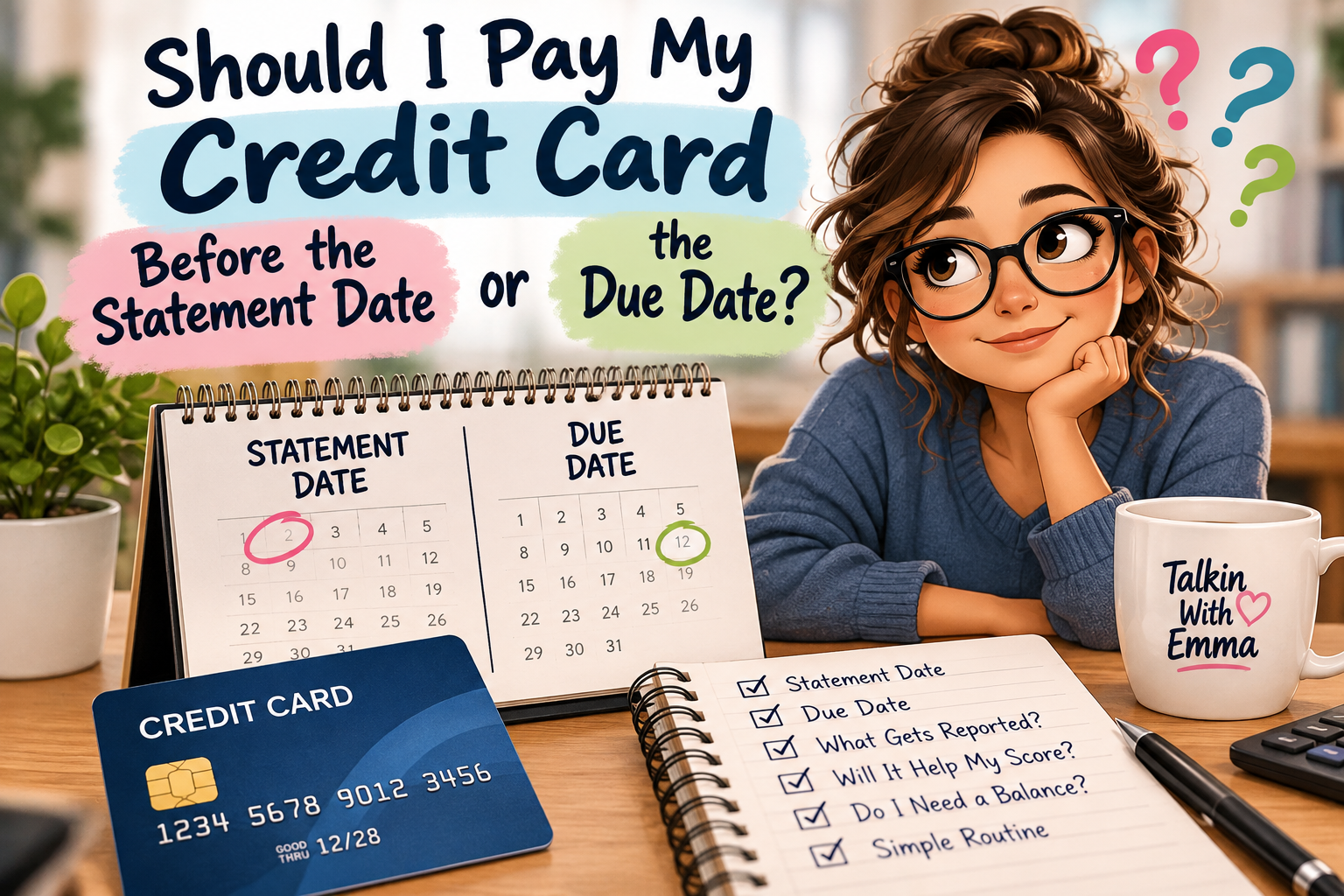
  • Should I Pay My Credit Card Before the Statement Date or the Due Date?

    Should I Pay My Credit Card Before the Statement Date or the Due Date?

    If you have ever tried to figure out the “right” day to pay a credit card, the internet can make a simple bill feel like a strategy game.

    Pay before the statement date. Pay on the due date. Pay twice a month. Leave a tiny balance. Never leave a balance.

    That is a lot of rules for something that should be much easier.

    Here is the short answer: If your goal is to make an on-time payment and, when your card has an applicable grace period, avoid interest on purchases, focus on paying the amount required by your card agreement by the due date. If you are trying to lower the balance that may appear on your credit reports, making a payment before the statement closes may help because many issuers report account information around the end of a billing cycle. You do not need to carry a balance or pay interest to build credit.

    First, What Is the Statement Date?

    Your credit card runs on billing cycles. At the end of a cycle, the card company creates a statement showing what happened during that period.

    That statement usually includes your statement balance, minimum payment, payment due date, interest and fees, credit limit, and a list of transactions.

    Think of the statement closing date as the point when the card company takes a snapshot of that billing cycle and prepares your bill.

    Then What Is the Due Date?

    The due date is the deadline for the payment shown on your statement.

    At minimum, you need to make the required minimum payment by the due date to keep the payment from being late. Federal rules generally require card issuers to deliver or mail statements at least 21 days before the payment is due.

    If your card provides a grace period on purchases and you meet its terms, paying the applicable statement balance in full by the due date can generally let you avoid interest on those purchases. Check your own card agreement because grace periods are not required and their terms can differ.

    So Why Would Anyone Pay Before the Statement Closes?

    This is where credit utilization enters the conversation.

    Credit utilization is basically how much of your available revolving credit you are using. If you have a $1,000 limit and a $500 reported balance, that card is showing 50% utilization.

    Credit scoring models can consider utilization. The balance that appears on a credit report is not necessarily the balance sitting in your account on the exact day someone checks your credit. Credit card companies periodically report account information to the credit bureaus, and the timing can vary by issuer.

    That means a person who pays a card in full every month can still have a balance reported.

    For example, imagine you have a $1,000 limit. You spend $600 during the month. Your statement closes showing $600, and then you pay that $600 in full before the due date.

    You did not do anything wrong. You paid your bill as agreed. But if the issuer reported the $600 balance, your credit report may temporarily show relatively high utilization on that card.

    If you had paid $400 before the statement closed, the statement might instead close with $200, depending on when the payment posted and when the issuer reports. That could mean a lower reported balance.

    That is the practical reason some people make an early payment. It is not because paying on the due date is automatically bad.

    Do I Need to Leave a Balance to Build Credit?

    No.

    This is one of those credit myths that refuses to go away.

    You do not need to carry debt from one billing cycle to the next and pay interest just to prove that you can use credit. On-time account history can help build credit without deliberately paying interest.

    If you can pay your statement balance in full and your card’s grace-period terms apply, paying it by the due date is usually the less expensive approach.

    What Is the Difference Between the Minimum Payment and the Statement Balance?

    This distinction matters much more than memorizing a special payment trick.

    The minimum payment is the smallest amount your issuer says you must pay by the due date to satisfy that month’s required payment.

    The statement balance is the balance shown when that billing cycle closed.

    If you pay only the minimum, the rest does not disappear. You may pay interest on the unpaid amount, and paying a debt down can take much longer.

    If money is tight and you cannot pay the full statement balance, do not let “I can’t pay it all” turn into “so I won’t pay anything.” Making at least the required minimum payment on time is important. Then look at what you can realistically pay above it.

    Is It Bad to Pay My Credit Card More Than Once a Month?

    No. You can generally make more than one payment during a billing cycle.

    For some people, that is useful. Maybe you get paid every two weeks and prefer paying part of the card each payday. Maybe making an early payment helps keep your reported balance lower. Maybe smaller payments simply make the household budget easier to manage.

    Those are practical reasons.

    What you do not need is a complicated schedule because someone online promised that paying on two magic days will automatically boost your score.

    Please Don’t Turn This Into Another Credit-Score Game

    Once people learn that reported balances can affect utilization, it is easy to start micromanaging every purchase and payment.

    You probably do not need to do that.

    Credit scores can matter, especially when you are preparing to apply for a mortgage, auto loan, apartment, or another product where your credit will be reviewed. In that situation, paying balances down before they are reported may be useful if utilization is high.

    But for everyday credit management, the bigger habits are much less exciting:

    • Know your due date.
    • Make at least the required payment on time.
    • Pay the statement balance in full when you reasonably can and when that fits your card’s terms.
    • Keep an eye on how much of your available credit you are using.
    • Read your statements.
    • Do not spend money just because credit is available.

    Those habits are not flashy enough for a viral “credit hack,” but they are much more useful.

    A Simple Credit Card Routine

    If you want to keep this simple, try this:

    1. Check your statement every month. Make sure the transactions look right and note the statement balance, minimum payment, and due date.
    2. Set up a reminder or autopay. At the very least, protect yourself from accidentally missing the required payment.
    3. Pay the statement balance in full when you can. If your card has an applicable grace period and you meet its conditions, this can help you avoid purchase interest.
    4. If your reported balance is high, consider paying earlier. An extra payment before the statement closes may reduce the balance that gets reported, depending on your issuer’s reporting schedule.
    5. If you cannot pay in full, make a plan instead of avoiding the bill. Pay at least the required minimum on time, then decide how much extra you can put toward the balance.

    That is enough. You do not need to turn paying a credit card into a part-time job.

    Quick Questions

    Does paying before the statement date help my credit score?

    It can help lower the balance that may be reported to the credit bureaus, which may lower your reported utilization. Whether that changes a particular score depends on the information in your credit report and the scoring model being used.

    When do credit card companies report balances?

    Reporting schedules vary. Many issuers report periodically around the end of a billing cycle, but you should not assume every issuer reports on the same day. You can check your credit reports to see what balance is appearing and ask your issuer about its reporting practices.

    Should I leave a small balance on my card?

    You do not need to carry a balance from month to month or pay interest in order to build credit.

    Should I pay on the statement date or due date?

    You do not have to wait for either date to make a payment. The due date is the important deadline for making the required payment on time. Paying earlier can be useful for budgeting or for reducing the balance that may be reported.

    What if I cannot afford the statement balance?

    Pay at least the required minimum by the due date if you can, then pay as much additional principal as your budget reasonably allows. If you are struggling to make even the minimum payment, contact the card issuer as soon as possible rather than waiting until after you miss it.

    The Bottom Line

    The statement date and the due date do two different jobs.

    The statement date closes out a billing cycle and helps determine what appears on that month’s statement. The due date tells you when the required payment must be received.

    If you want the simplest rule, start here: pay on time, pay the statement balance in full when you reasonably can, and do not carry debt just because someone told you it helps your credit.

    Once you understand what the dates and numbers actually mean, credit gets a lot less mysterious.

    Friendly conversations. Practical tools. Clear explanations.

    Want a Little More Help?

    If you’re trying to make credit-card payments fit more comfortably into the rest of your month, it can help to look at the whole money picture instead of one due date at a time.

    Want a simple free tool to help with the next step?
    Get the free Monthly Money Check-In.

    Want a clearer, beginner-friendly way to work through your money?
    Take a look at Let’s Talk About Money.

    Want practical insurance, money, and everyday-life help in your inbox?
    Join Emma’s Mailbox.

    Share This Conversation