
Author: Emma

  • Buying a Car This Weekend? When to Call Your Insurance Company

    Buying a Car This Weekend? When to Call Your Insurance Company

    You found the car.

    You drove it.

    You like it.

    The numbers are starting to look acceptable.

    And then somebody at the dealership asks:

    “Do you have proof of insurance?”

    Right.

    Insurance.

    One more thing.

    If you’re buying a car soon, I would not leave this part until you’re sitting at the dealership with paperwork spread across the desk and somebody waiting for an answer.

    Call your insurance company before you buy the car.

    Preferably before you fall completely in love with it.

    There are a few reasons for that.

    Call Before You Sign, Not After You Drive Away

    If you already have auto insurance, your current policy may provide some temporary coverage for a newly acquired vehicle.

    Or it may not work the way you think it does.

    How much coverage applies, what kind of coverage applies, how long it lasts, and what you need to do next can depend on your policy, insurer, and state.

    So instead of relying on:

    “I think my insurance automatically covers a new car for a few days.”

    Call and ask.

    Try:

    “I’m considering buying another vehicle. What happens to my coverage when I take ownership, and what do you need from me before I drive it home?”

    Now you know.

    Much better than finding out in the dealership parking lot.

    Get the Insurance Price Before You Buy the Car

    This part matters.

    The car payment is not the only monthly cost of the car.

    Insurance counts too.

    A vehicle that looks affordable at the dealership can feel a lot less affordable once you add the insurance bill.

    Different vehicles can cost very different amounts to insure.

    Repair costs can matter.

    Vehicle value can matter.

    The type of vehicle can matter.

    Safety and loss history can matter.

    And your own rating factors still matter too.

    So if you’re seriously considering a car, get the VIN and ask your insurer—or several insurers—what it would cost to insure.

    Do that before you sign if you can.

    You may still buy the car.

    At least you’ll be buying it with the real number in front of you.

    The VIN Is Your Friend

    If you’re getting an actual insurance quote for a specific car, the VIN helps your insurer identify exactly what you’re looking at.

    Ask the dealer for it.

    Then be ready with things like:

    • The VIN
    • Year, make, and model
    • Who will drive the vehicle
    • How you’ll use it
    • Where it will normally be kept
    • Approximate annual mileage, if asked
    • Whether you’re financing, leasing, or paying cash

    Your insurer may need a few other things too.

    The goal is to avoid:

    “It’s some kind of blue Honda SUV.”

    We’re aiming for slightly more precision.

    Financing or Leasing? The Lender Gets a Say Too

    This is where buying the car and insuring the car start bumping into each other.

    If you’re financing or leasing, the lender or leasing company may require certain coverage on the vehicle.

    Collision and comprehensive are commonly part of that conversation.

    That doesn’t mean the lender chooses every part of your auto policy.

    But it may mean you cannot simply carry the minimum liability coverage and call it done.

    Ask what the lender requires.

    Then make sure the insurance quote you’re considering actually meets those requirements.

    And if collision, comprehensive, liability limits, deductibles, rental reimbursement, and uninsured motorist coverage are starting to blur together, Let’s Talk About Auto Insurance walks through what those coverages do and why they matter.

    Don’t Automatically Copy the Coverage From Your Old Car

    Let’s say you’ve been driving a 12-year-old car that’s fully paid off.

    You may have made certain insurance choices because of that car’s age, value, or how you used it.

    Now you’re buying a much newer car with a loan.

    Different car.

    Different situation.

    Simply copying every choice from the old car may not make sense.

    Maybe the lender requires coverage you did not carry before.

    Maybe you want to look at the deductible again.

    Maybe rental reimbursement matters more now because being without the car would create a bigger transportation problem.

    Maybe nothing needs changing except the vehicle itself.

    Fine.

    Just look at it.

    “Whatever I had before” is convenient.

    It isn’t always a decision.

    Ask What Happens to the Old Car

    Are you trading it in?

    Selling it?

    Keeping it?

    Giving it to someone else?

    Don’t forget that part.

    If you’re replacing the old vehicle, ask your insurer how and when it should come off the policy.

    If you’re keeping both cars, you’re adding a vehicle rather than replacing one.

    And don’t remove coverage too early if you still own or drive the old car.

    The timing matters.

    We’re trying to avoid a coverage gap—or a car sitting in the driveway that everybody somehow forgot was still part of the plan.

    Don’t Forget GAP If You’re Financing

    GAP is another term you may hear while you’re sitting at the dealership.

    It deals with a fairly specific problem:

    You owe more on the vehicle loan than the vehicle is worth for purposes of an insurance settlement after a total loss.

    Suppose you owe $32,000.

    The car is totaled.

    The applicable insurance settlement is based on a lower vehicle value.

    You may still owe money on the loan after the auto insurance payment.

    GAP may help with that difference, depending on the product and its terms.

    You may be offered GAP through the dealer or lender. It may also be available elsewhere.

    So don’t assume the first version put in front of you is the only option.

    Ask:

    • What does it cost?
    • What exactly does it cover?
    • Are there limits or exclusions?
    • Do I already have anything similar?
    • Can I get similar protection somewhere else?

    You do not need to become a GAP expert in the finance office.

    You do need to understand what you’re paying for.

    Ask for the New Premium in Actual Dollars

    Don’t just ask:

    “Will my insurance go up?”

    Ask:

    “What will my new premium be?”

    Those are not the same question.

    “Probably a little” is not a budgeting number.

    Maybe the increase is $18 a month.

    Maybe it’s $90.

    Maybe the premium goes down.

    Find out.

    If you’re choosing between several vehicles, insurance cost may even affect which one makes more sense.

    Car A and Car B might have almost identical payments.

    But if Car A costs another $70 a month to insure?

    They’re not quite as identical anymore.

    If You’re Shopping for Insurance Too, Compare Carefully

    Buying a car can also be a good time to compare insurance companies.

    Just make sure you’re comparing similar things.

    Don’t get one quote using your current limits and another using much lower limits and then decide the second company is cheaper.

    Of course it’s cheaper.

    You changed the thing you’re buying.

    Try to keep the major pieces reasonably consistent:

    • Coverage choices
    • Limits
    • Deductibles

    Then compare the price.

    That’s where the Insurance Checkup & Quote Comparison Workbook can help you keep the numbers straight.

    The dealership is already giving your brain enough numbers to manage.

    Put the insurance numbers somewhere else.

    What About the Dealer’s Insurance Products?

    Dealerships may offer other insurance-related products or protections.

    Some may be useful.

    Some may duplicate something you already have.

    Some may solve one very specific problem.

    Don’t feel like you have to say yes simply because you’ve already signed seventeen other pieces of paper.

    Ask what the product does.

    Ask what it costs.

    Ask whether it’s insurance, a waiver, a service contract, or something else.

    Ask whether you’re required to buy it.

    Ask whether you can buy similar protection somewhere else.

    And read before you sign.

    Being tired of paperwork is not the same thing as understanding the paperwork.

    Unfortunately.

    What Should You Ask Your Insurer Before You Go?

    Keep this part simple.

    Tell them you’re considering buying a specific vehicle.

    Then ask:

    • What would it cost to insure this car?
    • What coverage would apply when I take ownership?
    • Do I need to contact you before I leave the dealership?
    • What information do you need from me?
    • If I’m financing or leasing, does this quote meet the lender’s requirements?
    • What happens to my current vehicle if I’m trading it in?
    • When will the new premium take effect?
    • How will I get proof of insurance?

    Those answers should eliminate most of the last-minute scrambling.

    What If You’re Buying on a Saturday?

    Think about this before Saturday gets here.

    If your agent or insurer has limited weekend hours, don’t assume somebody will be available when you’re sitting at the dealership.

    Some companies offer 24-hour phone or online service.

    Some don’t.

    Find out ahead of time.

    If you’re buying outside normal business hours, ask how you’re supposed to add the vehicle and get proof of coverage.

    Again:

    We’re not trying to memorize insurance rules.

    We’re trying to keep Future You from standing in the dealership saying:

    “Um…I think I’m covered?”

    Before You Drive Away

    Take a minute.

    Make sure the insurance part is actually finished.

    You should know:

    • Which vehicle is insured
    • When coverage starts
    • What major coverages and deductibles you selected
    • Whether lender requirements have been handled
    • What the premium is
    • What happens to the old vehicle
    • How to access your proof of insurance

    If you don’t know one of those things?

    Ask.

    The new car will still be exciting in ten minutes.

    Buying the Car Is the Fun Part

    Insurance is rarely the part anybody is excited about.

    Nobody posts:

    “NEW CAR!!! And you should see my declarations page!”

    That’s okay.

    The goal isn’t to make insurance exciting.

    It’s to keep the insurance part from becoming a problem later.

    So if you’re buying a car this weekend, make one call before you go.

    Get the VIN.

    Get the insurance price.

    Find out when coverage starts.

    Ask what your insurer needs.

    Then go buy the car knowing the number on the dealership paperwork isn’t the only number coming home with you.

    And if you’re still not sure what the coverages actually do—or why you might choose one option over another—Let’s Talk About Auto Insurance takes that conversation further.

    For today, though?

    Don’t let the first insurance conversation happen after you’ve already bought the car.

    That’s one surprise we can avoid.


    This article is for general educational and informational purposes only and isn’t intended as individualized insurance, financial, legal, or tax advice. Auto insurance requirements, newly acquired vehicle provisions, coverage timing, lender requirements, policy terms, and any grace periods vary by insurer, policy, and state. Confirm your coverage directly with your insurer or licensed insurance professional before relying on coverage for a newly purchased vehicle.
    Share This Conversation
  • How to Lower Your Monthly Bills Without Making Yourself Miserable

    How to Lower Your Monthly Bills Without Making Yourself Miserable

    You need to spend less.

    Okay.

    So you start looking around.

    Cancel Netflix.

    Stop buying coffee.

    Never eat at a restaurant again.

    Apparently happiness has been removed from the budget.

    And after all that?

    You saved $31.

    This is my problem with a lot of advice about cutting expenses.

    Yes, little things add up.

    But so do big things.

    And if we’re trying to create some actual breathing room in your budget, I’d rather look for $50 in one place before chasing $2 in twenty-five places.

    So let’s go looking for the bigger stuff first.

    Start With the Bills That Come Back Every Month

    Recurring expenses are a good place to start because you usually only have to make the change once.

    Save $30 on something you buy one time?

    You saved $30.

    Lower a recurring bill by $30 a month?

    That’s $360 over a year if the savings continues.

    Much more interesting.

    Pull up your bank or credit card statements and look for the bills that keep coming back.

    Phone.

    Internet.

    Insurance.

    Subscriptions.

    Memberships.

    Software.

    Storage.

    Anything else you’re paying repeatedly.

    We’re not cancelling everything.

    We’re asking whether you’re still getting enough value for what you’re paying.

    Start With the Biggest Bills You Can Actually Change

    Your mortgage might be your biggest bill.

    That doesn’t mean you’re going to solve it this afternoon.

    We’re looking for expenses that are both:

    Big enough to matter.

    and

    Realistically changeable.

    Your phone bill might qualify.

    Internet might.

    Insurance might.

    A collection of subscriptions might.

    A service plan you signed up for four years ago and haven’t looked at since definitely deserves an invitation to this conversation.

    Start there.

    Call the Phone Company

    I know.

    Nobody woke up this morning hoping to spend part of the day talking to the phone company.

    Do it anyway.

    Look at your current plan.

    How much are you paying?

    What are you actually getting?

    Are you financing devices?

    Paying for insurance or add-ons?

    Using all the lines?

    Then look at what’s available now.

    Your provider may have a less expensive plan that still works for you. Another provider might too.

    Sometimes simply asking:

    “Are there any less expensive plans available that would still meet my needs?”

    can turn up an option you didn’t know existed.

    Don’t assume the plan you’ve had for five years is still the best deal.

    Companies change their offers.

    Your needs change too.

    Do the Same Thing With Internet

    Internet bills have a habit of starting at one number and eventually becoming another number entirely.

    Maybe a promotional rate expired.

    Maybe the price increased.

    Maybe you’re paying for speed you don’t need.

    Maybe equipment fees have quietly joined the party.

    Pull up the actual bill—not just the amount coming out of your account.

    What are you paying for?

    Then check what’s currently available.

    If there’s a lower-cost plan that meets your needs, ask about it.

    If a competitor has a better offer, that’s useful information too.

    You don’t necessarily have to switch.

    But knowing your options makes for a much more interesting phone call.

    Shop Your Insurance—Carefully

    Insurance can be another meaningful recurring expense.

    Auto.

    Homeowners.

    Renters.

    Other coverage you may have.

    If you haven’t compared rates in a while, getting quotes can be worth doing.

    But please don’t shop insurance by price alone.

    A quote that’s $40 cheaper isn’t necessarily a better deal if the coverage changed.

    Check:

    Coverage limits
    Deductibles
    Included coverages
    Exclusions or important differences
    Discounts

    Then compare the premium.

    If you want some help keeping those quotes straight, the Insurance Checkup & Quote Comparison Workbook gives you a place to put them side by side.

    A lower insurance bill is wonderful.

    A lower insurance bill because you accidentally removed protection you wanted?

    Less wonderful.

    Now Go Subscription Hunting

    Pull up your statements and find the recurring subscriptions.

    Streaming.

    Music.

    Apps.

    Cloud storage.

    Fitness.

    News.

    Gaming.

    Memberships.

    Software.

    Then ask three questions:

    Do I still use this?

    Would I notice if it disappeared?

    Would I sign up again today at this price?

    That last one catches a lot.

    Maybe you signed up when it was $7.99.

    Now it’s $15.99.

    Would you still buy it?

    If yes, keep it.

    We’re not cancelling things just because they cost money.

    If no?

    There you go.

    Don’t Cancel the Things That Make Your Life Better Just Because They’re Easy Targets

    Your $12 streaming subscription is visible.

    So it’s easy to attack.

    But maybe you use it five nights a week.

    You love it.

    Your family uses it.

    Meanwhile, you’re paying $38 a month for something you haven’t touched since February.

    Which one should go?

    Exactly.

    The goal isn’t to make your bank statement as joyless as possible.

    It’s to stop paying for things that aren’t doing enough for you.

    There’s a difference.

    Look for Fees

    Fees are particularly irritating because they often give you absolutely nothing in return.

    Bank fees.

    Late fees.

    ATM fees.

    Delivery fees.

    Convenience fees.

    Service fees.

    Fees that appear to exist because someone discovered they could charge a fee.

    Look through the last couple of months.

    Are any repeating?

    If you’re regularly paying account fees, see whether another account or institution could reduce them.

    If late fees keep appearing, would changing a due date or setting a reminder help?

    If delivery fees are adding up, maybe you still order food—but pick it up sometimes.

    We’re looking for places where your money is leaving and you’re getting very little in return.

    Check What You’re Paying for Convenience

    Convenience is worth money.

    Time has value too.

    Delivery, prepared food, same-day shipping, and services that save you time aren’t automatically bad.

    The problem is when the cost becomes invisible.

    Let’s say delivery adds $14 to an order.

    Once?

    Fine.

    Twice a week?

    Now we’re talking about roughly $100 or more in some months.

    Maybe that’s worth it to you.

    Great.

    Keep it.

    But make the decision knowing what it costs.

    “I spend about $100 a month on delivery because it makes our busiest nights easier” is a choice.

    “I had no idea we were spending $100 a month on delivery” is a discovery.

    We want choices.

    Look at Groceries Without Declaring War on Food

    Groceries are expensive.

    And advice like:

    “Just spend less at the grocery store”

    isn’t particularly useful.

    You need food.

    Instead of choosing some random amount to cut, look for patterns.

    Food that regularly gets thrown away.

    Multiple little grocery trips that somehow cost $46 every time.

    Impulse purchases.

    Things bought because they’re on sale even though nobody in the house actually likes them.

    That’s where I’d start.

    Reducing food waste by $20 a week is about $80 a month.

    And nobody had to survive on lentils for thirty consecutive days.

    Don’t Ignore Debt Payments

    Debt payments deserve a look too.

    If a big chunk of every paycheck is already spoken for before the month really gets going, write those payments down.

    How much are you paying toward credit cards, personal loans, or other debt every month?

    What are the interest rates?

    Which balances are costing you the most?

    We’re not solving debt in this article.

    That’s its own conversation.

    But eventually, paying off a debt can do more than reduce what you owe.

    It can remove an entire monthly payment.

    That’s when your budget really starts to breathe.

    For now, know the numbers.

    What About the Really Big Expenses?

    Housing.

    Transportation.

    Childcare.

    These can take enormous pieces of a budget.

    They’re also much harder to change.

    I’m not going to tell you:

    “Have you considered simply moving?”

    as though changing homes costs nothing and you can knock it out Tuesday afternoon.

    But if housing or transportation costs keep making the rest of your budget impossible, they may deserve a bigger conversation eventually.

    Some expenses can’t be fixed with one phone call.

    So work on the ones you can change now.

    Keep a Running Total of What You Find

    This is where things start getting satisfying.

    Cancelled unused app:

    $11 a month.

    Changed phone plan:

    $25.

    Reduced internet bill:

    $15.

    Cancelled membership:

    $20.

    Reduced delivery fees:

    $30.

    That’s $101 a month.

    Not life-changing money for everybody.

    But that’s $1,212 over a year if those savings continue.

    And we didn’t ban restaurants.

    Nobody confiscated your coffee.

    You didn’t have to turn the thermostat down to a temperature usually associated with food storage.

    We looked for expenses that weren’t giving you enough back.

    That’s a much more sustainable way to cut spending.

    Now Give the Savings a Job

    This may be the most important part.

    You lowered your bills by $101.

    Fantastic.

    What happens to the $101?

    If you don’t decide, there’s a pretty good chance it simply disappears into regular spending.

    A little more at the grocery store.

    An extra order.

    A couple of random purchases.

    Three months later, you’re wondering why you don’t feel any richer.

    So decide.

    Maybe:

    $40 goes to emergency savings
    $30 goes toward debt
    $20 goes toward an irregular expense
    $11 stays available for something fun

    Your answer can be completely different.

    This is where My Monthly Money Check-In can help.

    Go back through your numbers and replace the old bill amounts with the new ones.

    Then decide where you want the difference to go.

    You didn’t just cut an expense.

    You redirected money.

    That’s the part that actually changes something.

    Don’t Try to Do All of This Today

    Please don’t finish this article and immediately call seven companies.

    Pick one bill.

    Preferably one that could save enough money to be worth the trouble.

    Handle it.

    Then do another next week.

    This isn’t a financial emergency drill.

    We’re gradually making your monthly expenses work better.

    And if you spend twenty minutes on the phone and save $25 a month?

    That’s $300 a year for twenty minutes of annoyance.

    I’ve had worse meetings.

    Cutting Expenses Isn’t About Spending as Little as Possible

    That’s not the goal.

    The goal is having enough room in your budget for the things that matter.

    Bills.

    Food.

    Savings.

    Debt.

    Emergencies.

    And yes…

    Things you enjoy.

    If your budget only works when nothing fun ever happens, I’m not convinced it works.

    Spend intentionally.

    Keep the things that make your life better.

    Question the things that don’t.

    And pay particular attention to the expenses that come back month after month.

    Because a small recurring change can quietly become a pretty decent amount of money over a year.

    Start with one bill.

    See what you can change.

    Then give whatever you save a better job.

    That’s how we create breathing room without making life miserable in the process.

    Want a Little Help With the Next Step?

    If you’re reviewing insurance costs, the Insurance Checkup & Quote Comparison Workbook can help you compare coverage, limits, deductibles, and premiums side by side.

    If you’re working on your monthly spending, My Monthly Money Check-In gives you a simple place to see what came in, where it went, and what you want your money to do next.

    This article is for general educational and informational purposes only and isn’t intended as individualized financial, investment, tax, or legal advice. Everyone’s financial situation is different. Consider your own circumstances and, when appropriate, consult a qualified financial or other professional before making significant financial decisions.

    Share This Conversation
  • Why an Emergency Fund Matters Even When You Have Insurance

    Why an Emergency Fund Matters Even When You Have Insurance

    Insurance can protect you from some very expensive problems.

    So if you have insurance, do you really need an emergency fund too?

    Yes.

    Not because your insurance isn’t doing its job. The two simply have different jobs.

    Insurance can help with certain covered losses. An emergency fund gives you money you can reach when life creates an expense right now.

    And sometimes those two things meet in the same afternoon.

    You might have a car accident and discover that your policy has a deductible. A storm might damage your home, but you still need to buy supplies before a claim is settled. You may have a covered loss and still have expenses that aren’t part of the claim at all.

    That’s where having some cash set aside can make a hard day a little easier.

    Insurance Doesn’t Mean You Never Pay Anything

    This is one of those ideas that sounds obvious once somebody says it, but it’s easy to overlook.

    Having insurance doesn’t mean every unexpected expense becomes the insurance company’s expense.

    Depending on the policy and what happened, you may still be responsible for things like:

    • a deductible
    • expenses above a coverage limit
    • something your policy doesn’t cover
    • temporary costs while you’re dealing with the problem
    • regular repairs or maintenance that aren’t insurance claims

    And even when insurance does cover something, you may have expenses before everything is sorted out.

    That’s why I like to think of insurance and emergency savings as two different layers of protection.

    Insurance helps transfer some financial risk.

    Emergency savings gives you some room to handle the part that still belongs to you.

    You usually want both.

    Think About Your Deductible for a Minute

    Grab one of your insurance policies.

    Your auto policy is a good place to start.

    If you have collision or comprehensive coverage, look at the deductible.

    Maybe it’s $500. Maybe it’s $1,000. Maybe yours is different.

    Now ask yourself a very simple question:

    If I needed to pay that deductible this week, where would the money come from?

    Not eventually.

    This week.

    Would it come from savings?

    A credit card?

    Money you needed for rent or groceries?

    Would you have to borrow it?

    There isn’t any judgment hiding in that question. You’re simply finding out how prepared your current financial setup is for the coverage you’ve chosen.

    Your insurance policy and your bank account don’t live in separate worlds.

    They meet when something happens.

    A Lower Premium Can Mean More Risk in Your Pocket

    Here’s another place insurance and emergency savings connect.

    Sometimes choosing a higher deductible can lower an insurance premium.

    That can be useful.

    But there’s a tradeoff.

    You’re agreeing to take responsibility for more of a covered loss before the applicable insurance coverage begins paying.

    So don’t look at the premium by itself.

    Ask:

    Could I actually afford the deductible I’ve chosen?

    Saving a few dollars on a premium isn’t much help if the deductible becomes a financial crisis when you need to use the coverage.

    That doesn’t automatically mean you should choose the lowest deductible available, either.

    It means the deductible should make sense with the rest of your finances.

    Your Emergency Fund Doesn’t Have to Appear Overnight

    This is where people can get discouraged.

    They hear emergency fund and picture a giant savings account they don’t have.

    So they decide they’re already behind.

    I’d rather make the first goal smaller.

    If your emergency savings is currently $0, then getting it to $100 is progress.

    Then maybe $250.

    Then $500.

    Keep building.

    You don’t have to solve every possible financial emergency before your emergency fund becomes useful.

    A smaller cushion can still help keep a relatively small problem from landing immediately on a credit card or disrupting the rest of your monthly bills.

    The important part is to start giving unexpected expenses somewhere else to go.

    What Should You Be Saving For?

    You don’t need to predict exactly what will happen.

    Life is far too creative for that.

    Instead, look at the expenses you already know you’re responsible for.

    Start with questions like these:

    What are my insurance deductibles?

    Look at auto, renters or homeowners coverage, health insurance, and any other policies where you may have out-of-pocket costs.

    What would happen if my car needed an unexpected repair?

    Not every car problem is an insurance claim.

    What if I had to miss work or change my normal routine for a few days?

    Would that create extra transportation, food, childcare, or other costs?

    What household expense would be difficult for me to absorb today?

    That answer gives you something practical to work toward.

    You aren’t trying to save for every disaster imaginable.

    You’re building breathing room.

    Insurance Is Still Important

    I don’t want the lesson here to become, “Just save money instead.”

    That’s not what I’m saying.

    Some financial losses are far larger than most households could reasonably handle from savings alone.

    That’s one reason insurance exists.

    The goal isn’t to choose between insurance and savings.

    It’s to understand what each one is supposed to do.

    Your insurance protects against certain risks according to the terms, limits, deductibles, exclusions, and other provisions of your policy.

    Your emergency fund helps you handle some of the expenses that remain yours.

    They work better together.

    Try This: Connect Your Coverage to Your Savings

    Take ten minutes and make a short list.

    Write down:

    1. Your current emergency savings balance.
    2. Your auto insurance deductibles.
    3. Any homeowners or renters insurance deductible you have.
    4. A health insurance out-of-pocket amount you would want to be prepared for.
    5. One non-insurance emergency expense that could realistically happen in your household.

    Now look at the list.

    You don’t need to fix everything today.

    Just choose your first target.

    Maybe your first goal is $250.

    Maybe it’s enough to cover your auto deductible.

    Maybe you already have that and you’re ready for the next level.

    The right starting point is the one that moves you from “I hope nothing happens” toward “If something happens, I have a plan.”

    That’s a much more useful place to be.

    Want Help Planning Your Emergency Fund?

    I made a free Emergency Fund Planner to help you choose a starter target, estimate the expenses you want your savings to handle, and decide what to work toward next.

    Want to Keep Going?

    If some of the insurance terms in this conversation still feel unfamiliar, visit Free Stuff for free Talkin With Emma resources that can help you make sense of the basics.

    If you’re ready to take a closer look at the policies you already have, visit Tools for practical resources designed to help you review and compare your coverage.

    And if you’d like a beginner-friendly explanation of how insurance works before getting deeper into individual policies, visit Books and take a look at Let’s Talk About Insurance.

    You can also find more everyday conversations about insurance, money, and life on the Talkin With Emma Blog.

    You don’t have to get your insurance and your finances perfect all at once.

    Understand one piece.

    Make one decision.

    Build one little bit of breathing room.

    Then keep going.

    Friendly conversations. Practical tools. Clear explanations.

    Share This Conversation
  • Someone Hit My Parked Car. What Do I Do About Insurance?

    Someone Hit My Parked Car. What Do I Do About Insurance?

    You walk back to your car.

    Something looks wrong.

    Very wrong.

    There’s a dent that wasn’t there before. Maybe a broken light. Scraped paint. A bumper hanging at an angle bumpers generally aren’t supposed to hang at.

    And you weren’t even in the car.

    Wonderful.

    So now what?

    The answer depends partly on whether the person who hit you is still there—or at least had the decency to leave useful information.

    Either way, don’t start with the insurance company.

    Start with the car.

    First, Take a Look Around

    Before moving anything, take a minute if it’s safe to leave the car where it is.

    Look at the damage and the area around it.

    Is there another damaged vehicle nearby? A note on your windshield? Broken pieces on the ground? Cameras on a nearby building? Anyone who may have seen what happened?

    Then get your phone out.

    Take pictures. A lot of them.

    Get:

    • The whole car
    • Close-ups of the damage
    • The area around the vehicle
    • Where the car was parked
    • Any debris
    • Nearby signs or markings
    • Any note left on the car

    If another vehicle is involved and the driver is there, photograph that damage too if you can do so safely.

    We’re preserving what everything looked like before people move on with their day.

    If the Driver Is Still There

    Good.

    Well—not good that they hit your car. But much better than disappearing.

    Exchange information. Get their:

    • Name and contact information
    • Driver’s license information where appropriate
    • License plate number
    • Insurance company
    • Policy or insurance-card information
    • Vehicle details

    Also get contact information from anyone who saw what happened.

    Give the other driver the information you’re required to provide, too.

    Keep the conversation simple. You don’t need a parking-lot debate about fault. Collect the facts and let the claims process handle the rest.

    If you’re unsure what to ask for, the free Insurance Questions Checklist can help you organize your questions before you make the calls.

    If They Left a Note

    Take a picture of it before doing anything else.

    Paper has a long history of disappearing at exactly the wrong moment.

    Then check what’s actually on it. Ideally, you have enough information to identify the driver and contact their insurer.

    If the note says:

    Sorry about your car. —Mike

    Mike has left us emotionally richer and practically nowhere.

    Save what you have anyway. Then look for witnesses or nearby cameras that might help identify the vehicle.

    If Nobody Is There

    Now we may be dealing with a hit-and-run.

    Document the damage and surrounding area before leaving if it’s safe. Then contact the police or appropriate local law-enforcement agency and ask how property-damage hit-and-run reports are handled in your area.

    You may receive an incident or report number. Save it. Your insurer may ask for it.

    Reporting procedures vary, so don’t assume what your city, county, or state requires. Ask.

    Look for Cameras—but Don’t Become a Detective

    Parking garage? Store parking lot? Apartment complex? Office building?

    Someone may have video.

    If you see cameras nearby, ask the property owner, manager, or security office whether footage may exist. Do it fairly quickly. Video isn’t always kept for long.

    But don’t spend three days conducting your own investigation. Check the obvious sources, preserve what you can, and let the appropriate people handle the rest.

    Now Call Your Insurance Company

    Once you’ve documented the scene and handled any appropriate police reporting, contact your insurer.

    Tell them:

    • Your vehicle was parked
    • You weren’t in it
    • You found damage
    • Whether the other driver is known
    • Whether insurance information was left
    • Whether you have a police or incident report

    Then ask what your options are.

    Depending on the circumstances, your coverage, and state rules, the claim might involve the other driver’s property-damage liability coverage, your collision coverage, or uninsured-motorist property-damage coverage where available and applicable.

    Don’t guess which one applies. Ask the insurer to explain it based on the facts and your policy.

    If insurance terminology starts getting in the way, keep the free Insurance Terms Cheat Sheet nearby while you talk.

    If You Know Who Hit You

    If the other driver is identified and insured, their property-damage liability coverage may respond if they’re responsible for the accident.

    You may be able to pursue the claim through their insurer. Depending on your coverage and circumstances, you may also have the option to use your own insurer and let the companies sort out reimbursement later.

    Ask what the practical differences are:

    • Will a deductible apply if I use my own coverage?
    • How will the repairs be handled?
    • What happens while the other insurer is deciding responsibility?
    • Do I have rental reimbursement or another transportation option?
    • What documents do you need from me?

    You don’t need to decide everything while standing beside the car. Get the options first.

    What If You Have No Idea Who Did It?

    This is where your own coverage becomes more important.

    Collision coverage generally applies to physical damage caused by a collision with another vehicle or object, subject to the policy and deductible. Uninsured-motorist property-damage coverage may apply to some hit-and-run losses in some states, but availability, definitions, and requirements vary.

    That means:

    I wasn’t driving.

    doesn’t automatically mean:

    My insurance can’t help.

    But it doesn’t mean every policy handles parked-car damage the same way, either.

    Ask this:

    What coverage on my policy could apply to damage from an unknown driver hitting my parked car?

    That’s the question.

    Your Deductible May Matter

    Suppose the repair costs $1,800 and the applicable deductible is $1,000.

    Depending on which coverage handles the claim, you may be responsible for that $1,000.

    Now suppose the damage is $700.

    A claim under coverage with a $1,000 deductible looks very different.

    Before deciding what to do, understand:

    • The approximate repair cost
    • Which coverage might apply
    • The deductible
    • What the insurer needs from you

    Calling to ask questions and proceeding with a claim may not be the same decision. Be clear about what the insurer is opening or recording when you call.

    Get a Repair Estimate

    That scrape may be cosmetic.

    Or it may become an expensive lesson in what modern bumpers, sensors, cameras, and paint cost.

    A repair estimate gives you something concrete. If the damage is near or below your deductible, that may affect your decision. If the repair is substantial, insurance becomes more relevant.

    Initial estimates can also change when a shop finds hidden damage after taking the vehicle apart.

    Keep the estimate and ask how supplements or additional damage are handled if repairs begin.

    What If You Were Parked Illegally?

    Maybe you were double-parked. In a loading zone. Partially blocking something.

    That can complicate the facts, but we’re not deciding liability here. Responsibility may depend on the details and applicable state law.

    Tell the truth about where the vehicle was and what happened. Let the insurers—and, when necessary, the appropriate authorities—evaluate fault.

    Don’t rewrite the scene because you’re worried something makes you look bad. Accurate information is easier to evaluate than a story that changes later.

    Does a Parking Lot Change Anything?

    People often ask whether insurance works differently because an accident happened on private property.

    Don’t assume a parking lot makes insurance disappear.

    What may become harder is determining what happened and who was responsible. Parking lots have cars backing out, unusual traffic patterns, pedestrians, limited witnesses, and sometimes no police response for minor damage.

    That’s why the pictures, notes, witness information, and camera questions matter.

    Document what happened. Then let the claim be evaluated using the actual facts.

    Should You Call the Other Driver’s Insurer Yourself?

    If you have the other driver’s insurance information, you may be able to report the claim directly to that company.

    It can still be useful to notify your own insurer, especially if the damage is substantial or responsibility is unclear. Your company can explain the options available under your policy.

    You aren’t bothering them.

    This is quite literally why you have an insurance company.

    What About a Rental Car?

    If the other insurer accepts responsibility, rental or loss-of-use expenses may become part of the claim depending on the circumstances and applicable rules.

    If you use your own policy, rental reimbursement generally requires that you bought that optional coverage. It usually has daily and total limits.

    So don’t assume:

    My car is in the shop, therefore insurance pays for a rental.

    Check first.

    Before you rent the luxury SUV.

    Please.

    Will a Parked-Car Claim Raise Your Rate?

    Maybe.

    I know. Unsatisfying.

    The effect can depend on state rules, insurer practices, the coverage involved, your claims history, and other rating factors.

    Don’t avoid reporting serious damage solely because someone online said every claim raises your rate. Don’t assume a claim can never affect anything, either.

    Ask how claims are handled under your policy and in your state. Then make the decision using information that applies to you.

    For more plain-language insurance guidance, visit the TalkinWithEmma blog.

    If the Damage Is Small, Do You Have to File a Claim?

    Not necessarily.

    Maybe someone scraped the bumper. The repair is $300. Your deductible is $1,000. The other driver is unknown.

    You may decide to handle it yourself.

    First, make sure the damage really is small. Sensors and other equipment can hide behind parts that look ordinary. What appears to be a minor scrape may cost more than expected.

    Get enough information to make the decision. Don’t make it from the parking lot while you’re still angry.

    Don’t Repair It Before You Document It

    If the vehicle needs immediate work for safety, that’s different.

    Otherwise, give the insurer a chance to explain what documentation or inspection it needs before repairs erase the evidence.

    Keep:

    • Photos and videos
    • Repair estimates
    • Receipts
    • The police or incident-report number
    • The other driver’s note
    • Witness information
    • Notes from calls with insurers and repair shops

    Future You shouldn’t have to reconstruct the whole thing from memory.

    If you want a simple place to organize policy and quote details, see the resources on the TalkinWithEmma Tools page.

    Someone Hit Your Parked Car. Now What?

    Start with the scene.

    Take pictures. Look for a note, witnesses, or obvious cameras. Exchange information if the driver is there. If the driver left and can’t be identified, ask the appropriate police agency about a hit-and-run report.

    Then contact your insurer.

    Find out what coverage might apply, whether a deductible applies, and what documentation is needed. Get a repair estimate before assuming the damage is tiny—or enormous.

    You weren’t driving. The car was minding its own business.

    Apparently someone else’s car was not.

    Now document what happened, find out which insurance may apply, and work through it from there.

    One step at a time.


    This article is for general educational and informational purposes only and isn’t intended as individualized insurance, financial, legal, or repair advice. Insurance coverage, deductibles, fault rules, hit-and-run procedures, reporting requirements, and claims practices vary by policy, insurer, and state. Contact your insurer, licensed insurance professional, appropriate law-enforcement agency, state insurance regulator, or another qualified professional when needed.

    Share This Conversation
  • My Car Insurance Went Up and Nothing Changed. What Should I Do?

    My Car Insurance Went Up and Nothing Changed. What Should I Do?

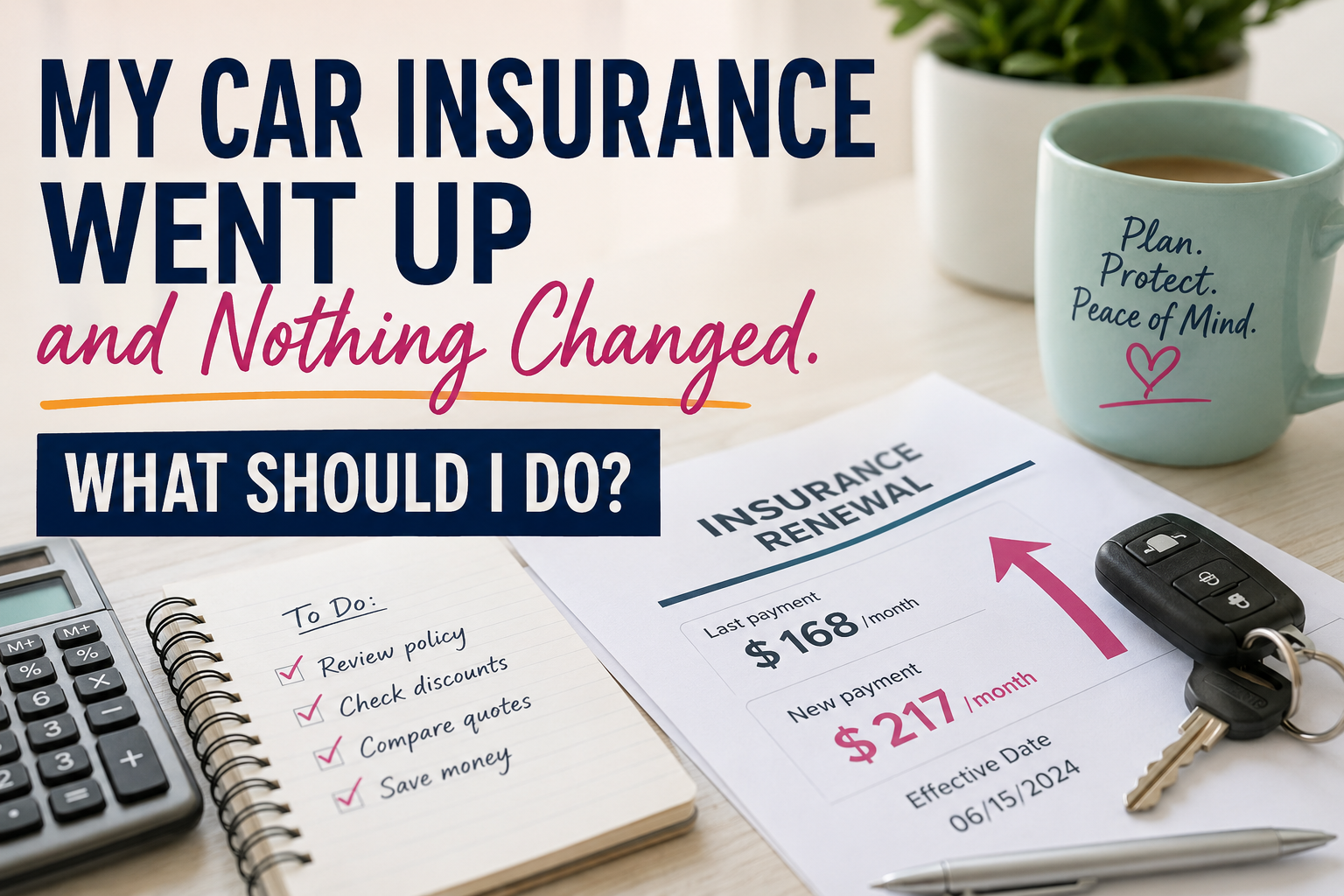
    Your car insurance renewal showed up.

    Last time: $168 a month.

    New price: $217.

    Okay.

    That’s not a rounding error.

    So naturally, you start going through the list.

    Accident? No.

    Ticket? No.

    New car? No.

    New driver? No.

    Moved? Nope.

    Same car. Same house. Same person who was apparently perfectly acceptable to insure six months ago.

    So why are you suddenly paying more?

    Here’s the frustrating answer:

    You may not have done anything.

    But before you get mad, cancel the policy, or spend the afternoon collecting twelve different quotes, let’s figure out what actually changed.

    Start With the Renewal—Not Just the Price

    The new premium is obviously the part that got your attention.

    But don’t stop there.

    Pull out your current policy information and the renewal. We’re going to compare them side by side.

    Look at:

    • Vehicles
    • Drivers
    • Coverage limits
    • Deductibles
    • Discounts
    • Vehicle use or mileage, if shown
    • Address or garaging information
    • Optional coverages
    • And, finally, the premium

    If some of those terms aren’t familiar yet, the Insurance Terms Cheat Sheet can help while you work through the policy.

    We’re trying to answer one question:

    Did your price change because something on your policy changed, or did the price change even though the policy basically stayed the same?

    Those are two different conversations.

    Make Sure Nothing Actually Did Change

    I know.

    You already said nothing changed.

    Check anyway.

    Insurance companies use more information than simply whether you crashed the car or got a ticket.

    Maybe a discount disappeared.

    Maybe the estimated mileage changed.

    Maybe a driver is classified differently.

    Maybe something about the vehicle information changed.

    Maybe a discount expired.

    Maybe the way you pay changed.

    Or maybe there’s simply an error.

    That’s why I’d look at the policy before calling anyone.

    You want to be able to say:

    “I’m comparing my old policy with the renewal, and I don’t see any meaningful change in my coverage or information. Can you explain what’s causing the increase?”

    That’s a much more useful question than:

    “Why did my insurance go up?”

    Check Your Discounts

    This one deserves its own stop.

    Look at the discounts on the old policy.

    Now look at the renewal.

    Are they all still there?

    You might see things like a safe-driver discount, multi-policy discount, multi-car discount, low-mileage discount, good-student discount, automatic-payment discount, or something else offered by your insurer.

    Discounts vary by company and state, so we’re not assuming you should have any particular one.

    We’re checking whether something you already had disappeared.

    And while you’re at it, ask:

    “Are there any discounts I’m eligible for that aren’t currently applied?”

    Simple question.

    Worth asking.

    Now Call the Insurance Company or Agent

    This is where we find out what’s going on.

    Have the renewal in front of you and ask:

    “Can you walk me through why my premium increased?”

    You don’t need to know all the insurance terminology.

    You don’t need to argue.

    You just want an explanation.

    If the answer is, “Rates increased in your area,” okay.

    Then ask whether there were any changes specific to your policy.

    If they mention a driver, vehicle, claim, mileage, or another factor, make sure the information is accurate.

    If something is wrong, ask what they need from you to correct it.

    And if everything is right and the rate simply increased?

    Well, now we know what problem we’re actually solving.

    We may not like the answer.

    But at least we have one.

    Yes, Your Rate Can Go Up Even If You Didn’t Have an Accident

    This is one of the things that frustrates people most about insurance.

    You can drive carefully, avoid tickets, file no claims—and still get a higher renewal.

    Why?

    Because your premium isn’t based only on what happened to you personally.

    Insurance companies are also estimating the cost of future claims. If vehicles become more expensive to repair, parts and labor cost more, medical claims become more expensive, theft patterns change, or losses increase in an area, those costs can eventually affect premiums.

    That doesn’t mean every increase automatically makes sense for your situation.

    And it certainly doesn’t mean you shouldn’t shop around.

    It just means:

    “But I didn’t have an accident” isn’t the only thing affecting the price.

    Don’t Immediately Start Cutting Coverage

    Your premium went up $50 a month.

    You want that $50 back.

    Understandable.

    So maybe you start looking at the policy and thinking:

    Higher deductible?

    Lower liability limit?

    Drop rental reimbursement?

    Remove collision?

    Hold on.

    We can review all of those things.

    But don’t start removing coverage simply because you’re angry about the price.

    Every change has another side.

    Raise the deductible?

    Your premium may go down, but you’re agreeing to take on more of the cost after certain claims.

    Lower a limit?

    You may be keeping more of the financial risk yourself.

    Remove a coverage?

    Make sure you understand what problem that coverage was handling before you decide you no longer want it.

    The goal isn’t:

    Make the premium number smaller at any cost.

    The goal is:

    Pay a reasonable amount for coverage that still makes sense for you.

    Now Look for Ways to Lower the Bill

    Once you know the policy information is correct, start with the easier possibilities.

    Ask about discounts.

    Review how many miles you’re driving.

    Make sure the vehicle-use information is accurate.

    Look at optional coverages.

    Ask what changing your deductibles would do to the premium.

    If you have more than one policy, ask whether bundling changes anything.

    But whenever you’re offered a change, ask one more question:

    “What am I giving up to save this money?”

    Sometimes the answer is:

    Nothing. You found a discount.

    Wonderful.

    Sometimes the answer is:

    You’re taking on another $500 of deductible.

    That’s different.

    Savings aren’t really savings until you understand the tradeoff.

    And Yes, This May Be the Time to Shop

    Sometimes you do everything above and reach a very simple conclusion.

    Your insurer wants $217 a month.

    You’d like to know whether somebody else wants less.

    Fair enough.

    Get some quotes.

    But please don’t compare only this:

    Company A: $217
    Company B: $181
    Company C: $159

    Looks like Company C wins.

    Maybe.

    Before we hand them the trophy, we need to know what they’re actually quoting.

    Compare the Coverage Before You Compare the Price

    This is where insurance shopping can get messy.

    One quote might have higher liability limits.

    Another might have lower limits.

    One might have a $500 deductible.

    Another has $1,000.

    One includes rental reimbursement.

    Another doesn’t.

    One includes a coverage you had before.

    Another leaves it out.

    Suddenly, $159 versus $217 isn’t really a comparison.

    It’s two different products with two different prices.

    That’s exactly why we created the Insurance Checkup & Quote Comparison Tool.

    Put the quotes next to each other and compare:

    • Limits
    • Deductibles
    • Coverages
    • Options
    • Then price

    You don’t have to choose the quote with the most coverage.

    And you don’t automatically have to choose the cheapest one.

    You just need to understand what you’re choosing.

    Be Careful About Raising Your Deductible Just to Lower the Premium

    Raising a deductible is a common way to reduce the price.

    And sometimes it makes perfect sense.

    Suppose changing your collision deductible from $500 to $1,000 saves you money.

    Great.

    But I want you to ask yourself something else:

    If you had a covered collision next Tuesday, could you reasonably handle that $1,000 deductible?

    If the answer is yes, maybe that tradeoff deserves consideration.

    If the answer is:

    “I’d have to put the deductible on a credit card,”

    then we should think a little harder.

    The cheapest insurance decision today can become an expensive problem later.

    Don’t Cancel the Old Policy Too Early

    You found another insurer.

    The coverage looks good.

    The price is better.

    Excellent.

    Before cancelling your current policy, make sure the new coverage is actually set to begin.

    Check the effective date.

    Make sure you’ve completed everything the new insurer requires.

    Then coordinate the cancellation of the old policy.

    We do not want:

    Old policy ends Friday.

    New policy begins Monday.

    Saturday and Sunday suddenly become extremely exciting.

    Avoid the lapse.

    What If the Other Quotes Aren’t Any Better?

    That can happen too.

    You get three quotes.

    Maybe four.

    And they’re all expensive.

    That’s useful information.

    It suggests your current insurer may not be uniquely expensive.

    At that point, we have to look at the bigger picture.

    Can you comfortably handle the premium?

    Are there reasonable changes available?

    Could you increase a deductible without creating another financial problem?

    Are there expenses elsewhere that could be adjusted?

    This is where auto insurance stops being only an insurance question and starts becoming a money question.

    You need the coverage.

    But you also have to be able to afford it.

    Don’t Shop Yourself Into Worse Insurance

    This is the part I really want you to remember.

    A lower premium feels like a win.

    And it can be.

    But saving $38 a month isn’t much of a victory if you accidentally gave up something you would have wanted after a serious accident.

    So slow down.

    You don’t have to understand every sentence in an insurance contract before you can shop intelligently.

    You do need to understand the major choices you’re making.

    That’s one of the reasons we’re putting together Let’s Talk About Auto Insurance.

    The book goes much deeper into what the different coverages actually do, how limits and deductibles work, why premiums change, and what to think about when you’re deciding what protection makes sense for you.

    But you don’t need the whole book to deal with today’s renewal.

    Today, you need a plan.

    So Your Car Insurance Went Up. Now What?

    Don’t panic.

    Don’t immediately cancel.

    And don’t start randomly removing coverage.

    Do this instead:

    1. Compare the old policy with the renewal.
    2. Make sure the drivers, vehicles, and other information are correct.
    3. Check your discounts.
    4. Ask why the premium changed.
    5. Ask what options might lower it.
    6. Understand the tradeoffs before changing coverage.
    7. Get a few comparable quotes if the price still doesn’t make sense.
    8. Use the Insurance Checkup & Quote Comparison Tool so you’re comparing the same things.
    9. Then decide whether staying or switching makes more sense.

    Maybe you find a much better price.

    Maybe you discover a missing discount.

    Maybe you make a reasonable adjustment.

    Maybe you decide your current policy is still the best option available.

    Any of those can be a good outcome.

    Because the goal wasn’t simply to get a cheaper number.

    The goal was to understand why the number changed and make a deliberate decision about what to do next.

    That’s a much better response than staring at the renewal and wondering:

    What did I do?

    Maybe nothing.

    Now let’s see what you can actually do about it.


    This article is for general educational and informational purposes only and isn’t intended as individualized insurance, financial, legal, or tax advice. Insurance coverage, pricing, requirements, and policy terms vary by insurer, policy, and state. Review your own policy and circumstances, and contact your insurance company, licensed insurance professional, state insurance regulator, or another qualified professional when appropriate.

    Share This Conversation
  • Where Does My Money Go? How to Find Where Your Paycheck Is Going

    Where Does My Money Go? How to Find Where Your Paycheck Is Going

    You got paid Friday.

    It’s Tuesday.

    You didn’t buy a television. You didn’t book a vacation. You didn’t even go anywhere particularly interesting.

    And somehow there’s $347 left.

    Okay.

    Before we blame the coffee, let’s figure out what actually happened.

    When money disappears faster than you expected, it’s easy to assume you’re spending too much.

    Maybe you are.

    But maybe your bills have crept up. Maybe groceries cost more than you realized. Maybe six little automatic charges hit at once. Maybe you’ve been spending $12 here and $18 there without noticing how quickly those numbers add up.

    Or maybe the math simply doesn’t work anymore.

    That’s important too.

    We’re not going to start with what you should be spending.

    We’re going to find out what you actually are spending.

    Then we can do something useful with it.

    First, Don’t Start With a Budget

    I know.

    We’re talking about money, and I’m telling you not to make a budget.

    Yet.

    A budget works much better when it’s based on real numbers.

    If you sit down and write:

    Groceries: $400
    Gas: $150
    Eating out: $100

    because those numbers seem reasonable, you’ve created a lovely budget for a person who may or may not exist.

    We need yours.

    Before deciding where your money should go next month, let’s find out where it went last month.

    Pull up your bank account. Grab your credit card statement too, if you use one regularly.

    We’re looking at roughly the last 30 days.

    No judgment. No guilt. No promising that you’ll never order takeout again.

    We’re investigating.

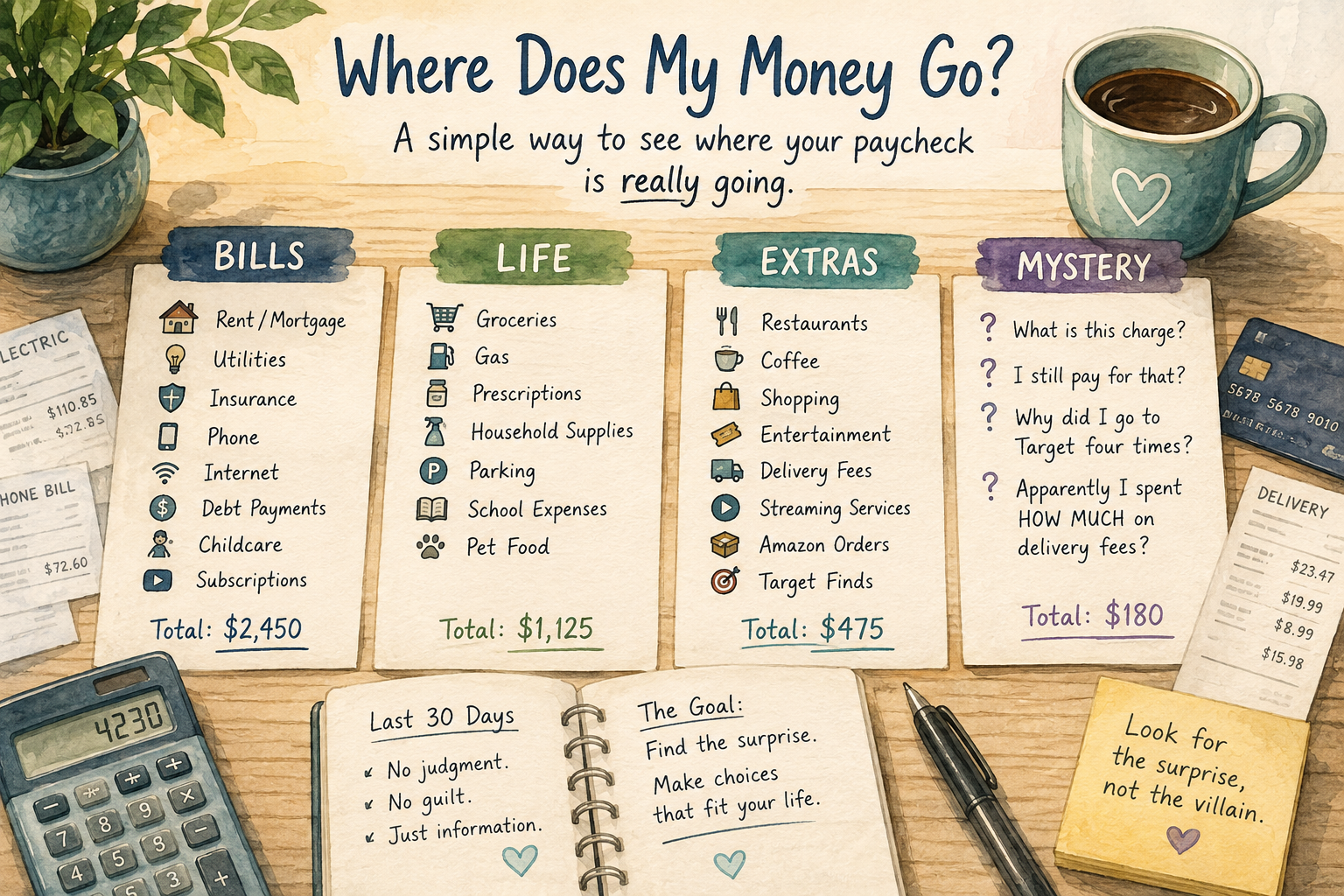
    Meet Bills, Life, Extras and Mystery

    We’re going to make this very complicated.

    Four categories.

    That’s it.

    Take the spending from the last month and sort it into:

    Bills

    These are the things that show up because life apparently requires a subscription fee.

    Rent or mortgage. Utilities. Insurance. Phone. Internet. Minimum debt payments. Childcare. Regular subscriptions.

    Anything you’re committed to paying on a recurring basis belongs here.

    Some of these amounts may change a little month to month. That’s fine.

    We’re looking for the basic cost of keeping your life running.

    Life

    This is the everyday stuff.

    Groceries. Gas. Prescriptions. Household supplies. Parking. School expenses. Pet food.

    The things you buy because people, cars, houses and apparently dogs require constant maintenance.

    These aren’t necessarily fixed bills, but they’re also not exactly optional.

    You have to eat. You may have to drive to work.

    The dog remains strangely unwilling to purchase his own food.

    Life costs money.

    Put it here.

    Extras

    Here’s where things get interesting.

    Restaurants. Coffee. Shopping. Entertainment. Delivery fees. Streaming services you could live without. Random Amazon orders.

    That thing Target convinced you was essential even though you went in for toothpaste.

    Extras aren’t bad.

    Let me say that again.

    Extras aren’t bad.

    Money is allowed to make your life enjoyable.

    We’re not creating a budget where you sit at home in the dark eating beans while congratulating yourself on your financial discipline.

    We just want to know how much is going here.

    Mystery

    You knew this category was coming.

    Mystery is:

    “What is this $27.43 charge?”

    “I still pay for that?”

    “Why did I go to Target four times?”

    “Apparently I spent how much on delivery fees?”

    These are the transactions you didn’t remember making, charges you don’t recognize immediately, subscriptions you’d forgotten about, and little purchases that somehow became a much bigger number when you added them together.

    Mystery is often where we learn something.

    Not necessarily something we wanted to learn.

    But something useful.

    Add Up Your Monthly Spending

    Once everything has a home, total each category.

    Let’s say you end up with:

    Bills: $2,450
    Life: $1,125
    Extras: $475
    Mystery: $180

    Now we’re getting somewhere.

    Maybe you expected Extras to be the problem and discover they really aren’t.

    Maybe Bills are eating far more of your income than you realized.

    Maybe groceries have quietly climbed by $200 a month.

    Maybe Mystery contains four subscriptions and $96 worth of fees you’d barely noticed.

    This is why we looked before we started cutting.

    You can’t fix a money problem very well when you’re guessing what the problem is.

    Look for the Surprise, Not the Villain

    Personal finance loves finding villains.

    Coffee. Avocado toast. Streaming services. Eating out.

    Whatever we’re all supposedly doing wrong this year.

    I’m less interested in finding something to blame.

    I want to find the surprise.

    What number made you stop and say:

    “Wait. Really?”

    Maybe it’s groceries.

    Maybe it’s insurance.

    Maybe it’s takeout.

    Maybe it’s a collection of $9.99 charges quietly having a party in your checking account.

    That’s where I’d look first.

    Because the biggest opportunity isn’t always where somebody on the internet told you it would be.

    It’s where your numbers say it is.

    Check the Small Stuff—But Don’t Obsess Over It

    Small purchases add up. They absolutely do.

    Five dollars here. Twelve dollars there. Do that often enough and eventually we’re talking about real money.

    But I don’t want you spending forty minutes feeling guilty about a $4 coffee while ignoring the $175 bill that might be worth investigating.

    I’d look at the big numbers first.

    Housing. Transportation. Insurance. Debt payments. Phone. Internet. Subscriptions. Groceries.

    Then look at the smaller stuff.

    If you’re spending $160 a month on something you barely use, that’s interesting.

    If you’re spending $18 a month on something you genuinely enjoy and can afford?

    Maybe we leave it alone.

    Not every expense needs to be optimized within an inch of its life.

    Look for Money That’s Leaving Automatically

    Automatic payments are wonderful.

    Until you forget about them.

    Go through your transactions and look specifically for recurring charges.

    Streaming services. Apps. Cloud storage. Memberships. Software. Subscriptions.

    Anything else that quietly renews while you’re busy doing something more interesting.

    Here are three questions I like:

    Do I still use this?

    Would I notice if it disappeared?

    Would I sign up for it again today at this price?

    That last one is my favorite.

    Something you happily paid $8 for three years ago might now cost $17.99.

    And apparently nobody thought to ask whether you were still enjoying yourself.

    If you’d happily buy it again, great.

    If you wouldn’t?

    That’s one worth looking at.

    Then Look at the Expenses You Can’t Just Cancel

    This part matters.

    Sometimes you go through everything and discover there really isn’t much nonsense.

    You’re not secretly spending $600 a month on lattes. You’re not paying for fourteen streaming services. You’re not ordering packages every afternoon.

    Your rent is high.

    Groceries are high.

    Insurance went up.

    Gas isn’t cheap.

    And your paycheck hasn’t kept up.

    Sometimes the numbers are tight because the numbers are tight.

    That’s useful information too.

    Instead of asking:

    “How do I stop wasting money?”

    we can start asking:

    “Which of these bigger expenses might actually be changeable?”

    Maybe insurance is worth shopping.

    Maybe it’s worth checking whether the phone or internet bill can be reduced.

    Maybe a debt payment needs a larger strategy.

    Maybe income is part of the problem.

    None of those is necessarily an easy fix.

    But at least we’re looking at the real problem instead of blaming a cup of coffee for something it didn’t do.

    Don’t Forget the Bills That Don’t Come Every Month

    Car registration. Birthdays. Annual subscriptions. Car maintenance. Vet visits.

    They don’t happen every month, but they still take money when they arrive.

    That’s why I like to remember:

    Not monthly doesn’t mean unexpected.

    For now, make note of the expenses you notice that come around occasionally.

    We’ll talk separately about how to plan for them instead of letting them surprise the budget every time.

    Now We Can Make a Budget

    This is where budgeting becomes useful.

    Because now we’re not inventing numbers.

    We know roughly what Bills cost. We know what Life costs. We’ve seen Extras. We’ve investigated Mystery.

    And we’ve started noticing expenses that don’t happen every month.

    Now you can decide what you want the next month to look like.

    Maybe you want to reduce takeout by $75.

    Maybe there are two subscriptions you no longer want.

    Maybe you’d like to set aside $50 for car maintenance or start putting $25 toward emergency savings.

    Whatever makes sense for your situation.

    If you use a budgeting worksheet or other budgeting tool, this is also where it becomes much more useful.

    Instead of staring at blank categories and guessing what numbers you’re supposed to put in them, you can start with what you just found:

    Real income. Real bills. Real spending.

    Then make adjustments from there.

    That’s a budget you actually have a chance of using.

    Don’t Try to Fix Everything at Once

    You’ve gone through the numbers.

    You’ve discovered six things you’d like to change.

    Excellent.

    Please don’t change all six tomorrow.

    Pick one or two places to start.

    Maybe you cancel something you don’t use. Maybe you try a different grocery target. Maybe you move $25 into savings on payday.

    Give yourself a chance to see whether the change actually works.

    Then adjust again.

    Money habits are much easier to change when we’re not trying to reinvent our entire financial life on a Sunday afternoon.

    Do This Again Next Month

    Not forever.

    I’m not asking you to spend the rest of your life categorizing every $6 purchase.

    Do it again next month.

    See what changed.

    Did Mystery get smaller?

    Did the grocery number surprise you again?

    Did you actually save the $75 you planned to save?

    Did something completely different happen?

    That’s how you turn a budget from something you wrote once into something that actually reflects your life.

    Eventually, you won’t need to investigate quite so much.

    You’ll know your numbers.

    So…Where Did Your Money Go?

    Maybe you spent more on Extras than you realized.

    Maybe your Bills have quietly climbed.

    Maybe Life simply costs more than it used to.

    Maybe Mystery was having a particularly good month.

    Or maybe you discover you’re actually doing a pretty decent job with the money you have.

    That’s worth knowing too.

    This isn’t about catching yourself doing something wrong.

    It’s about stopping the guessing.

    Pull the statements. Look at the last 30 days.

    Sort the spending into:

    Bills. Life. Extras. Mystery.

    Find the surprise.

    Then decide what you want to change.

    That’s when a budget starts becoming useful.

    Not because somebody handed you percentages and told you what your life should cost.

    Because you finally know what your life costs.

    And that’s a much better place to start.


    More Money conversations are coming to Talkin With Emma. We’ll keep working through this stuff one question at a time.

    This article is for general educational and informational purposes only and isn’t intended as individualized financial, investment, tax, or legal advice. Everyone’s financial situation is different. Consider your own circumstances and, when appropriate, consult a qualified financial or other professional before making significant financial decisions.

    Share This Conversation
  • Why Did My Insurance Premium Go Up When Nothing Changed?

    Why Did My Insurance Premium Go Up When Nothing Changed?

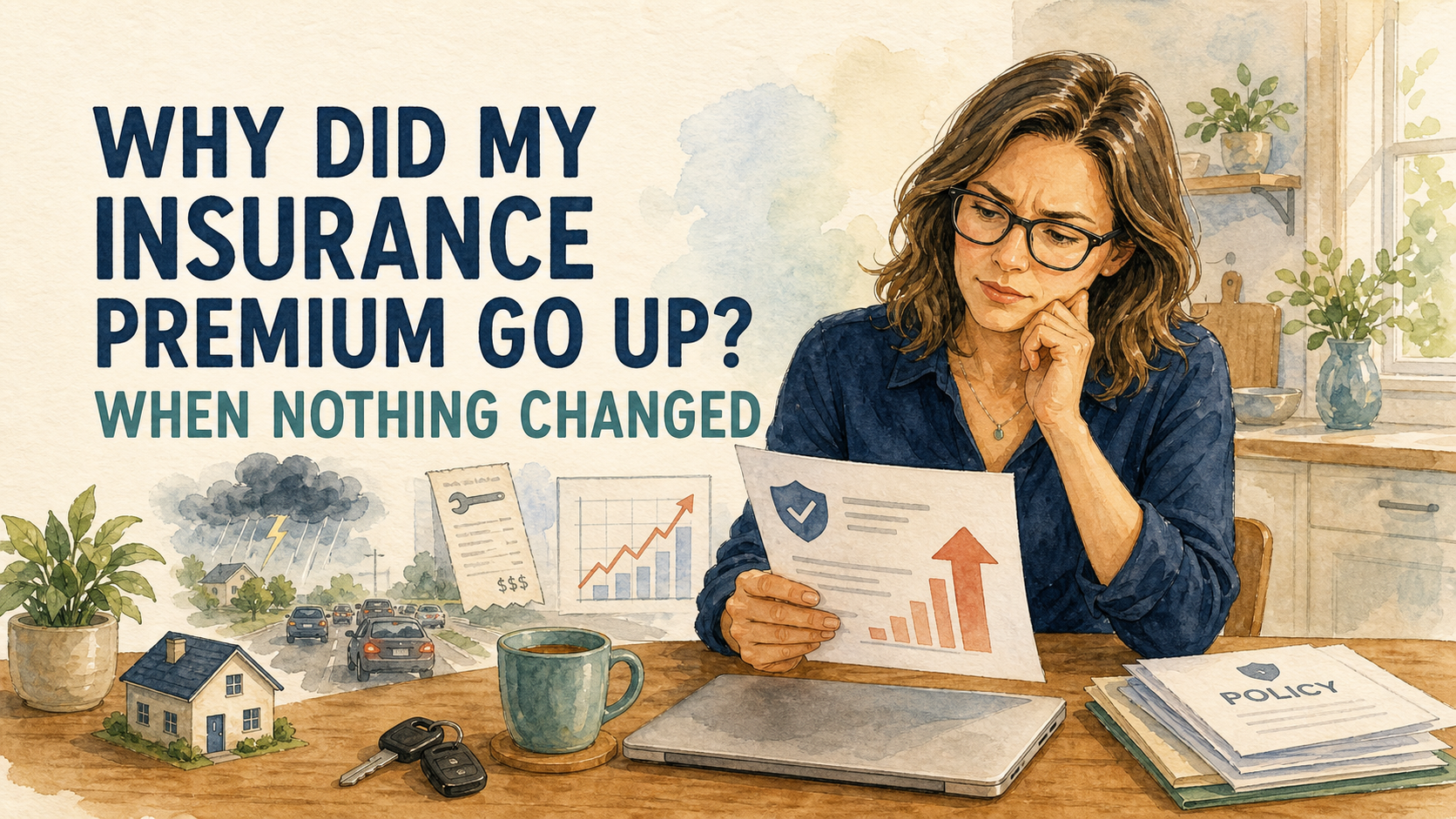
    You open your insurance renewal.

    And there it is.

    A higher premium.

    Again.

    So you start running through the list.

    No claims.

    No tickets.

    Same house.

    Same car.

    Same people.

    You certainly didn’t call the insurance company and ask them to make anything more expensive.

    So why did your insurance premium go up when nothing changed?

    Here’s the frustrating answer:

    Something probably did change.

    It just may not have been you.

    Your Insurance Price Isn’t Based Only on What You Do

    This is probably one of the biggest misunderstandings about insurance pricing.

    It feels personal because it’s your bill.

    So when the price goes up, naturally you start looking at yourself.

    Did I file a claim?

    Get a ticket?

    Change coverage?

    Move?

    Add a driver?

    Those things can matter.

    But your own history is only part of the picture.

    Insurance companies are also looking at the cost of claims, the risks they’re insuring, and other pricing factors that can change even when your life looks exactly the same.

    So:

    “I didn’t do anything.”

    and

    “Nothing affecting my insurance price changed.”

    aren’t always the same thing.

    If insurance pricing already feels like another language, Insurance Is Confusing: Insurance Basics in Plain English is a good place to start.

    Repairs May Cost More Than They Used To

    Let’s start with something pretty ordinary.

    Stuff gets more expensive.

    Cars are a great example.

    A bumper isn’t always just a bumper anymore.

    There may be sensors.

    Cameras.

    Radar.

    And other technology tucked into what still looks like a fairly ordinary piece of plastic.

    That can make repairs more expensive.

    Homes have the same problem.

    Labor costs change.

    Building materials change.

    Replacement costs change.

    If it costs insurers more to repair or replace damaged property, that can eventually show up in insurance pricing.

    You didn’t change your car.

    The cost of fixing your car may have changed.

    Medical Costs Can Affect Insurance Prices Too

    Not every insurance claim is about damaged property.

    Some involve injuries.

    And medical care can get expensive very quickly.

    If the cost of treating injuries rises, the expected cost of certain claims can rise too.

    Again:

    You didn’t go to the doctor.

    You didn’t have an accident.

    But what a future claim might cost can still change.

    Insurance pricing isn’t based only on what happened to you last year.

    Insurers are also trying to estimate what future losses may cost.

    There May Be More Insurance Claims Around You

    Your own claim history can matter.

    But broader claim patterns can matter too.

    An area may be seeing more:

    • Storm damage
    • Theft
    • Auto accidents
    • Water losses
    • Wildfires
    • Other costly events

    That doesn’t mean your insurer looks at your neighbor’s claim and sends you their bill.

    It means broader patterns of losses and risk can affect insurance pricing.

    Your house may still be sitting exactly where it was last year.

    The cost or risk of insuring homes in that area may have changed.

    Weather Doesn’t Need Your Permission

    This is especially important with property insurance.

    Severe weather can create enormous insured losses.

    Hurricanes.

    Hail.

    Wind.

    Wildfires.

    Winter storms.

    And other major weather events.

    You may have gone years without filing a homeowners claim.

    Wonderful.

    That doesn’t mean insurers haven’t been paying large claims elsewhere.

    You didn’t have the storm.

    The insurance market did.

    Your Insurance Company May Have Changed Its Rates

    Insurance companies don’t necessarily charge the same rates forever.

    Their pricing can change based on things such as claims experience, expected losses, expenses, market conditions, and other rating factors.

    Rate rules and approval requirements can also vary by insurance type and state.

    So your renewal may increase even when your personal information looks basically the same.

    That’s why I don’t love:

    “My insurance went up for no reason.”

    There’s usually a reason.

    The frustrating part is that the reason may not be obvious from looking at the new bill.

    First, Make Sure Your Coverage Really Didn’t Change

    Before blaming the entire insurance industry, though, let’s check the policy.

    Pull out last year’s information and the new renewal.

    Put them next to each other.

    Did a coverage limit increase?

    Did the insured value of your home change?

    Did an endorsement change?

    Did a deductible change?

    Was something added?

    Was something removed?

    Some coverage amounts may also change over time.

    With homeowners insurance, for example, an estimated rebuilding amount may change as construction costs change.

    So you may genuinely be thinking:

    “I didn’t change anything.”

    while something inside the policy did.

    Check.

    And if you’re not sure what limits, deductibles, or coverage mean, go back to Insurance Basics in Plain English before you start comparing numbers.

    Check Whether Any Insurance Discounts Changed

    This one is easy to miss.

    Maybe you had a discount last year.

    Now you don’t.

    Or maybe the amount changed.

    Depending on the insurer, discounts can be connected to things such as:

    • Bundling policies
    • Claims history
    • Driving history
    • Good-student eligibility
    • Telematics or usage-based programs
    • Automatic payments
    • Paperless billing
    • Protective devices
    • Other insurer-specific programs

    Maybe a temporary discount ended.

    Maybe you stopped qualifying for one.

    Maybe you changed another policy that affected a bundle.

    The base rate isn’t always the only thing moving.

    Ask:

    “Did any of my discounts change at renewal?”

    That one question can clear up a lot.

    And if you’re counting on a bundle discount, remember that a discount doesn’t automatically mean the final price is the lowest available. I walk through that in Does Bundling Insurance Actually Save Money?.

    Something in Your Life May Have Changed Without Feeling Like an Insurance Change

    Sometimes something really did change.

    It just didn’t feel like an insurance event when it happened.

    Maybe you:

    • Moved
    • Changed your commute
    • Added a driver
    • Bought another vehicle
    • Started using your car differently
    • Renovated your home
    • Installed a new roof
    • Started working from home
    • Started a home-based business
    • Bought something valuable

    Some changes may raise the price.

    Some may lower it.

    Some may affect coverage more than price.

    I wouldn’t try to guess.

    I’d just make sure the insurer has accurate information.

    Credit-Based Insurance Information May Matter in Some States

    Depending on the state and type of insurance, an insurer may be allowed to use certain credit-based insurance information as one factor in pricing or underwriting.

    The rules vary, and some states restrict or prohibit its use.

    So don’t assume this applies to you.

    If you’re trying to understand a premium increase, ask your insurer what factors affected the renewal and whether credit-based insurance information played a role where its use is permitted.

    There’s no reason to guess when you can ask.

    Your Agent May Not Be the Person Setting the Price

    If you work with an insurance agent, it’s tempting to call and say:

    “Why did you raise my insurance?”

    Your agent may be able to explain the increase, review your coverage, and look for options.

    But the agent may not personally set the insurance company’s rates.

    I’d make the call more useful:

    “My renewal increased even though I haven’t had any claims or major changes. Can you help me figure out what changed?”

    Now we’re investigating.

    Much better.

    Find Out How Much Your Insurance Actually Increased

    I know.

    The bill is higher.

    You noticed.

    But get specific.

    Last year:

    $1,860

    This year:

    $2,070

    Difference:

    $210

    That’s about an 11.3% increase.

    Now we have something useful.

    Because:

    “My insurance went up!”

    could mean $36 a year.

    Or $936.

    Those are very different conversations.

    Look at both the dollar amount and the percentage increase.

    Ask the Insurance Company What Changed

    You don’t need a fancy script.

    Try:

    “My renewal premium increased from $1,860 to $2,070. I haven’t had any claims or major changes. Can you help me understand what changed?”

    Then ask:

    • Did my coverage change?
    • Did any discounts change?
    • Did any rating information change?
    • Was there a general rate increase?
    • Did I lose any discounts?
    • Are there discounts I may now qualify for?
    • Would changing my deductible affect the premium?
    • Are there coverage options I should review?

    That’s a productive phone call.

    Don’t Cut Coverage Just to Get Back to the Old Price

    This is where a higher premium can lead to a second problem.

    Your insurance goes up $40 a month.

    You want the $40 gone.

    So you start cutting things.

    Lower a limit.

    Raise a deductible.

    Drop coverage.

    Done.

    Maybe the bill is back where you want it.

    But what did you give up?

    That’s the question.

    There’s nothing wrong with reviewing coverage when the premium changes.

    You should.

    Just don’t make:

    “Get my bill back to $X.”

    the only goal.

    Make sure the insurance still does what you need it to do.

    That’s also one of the common insurance mistakes that can cost you later: focusing on the price without checking what changed in the coverage.

    Raising the Deductible May Help—But Check the Numbers

    A higher deductible may lower the premium.

    But don’t stop there.

    Ask what the actual savings would be.

    Then compare that with the additional amount you’d have to come up with after a covered loss.

    If increasing your deductible by $1,000 saves you $4.17 a month, I’d want you to notice that before clicking Accept.

    Numbers first.

    Decision second.

    Check Whether Bundling Is Still Saving You Money

    Maybe you bundle home and auto.

    Or renters and auto.

    And your insurer tells you there’s a bundle discount.

    Great.

    But having a discount and having the lowest total cost are not the same thing.

    If your premium increased enough to make you uncomfortable, compare the bundled price with other options.

    Maybe the bundle still wins.

    Maybe separate companies work better.

    Does Bundling Insurance Actually Save Money? walks through how to compare that without looking at the discount percentage alone.

    A Big Premium Increase May Be a Good Reason to Shop Around

    You don’t need to change insurance companies every time your premium moves a few dollars.

    But a meaningful renewal increase is a perfectly reasonable reason to see what else is available.

    Just compare similar insurance.

    Try to keep the same:

    • Coverage types
    • Limits
    • Deductibles
    • Drivers
    • Property information
    • Other important details

    Otherwise, you may think you found a much cheaper quote when you actually found less insurance.

    That’s exactly what the Insurance Checkup & Quote Comparison Workbook on the Talkin With Emma Tools page is designed to help with.

    Compare the insurance first.

    Then compare the price.

    Another Insurance Company May Be Cheaper Today—Not Forever

    Suppose you shop around.

    Current insurer:

    $2,070

    New insurer:

    $1,720

    That’s $350 a year.

    Interesting.

    Maybe switching makes sense.

    But don’t turn:

    “This company is cheaper today.”

    into:

    “This company will always be cheaper.”

    Rates can change.

    Discounts can change.

    Your life can change.

    You make today’s decision with today’s information.

    Then you review it again when you need to.

    Loyalty Is Fine. Overpaying Out of Habit Isn’t Required.

    Maybe you’ve been with the same insurer for 14 years.

    You like them.

    They handled a claim well.

    Your agent is terrific.

    Those things have value.

    Price isn’t everything.

    But being a longtime customer doesn’t mean you have to accept any renewal price without looking at it.

    You can appreciate good service and still compare your options.

    Maybe you stay.

    Maybe you leave.

    Either way, you made a decision.

    You didn’t just let the renewal happen to you.

    Don’t Cancel Your Old Insurance Until the New Policy Is Confirmed

    If you find a better option, coordinate the switch carefully.

    Make sure you know when the new policy actually starts before ending the old one.

    You don’t want to respond to an annoying premium increase by accidentally creating a lapse in coverage.

    That would be an impressive escalation.

    Confirm the new policy.

    Then deal with the old one.

    So, Why Did Your Insurance Premium Go Up?

    Maybe your coverage changed.

    Maybe a discount changed.

    Maybe your insurer changed its rates.

    Maybe repairs cost more.

    Maybe medical claims cost more.

    Maybe losses increased in your area.

    Maybe something in your own information changed.

    Maybe several things happened at once.

    A higher insurance premium doesn’t automatically mean you did something wrong.

    And it doesn’t mean you have to quietly pay it without asking questions.

    Start here:

    1. Compare your renewal with the previous policy.
    2. Check your coverage limits and deductibles.
    3. Check your discounts.
    4. Calculate the actual dollar and percentage increase.
    5. Ask your insurer or agent what changed.
    6. Decide whether the new price still makes sense.

    And if it doesn’t?

    Shop.

    Not angrily.

    Not randomly.

    Just compare your options.

    Sometimes the answer to:

    “Why did my insurance premium go up?”

    is understanding what changed.

    And sometimes it’s understanding what changed…

    then getting three new quotes anyway.

    What?

    If you want help understanding how premiums, deductibles, limits, and coverage fit together, visit the Talkin With Emma Books page and take a look at Let’s Talk About Insurance.

    If you’re ready to compare your current policy with new quotes, the Insurance Checkup & Quote Comparison Workbook gives you one place to organize the numbers.

    And if you need help with insurance rules or consumer questions where you live, you can find your state regulator through the NAIC State Insurance Department Directory.

    — Emma

    A Quick Note Before You Go

    This article is for general educational and informational purposes only and isn’t individualized insurance, financial, legal, or tax advice. Insurance premiums, rating factors, discounts, underwriting practices, rate changes, and regulatory requirements vary by insurance type, insurer, policy, and state. Contact your insurer or a licensed insurance professional for information about your specific premium and coverage, and consult your state insurance regulator or another qualified professional when appropriate.

    Share This Conversation
  • 8 Insurance Mistakes That Can Cost You Thousands

    Nobody buys insurance hoping to use it.

    You buy it, pay the bill, and hope it sits there quietly doing absolutely nothing.

    That’s the best-case scenario.

    The problem is that insurance mistakes tend to stay hidden while nothing is happening. You can go months—or years—thinking everything is fine.

    Then there’s an accident, a storm, a theft, or some other very bad Tuesday, and suddenly the details matter.

    A lot.

    The good news is you don’t have to become an insurance expert to avoid some of the most expensive mistakes.

    You just need to know what to look for.

    Here are eight common insurance mistakes I’d start with.

    1. Buying the Cheapest Insurance Policy Without Checking Why It’s Cheaper

    Everybody likes saving money.

    If two companies seem to be offering the same insurance and one costs $40 less a month, of course you’re going to look at the cheaper one.

    I would too.

    But there’s one word in that sentence that matters:

    Seem.

    Two insurance quotes can have very different coverage even when they look similar at first glance.

    One might have a $500 deductible while the other has a $1,500 deductible.

    One may have higher coverage limits.

    Another may leave out coverage that’s included in the more expensive quote.

    That doesn’t mean the cheaper policy is bad. It might be exactly what you need.

    Just make sure you know what you’re giving up—if anything—to get that lower price.

    Think about it this way.

    Saving $30 a month puts $360 back in your pocket over a year.

    That’s great.

    But if getting that savings means taking on thousands of dollars of additional financial risk you didn’t realize you were accepting, that’s a different decision.

    Compare the coverage first.

    Then compare the price.

    If insurance language makes that difficult, start with Insurance Is Confusing: Insurance Basics in Plain English.

    And if you’re comparing quotes, the Insurance Needs Checkup & Quote Comparison Workbook can help you put premiums, deductibles, limits, and coverage side by side instead of comparing price alone.

    2. Choosing a Deductible You Couldn’t Actually Pay

    Higher deductibles can sometimes mean lower premiums.

    And when you’re trying to bring an insurance bill down, raising the deductible can look pretty attractive.

    But there’s another side to that decision.

    You may actually have to pay it.

    Suppose increasing your deductible from $500 to $2,000 saves you money every month.

    Fine.

    Now imagine something happens next Thursday.

    Could you come up with that $2,000?

    Not eventually.

    Not after three paychecks.

    When you need it.

    If the answer is no, that cheaper premium may have created a different financial problem.

    That doesn’t mean everyone should choose the lowest possible deductible. A lower deductible can make the premium more expensive, and you may be perfectly comfortable taking on more of the cost yourself.

    The number just needs to work with your finances.

    That’s the part that can get forgotten when we’re clicking through quote screens trying to make the monthly payment smaller.

    Before raising a deductible, look at your savings and ask yourself whether you could realistically handle it.

    If you couldn’t, at least you know the tradeoff you’re making.

    3. Assuming Something Is Covered Just Because You Have Insurance

    This may be one of the easiest insurance mistakes to make.

    You have homeowners insurance, so everything involving your house is covered.

    You have auto insurance, so everything involving your car is covered.

    You have health insurance, so every medical expense is covered.

    Except insurance generally doesn’t work that way.

    Policies have limits, conditions, and exclusions. Different types of coverage handle different risks.

    And sometimes the thing you assumed was covered isn’t.

    You don’t want to discover that while standing in your kitchen looking at water where water definitely isn’t supposed to be.

    Before you need the policy, get a basic understanding of what it covers—and what it doesn’t.

    You don’t have to read every page tonight.

    Start with the big stuff:

    • What events are covered?
    • What isn’t covered?
    • What are your limits?
    • What’s your deductible?
    • Are there situations where you may need separate or additional coverage?

    If you’re looking at those questions thinking, “I don’t even know where I’d find that,” don’t worry.

    Insurance policies aren’t exactly famous for being relaxing reading.

    Start with Insurance Is Confusing: Insurance Basics in Plain English if you need help with the language before digging into your actual policy.

    4. Carrying Too Little Coverage Because the Number Sounds Big

    Insurance numbers can be deceptive.

    $50,000 sounds like a lot of money.

    So does $100,000.

    Until you’re dealing with something that costs more.

    Imagine causing a serious accident involving several people.

    Or significant damage to your home.

    Suddenly the number doesn’t seem quite as enormous.

    The question isn’t whether your coverage limit sounds big when you say it out loud.

    It’s whether that limit makes sense for the financial risk you’re trying to protect against.

    And here’s where I’d be careful.

    There isn’t one magic coverage number that’s right for everybody.

    Your property, income, savings, debts, dependents, and ability to handle a financial loss can all affect the conversation.

    Instead of asking:

    “Is $100,000 a lot?”

    Try:

    “What am I trying to protect, and what happens if the loss is bigger than my insurance?”

    That’s a much more useful question.

    If you haven’t thought through what you’re protecting, the Insurance Needs Calculator can help you organize the pieces.

    It isn’t there to hand you a magic number and tell you what to buy.

    It’s there to help you see your situation more clearly.

    You can also read Do You Have Enough Insurance? 7 Signs Your Coverage May Need a Second Look for a broader coverage check.

    5. Forgetting to Update Your Insurance When Life Changes

    Insurance is remarkably good at sitting quietly in the background.

    Your life isn’t.

    You move.

    Get married.

    Get divorced.

    Have a baby.

    Buy something expensive.

    Start working from home.

    Add a teenage driver.

    Make improvements to the house.

    Start a side business that turns into an actual business.

    Meanwhile, the insurance policy you bought three years ago is still sitting there based on information from three years ago.

    That’s worth thinking about.

    Not every change requires different insurance.

    But some changes can affect what you’re protecting, who’s covered, how property is used, or how much financial risk you’re carrying.

    So when something significant changes, add one more question to the list:

    “Do I need to tell my insurance company about this?”

    It might take a five-minute phone call to find out.

    Five minutes now beats discovering later that something important was never updated.

    Not sure whether your current coverage still fits your life? Do You Have Enough Insurance? 7 Signs Your Coverage May Need a Second Look walks through some of the signs that it may be time for a review.

    6. Having No Record of What You Own

    Quick experiment.

    Without walking around your home, make a list of everything you own.

    Not just the expensive things.

    Everything.

    How’d you do?

    Probably not great.

    Most of us couldn’t come close.

    Now imagine trying to do it after a fire, major theft, or another disaster.

    You’re already dealing with the event itself, and now you’re trying to remember which television you owned, when you bought the laptop, what was in the closet, and whether you still have the receipt for a couch you bought four years ago.

    That’s not the moment I’d want to start building the list.

    A basic home inventory can make that job much easier.

    And this doesn’t have to become a six-week cataloging project.

    Walk through your home with your phone and take photos or video.

    Pay particular attention to higher-value items.

    Keep receipts or purchase records for major purchases when you have them.

    And store the information somewhere you could still access if something happened to your home.

    It doesn’t have to be perfect.

    Something is a whole lot better than trying to recreate everything from memory on one of the worst days of your year.

    7. Letting Your Insurance Coverage Lapse

    This one sounds obvious.

    Don’t let your insurance lapse.

    Done.

    Except lapses don’t always happen because someone deliberately decides, “You know what? I don’t need insurance anymore.”

    A payment gets missed.

    A credit card expires.

    Automatic payment doesn’t go through.

    A renewal notice goes to an old email address.

    Money gets tight and you tell yourself you’ll catch up next paycheck.

    Life happens.

    The danger is assuming you’re covered when you’re not.

    Depending on the type of insurance and where you live, a lapse can create more problems than simply being uninsured during that period. There may be legal or contractual requirements involved, and getting coverage again may not look exactly like picking up where you left off.

    If you’re struggling to afford a premium, don’t just ignore the bill and hope for the best.

    Call the insurer.

    Ask about your options.

    Review the policy.

    Shop around if you need to.

    See whether changing a deductible or adjusting optional coverage makes sense for your situation.

    And if your price suddenly increased, read Why Did My Insurance Premium Go Up When Nothing Changed? before assuming cancellation is your only option.

    Just make those decisions deliberately.

    Because finding out your policy isn’t active after something happens is about as bad as insurance surprises get.

    8. Waiting Until You Have a Claim to Learn How Claims Work

    Picture this.

    Something just happened.

    Maybe someone hit your car.

    Maybe a storm damaged your house.

    Maybe you came home and discovered something was stolen.

    You’re upset. You’re trying to figure out what happened. You’ve got phone calls to make and probably a dozen other things competing for your attention.

    And now seems like the perfect time to learn how an insurance claim works?

    Not really.

    Yet that’s when a lot of us first think about it.

    You don’t need to memorize your insurance company’s entire claims process in advance.

    You should, however, have a rough idea of what you’d need to do.

    Know how to contact your insurer.

    Know where your policy information is.

    Understand that documentation can matter.

    Depending on what happened and whether it’s safe to do so, that might mean photos, video, receipts, estimates, police or incident reports, or simply keeping notes about what happened and when.

    And keep copies of things.

    Emails.

    Documents.

    Receipts.

    Claim numbers.

    Names of people you speak with.

    If you’ve ever tried to remember the details of a phone conversation three months later, you already know why.

    There’s another reason I want you to understand the basics before there’s a claim.

    You may discover something about your coverage that you didn’t realize.

    And I’d much rather you discover that while sitting comfortably at your kitchen table than while dealing with whatever caused the claim.

    For now, the goal is simple.

    Know where your policy is.

    Know who you’d call.

    And if something happens, document what you can.

    That’s enough to put you several steps ahead of figuring everything out from scratch on a very bad day.

    If insurance terms are part of what makes this feel harder, grab the free Talkin With Emma Insurance Terms Cheat Sheet.

    The Expensive Part Usually Isn’t the Insurance Mistake

    It’s what happens afterward.

    Choosing a deductible that’s too high may not hurt you today.

    It becomes a problem when you need $2,000 next week and don’t have it.

    Not knowing your coverage limit isn’t costing you anything while everything is going well.

    It matters when a loss goes beyond that limit.

    Skipping the home inventory saves you twenty minutes today.

    It doesn’t feel quite as convenient when you’re trying to remember everything you owned after it’s gone.

    And not knowing how claims work isn’t particularly important while you don’t have one.

    Until you do.

    That’s what makes insurance tricky.

    A lot of the decisions don’t feel important when you make them because nothing bad is happening at the time.

    So don’t wait for something bad to make you look.

    Pick one policy.

    Not every policy you own.

    One.

    Look at the deductible.

    Find the coverage limits.

    Make sure you understand, at least generally, what’s covered and what isn’t.

    Check that the information on the policy still matches your life.

    And figure out where you’d start if you ever had to make a claim.

    Then you’re done for today.

    Seriously.

    Go do something more interesting.

    You Don’t Need to Become an Insurance Expert

    You just need to understand what you’re buying well enough to spot the decisions that could come back and bite you later.

    And yes, there’s more to it than we’ve covered here.

    A lot more.

    That’s why I wrote Let’s Talk About Insurance: A Friendly Conversation to Make Sense of Insurance.

    The book goes deeper into deductibles, limits, exclusions, different types of coverage, figuring out what you may need, comparing options, and the other pieces that are difficult to squeeze into one blog post without making you regret clicking on it.

    The goal isn’t to turn you into someone who talks about insurance at dinner parties.

    Please don’t do that to your friends.

    The goal is much simpler.

    Understand enough to ask good questions.

    Know what you’re paying for.

    And try to find the expensive surprises before they become expensive.

    That’s a pretty good place to start.

    — Emma

    A Quick Note Before You Go

    This article is for general educational purposes and isn’t individualized insurance, financial, legal, or tax advice. Insurance products, requirements, coverage, and policy terms vary by policy, insurer, and location. Review your policy documents and consider speaking with a licensed insurance professional about your individual situation.

    Share This Conversation
  • Do You Have Enough Insurance? 7 Signs Your Coverage May Need a Second Look

    Do You Have Enough Insurance? 7 Signs Your Coverage May Need a Second Look

    Most of us don’t spend much time thinking about insurance once we buy it.

    We pick a policy, make the payments, toss the paperwork in a drawer—or, more realistically, somewhere in our email—and get on with life.

    Which is fine.

    Until life changes and the insurance doesn’t.

    Maybe you’re making more money than you were a few years ago. Maybe you bought a house, got married, had a baby, paid off some debt, or somehow accumulated a garage full of stuff you definitely don’t remember buying.

    Or maybe money has gotten tighter.

    Any of those things can change what you need from your insurance.

    That doesn’t mean you should run out and buy more coverage. It doesn’t even mean there’s anything wrong with what you have now.

    It just means it might be worth taking another look.

    Here are seven signs it’s probably time.

    1. You Picked Your Insurance Mostly Because It Was Cheaper

    I understand this one.

    When you’re looking at two insurance quotes and one is $95 a month while the other is $112, that extra $17 gets your attention.

    Why pay more if you don’t have to?

    Sometimes the cheaper policy really is the better deal.

    But first, make sure you’re comparing the same thing.

    That $95 policy might have a higher deductible. Maybe the coverage limits are lower. Maybe the $112 policy includes something the cheaper one doesn’t.

    Now the comparison looks a little different.

    This is where insurance shopping can get frustrating. You’re staring at several quotes with different numbers, different coverage and different terminology, trying to remember which company offered what.

    Don’t compare the price by itself.

    Put the quotes next to each other and look at the coverage, limits and deductibles along with the premium.

    And if you’re staring at three quotes trying to remember which one had the $1,000 deductible and which one had the better limits, that’s exactly why we made the Insurance Checkup and Quote Comparison Worksheet. It gives you one place to put everything side by side.

    No more flipping between six browser tabs.

    2. You Couldn’t Tell Me Your Coverage Limits

    You don’t need to answer this out loud.

    But if I asked how much coverage your insurance actually provides, would you know?

    A lot of people wouldn’t.

    They know the monthly payment. They might know the deductible. Beyond that, things get fuzzy pretty quickly.

    That’s worth fixing.

    You don’t have to memorize every number on every policy. I certainly wouldn’t expect you to.

    But you should have a general idea of how much protection you’re paying for.

    Here’s why.

    Say something happens and the total financial loss is $100,000. If the applicable limit on your policy is $50,000, having insurance doesn’t magically make the other $50,000 disappear.

    Exactly what happens depends on the policy and circumstances, of course, but this is why those numbers matter.

    If you pull out your policy and the terminology immediately makes you want to close it again, start with our Insurance Is Confusing: A Beginner’s Guide to the Basics.

    Learn enough to know what you’re looking at.

    Then come back to the policy.

    3. Your Money Situation Looks Different Now

    Think back to when you bought the policy.

    Was money tighter?

    Were you earning less?

    Did you have less in savings?

    Or maybe things have gone the other direction. Your expenses are higher now. Your emergency fund took a hit. That comfortable cushion isn’t quite as comfortable as it used to be.

    Insurance decisions don’t happen in a vacuum. What you can afford to handle yourself matters too.

    Suppose your policy has a $1,000 deductible.

    Maybe you could pay that tomorrow and be annoyed about it, but otherwise be okay.

    For someone else, $1,000 means the rent is going to be short or groceries are going on a credit card for the next couple of months.

    Same deductible.

    Very different financial situation.

    That’s the question I’d rather have you think about:

    If something went wrong tomorrow, how much could you realistically handle on your own?

    Not theoretically.

    Not if everything went perfectly.

    Realistically.

    Once you know that, you can make much better decisions about where you need insurance to step in.

    4. Something Big Has Changed in Your Life

    Insurance has a funny way of staying exactly where we left it while everything around it changes.

    You get married.

    Have a child.

    Get divorced.

    Buy a house.

    Move.

    Change jobs.

    Start a business.

    Retire.

    Maybe your teenager starts driving, which is an adventure all by itself.

    Those aren’t just life events. They can change what you’re protecting and who depends on you.

    That doesn’t mean every life change requires a new policy.

    It means it’s worth asking a very simple question:

    Does the insurance I bought for my old life still make sense for the life I have now?

    Sometimes the answer will be yes.

    Great. You’re done.

    But I’d rather find that out now than after something happens.

    5. You Own More Than You Think You Do

    This one sneaks up on us.

    A television here.

    A laptop there.

    New furniture. Clothes. Tools. Kitchen appliances. Sports equipment. Jewelry. Maybe you’ve been slowly upgrading things around the house.

    None of those purchases felt enormous when you made them.

    Put several years of them together and suddenly you’ve accumulated quite a bit.

    Try a little experiment.

    Walk through your home and look around as if none of it belonged to you.

    What would it actually cost to replace the things you see?

    Not what you paid for them ten years ago.

    What would replacing them cost now?

    You don’t need to count every coffee mug.

    We’re looking for the bigger picture.

    If you haven’t thought about that number in years, your estimate of what you own may be stuck several years in the past too.

    6. You Can’t Remember the Last Time You Looked at Your Policies

    Paying the insurance bill doesn’t count.

    Neither does opening the renewal email long enough to see how much the premium went up.

    I’m talking about actually looking at the policy.

    If you can’t remember the last time you did that, you’re in very good company.

    Nobody is cancelling Saturday night plans because they can’t wait to review their insurance coverage.

    Still, every once in a while it’s worth checking.

    Maybe your deductible doesn’t make sense anymore.

    Maybe something in your life has changed.

    Maybe you’re paying for something you no longer need.

    Maybe everything looks fine.

    That’s allowed too.

    An insurance review doesn’t have to uncover a problem to be worthwhile.

    Sometimes the best outcome is simply being able to say, “Yep. I know what I have, and I’m comfortable with it.”

    Then put it away and go enjoy your Saturday.

    7. You Don’t Know What Would Happen If You Actually Had to Use Your Insurance

    This is the one I’d pay the most attention to.

    Imagine something happens tomorrow.

    A car accident. A kitchen fire. A tree decides your roof looks like a comfortable place to lie down.

    Whatever it is.

    Do you know what happens next financially?

    What would you pay?

    What would your insurance pay?

    Where might there be a gap?

    If you’re thinking, “Emma, I have absolutely no idea,” that’s okay.

    It doesn’t automatically mean you don’t have enough insurance.

    You may just not know enough about the coverage you already have.

    And that’s a much easier problem to start fixing.

    Pick one policy.

    Look at what you’re protecting. Check the limits. Find the deductible. Think about what you could reasonably afford to pay yourself if something happened.

    If you’re not sure where to begin, that’s what our free Insurance Needs Calculator is for. It can help you organize what you’re protecting and think through the areas that may deserve a closer look.

    It’s not there to tell you that you need to buy more insurance.

    It’s there to help you figure out what questions you should be asking.

    So…Do You Have Enough Insurance?

    Maybe you do.

    That’s not a very dramatic answer, I know.

    But anyone who tells you there’s one perfect amount of insurance for everybody is skipping over an important part of the conversation:

    We’re not all protecting the same life.

    Someone renting an apartment with a healthy emergency fund and no dependents is looking at a very different financial picture from someone with a mortgage, two kids, two cars and savings they’ve spent twenty years building.

    So don’t start with, “How much insurance am I supposed to have?”

    Start smaller.

    What am I protecting?

    What could seriously hurt me financially?

    How much could I handle myself?

    And where would I need my insurance to take over?

    You don’t have to solve your entire insurance life tonight.

    Start with one policy.

    Seriously. Just one.

    Find it.

    Look at the coverage. Find your deductible. Check the limits.

    If you understand what you’re looking at and everything still makes sense for your life today, great.

    One less thing to worry about.

    If it doesn’t make sense—or you realize you don’t understand half of what you’re reading—now you know what to work on.

    If You’re Still Thinking, “Okay, But What Does All This Insurance Stuff Mean?”

    That’s why we’re writing Let’s Talk About Insurance.

    There is a lot more behind the questions we’ve talked about here: how deductibles work, why coverage limits matter, what exclusions can mean, how different types of insurance fit together, and how to think about the amount of protection you actually need.

    Trying to squeeze all of that into this article would turn it into a small book.

    So we wrote the book instead.

    Let’s Talk About Insurance starts at the beginning and walks through insurance in plain English. No assumption that you already understand the terminology. No jumping ten steps ahead.

    Just insurance explained like a normal conversation.

    Until then, you don’t need to become an insurance expert.

    Learn what you have.

    Understand what you’re protecting.

    Ask questions when something doesn’t make sense.

    That’s enough to get started.


    This article is for general educational purposes and isn’t individualized insurance, financial, legal, or tax advice. Insurance products, requirements, coverage and policy terms vary. Review your policy documents and consider speaking with a licensed insurance professional about your individual situation.

    Share This Conversation
  • Insurance Is Confusing: Insurance Basics in Plain English

    Insurance Is Confusing: Insurance Basics in Plain English

    If you’ve ever looked at an insurance policy and thought, “Okay… I have no idea what any of this means,” you’re not alone.

    Insurance has its own language—premiums, deductibles, coverage limits, exclusions, claims—and somehow you’re expected to understand it before deciding what you’re buying.

    The good news? You don’t need to become an insurance expert.

    You just need to understand a few insurance basics so you know what you’re looking at and what questions to ask.

    Let’s make it easier.

    So, What Is Insurance?

    At its simplest, insurance is a way to help protect you from certain financial losses.

    You pay an insurance company a premium for coverage. If something happens that your policy covers, the insurance company may help pay for the loss.

    But that last part matters: the loss has to be covered under the terms of your policy.

    Your policy tells you what is covered, what isn’t, how much the company may pay, and what you may have to pay yourself.

    That’s why understanding the basics of your policy matters more than simply knowing what it costs.

    5 Insurance Terms Worth Knowing

    You don’t need to memorize an insurance dictionary.

    Start with these five:

    Premium: What you pay for your insurance coverage.

    Deductible: The amount you generally pay toward a covered loss before certain insurance coverage pays its part.

    Coverage: What your policy is designed to protect against.

    Limit: The most your insurance company will pay for a particular covered loss or type of coverage.

    Claim: A request you make to your insurance company for payment or coverage after something happens that may be covered by your policy.

    You’ll run into plenty of other insurance words, but these five give you a good place to start.

    Want something you can keep nearby? Grab the free Talkin With Emma Insurance Terms Cheat Sheet.

    It can help when you’re reading a policy, reviewing your coverage, or comparing quotes.

    What Are the Main Types of Insurance?

    Different types of insurance protect against different kinds of financial risk.

    Auto insurance can help protect you from certain financial losses involving your vehicle and your responsibility to other people.

    Homeowners and renters insurance can help protect your home or belongings and may also include liability coverage.

    Health insurance helps with certain healthcare costs according to the terms of your plan.

    Life insurance can provide a death benefit to your beneficiaries when you die, subject to the policy’s terms.

    Disability insurance can help replace part of your income if a covered disability prevents you from working.

    That doesn’t mean everyone needs every type of insurance.

    What makes sense for you depends on what you own, what you owe, who depends on you, and what kinds of losses would be difficult for you to handle yourself.

    What Should You Look at Before Buying Insurance?

    When you compare insurance policies, don’t look at the price alone.

    Ask:

    • What is covered?
    • What isn’t covered?
    • What are the deductibles?
    • What are the coverage limits?
    • Are there important exclusions?
    • What could I have to pay myself if something happened?

    Two policies can look almost identical at first and still have important differences.

    That’s why the cheapest quote isn’t automatically the best choice—and the most expensive policy isn’t automatically better.

    This is also where people can make some costly mistakes. If you’re reviewing your coverage, read 8 Common Insurance Mistakes That Can Cost You Thousands for a few things worth checking.

    If you’re comparing several quotes, the Insurance Checkup and Quote Comparison Worksheet gives you one place to put the premiums, deductibles, limits, and coverage side by side so you can see what you’re actually comparing.

    Why Did My Insurance Premium Change?

    Even when your own situation hasn’t changed much, your insurance price can.

    Companies may consider many factors when setting or renewing rates, and those factors can vary by insurer, policy, location, and type of insurance.

    So if your renewal arrives and the price suddenly looks different, don’t assume you did something wrong.

    Start by looking at what changed.

    I walk through that question in more detail here: Why Did My Insurance Premium Go Up When Nothing Changed?

    How Much Insurance Do You Need?

    This is one of the questions I hear most often.

    And unfortunately, there isn’t one magic number.

    Your answer may depend on your income, savings, property, debts, and whether anyone else depends on you financially.

    It can also depend on how much of a loss you could realistically handle yourself.

    The goal isn’t necessarily to buy the most insurance you can afford.

    It’s to understand what you’re trying to protect and what could happen financially if something went wrong.

    If you’re wondering whether your current coverage still fits your life, Do You Have Enough Insurance? 7 Signs Your Coverage May Need a Second Look is a good next read.

    You Don’t Have to Learn Insurance All at Once

    Insurance can feel complicated when you’re first trying to understand it.

    That’s okay.

    Start with the insurance basics.

    Learn a few important words. Look at the coverage you already have. Ask questions when something doesn’t make sense. And when you compare policies, look beyond the price.

    You don’t need to know everything about insurance.

    You just need enough information to understand what you’re buying and ask better questions.

    If you’re ready to go deeper, Let’s Talk About Insurance: A Friendly Conversation to Make Sense of Insurance walks through the basics step by step and gives you practical tools you can use along the way.

    And if you just need a quick reference, grab the free Talkin With Emma Insurance Terms Cheat Sheet here.

    You’ve got this. ♡

    — Emma

    A Quick Note Before You Go

    This article is for general educational information and isn’t personal insurance advice. Insurance rules, requirements, coverage, and policy terms can vary by state, company, and individual policy. Always review the actual policy and consider speaking with a licensed insurance professional about your situation.

    Share This Conversation