
You got paid Friday.
It’s Tuesday.
You didn’t buy a television. You didn’t book a vacation. You didn’t even go anywhere particularly interesting.
And somehow there’s $347 left.
Okay.
Before we blame the coffee, let’s figure out what actually happened.
When money disappears faster than you expected, it’s easy to assume you’re spending too much.
Maybe you are.
But maybe your bills have crept up. Maybe groceries cost more than you realized. Maybe six little automatic charges hit at once. Maybe you’ve been spending $12 here and $18 there without noticing how quickly those numbers add up.
Or maybe the math simply doesn’t work anymore.
That’s important too.
We’re not going to start with what you should be spending.
We’re going to find out what you actually are spending.
Then we can do something useful with it.
First, Don’t Start With a Budget
I know.
We’re talking about money, and I’m telling you not to make a budget.
Yet.
A budget works much better when it’s based on real numbers.
If you sit down and write:
Groceries: $400
Gas: $150
Eating out: $100
because those numbers seem reasonable, you’ve created a lovely budget for a person who may or may not exist.
We need yours.
Before deciding where your money should go next month, let’s find out where it went last month.
Pull up your bank account. Grab your credit card statement too, if you use one regularly.
We’re looking at roughly the last 30 days.
No judgment. No guilt. No promising that you’ll never order takeout again.
We’re investigating.
Meet Bills, Life, Extras and Mystery
We’re going to make this very complicated.
Four categories.
That’s it.
Take the spending from the last month and sort it into:
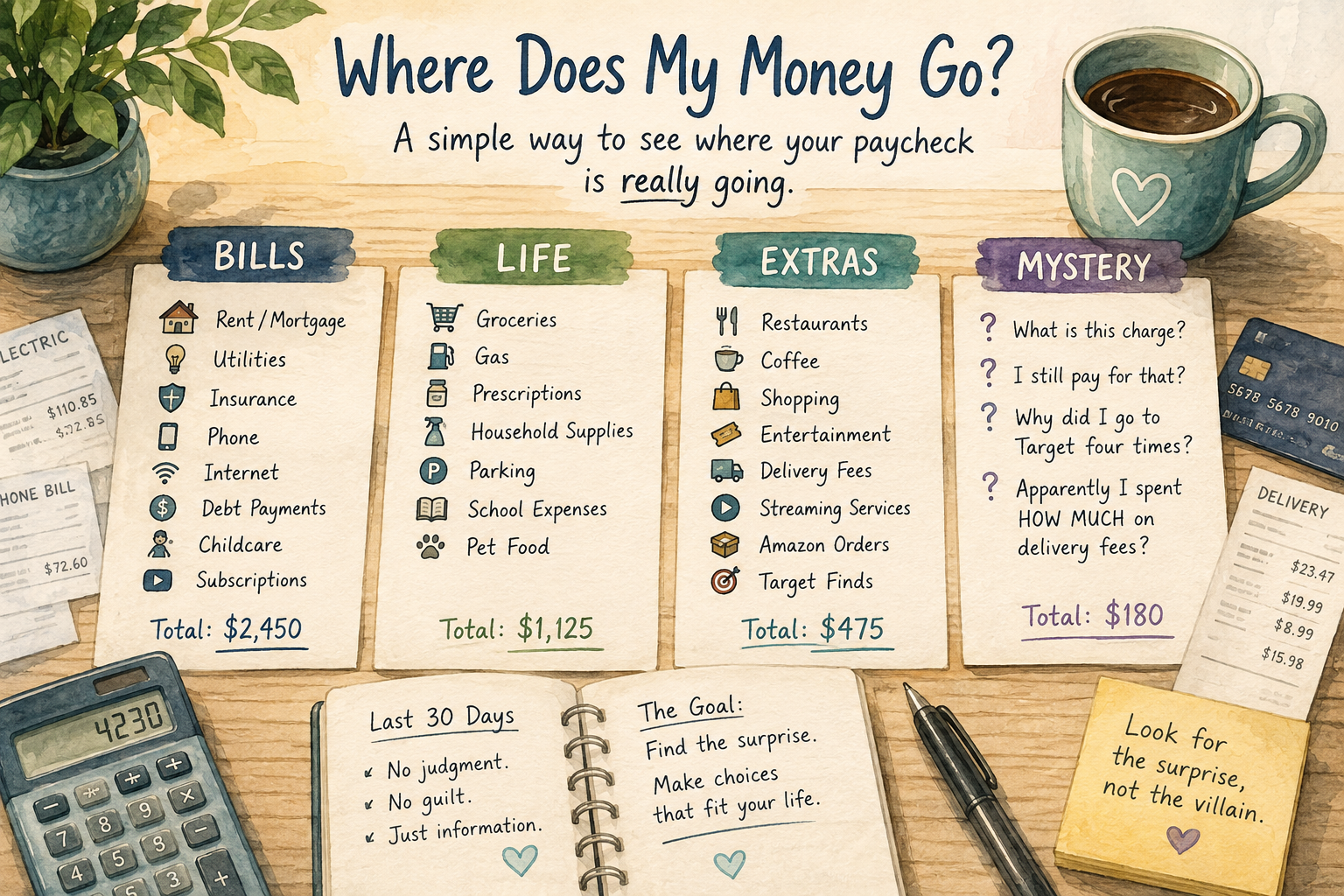
Bills
These are the things that show up because life apparently requires a subscription fee.
Rent or mortgage. Utilities. Insurance. Phone. Internet. Minimum debt payments. Childcare. Regular subscriptions.
Anything you’re committed to paying on a recurring basis belongs here.
Some of these amounts may change a little month to month. That’s fine.
We’re looking for the basic cost of keeping your life running.
Life
This is the everyday stuff.
Groceries. Gas. Prescriptions. Household supplies. Parking. School expenses. Pet food.
The things you buy because people, cars, houses and apparently dogs require constant maintenance.
These aren’t necessarily fixed bills, but they’re also not exactly optional.
You have to eat. You may have to drive to work.
The dog remains strangely unwilling to purchase his own food.
Life costs money.
Put it here.
Extras
Here’s where things get interesting.
Restaurants. Coffee. Shopping. Entertainment. Delivery fees. Streaming services you could live without. Random Amazon orders.
That thing Target convinced you was essential even though you went in for toothpaste.
Extras aren’t bad.
Let me say that again.
Extras aren’t bad.
Money is allowed to make your life enjoyable.
We’re not creating a budget where you sit at home in the dark eating beans while congratulating yourself on your financial discipline.
We just want to know how much is going here.
Mystery
You knew this category was coming.
Mystery is:
“What is this $27.43 charge?”
“I still pay for that?”
“Why did I go to Target four times?”
“Apparently I spent how much on delivery fees?”
These are the transactions you didn’t remember making, charges you don’t recognize immediately, subscriptions you’d forgotten about, and little purchases that somehow became a much bigger number when you added them together.
Mystery is often where we learn something.
Not necessarily something we wanted to learn.
But something useful.
Add Up Your Monthly Spending
Once everything has a home, total each category.
Let’s say you end up with:
Bills: $2,450
Life: $1,125
Extras: $475
Mystery: $180
Now we’re getting somewhere.
Maybe you expected Extras to be the problem and discover they really aren’t.
Maybe Bills are eating far more of your income than you realized.
Maybe groceries have quietly climbed by $200 a month.
Maybe Mystery contains four subscriptions and $96 worth of fees you’d barely noticed.
This is why we looked before we started cutting.
You can’t fix a money problem very well when you’re guessing what the problem is.
Look for the Surprise, Not the Villain
Personal finance loves finding villains.
Coffee. Avocado toast. Streaming services. Eating out.
Whatever we’re all supposedly doing wrong this year.
I’m less interested in finding something to blame.
I want to find the surprise.
What number made you stop and say:
“Wait. Really?”
Maybe it’s groceries.
Maybe it’s insurance.
Maybe it’s takeout.
Maybe it’s a collection of $9.99 charges quietly having a party in your checking account.
That’s where I’d look first.
Because the biggest opportunity isn’t always where somebody on the internet told you it would be.
It’s where your numbers say it is.
Check the Small Stuff—But Don’t Obsess Over It
Small purchases add up. They absolutely do.
Five dollars here. Twelve dollars there. Do that often enough and eventually we’re talking about real money.
But I don’t want you spending forty minutes feeling guilty about a $4 coffee while ignoring the $175 bill that might be worth investigating.
I’d look at the big numbers first.
Housing. Transportation. Insurance. Debt payments. Phone. Internet. Subscriptions. Groceries.
Then look at the smaller stuff.
If you’re spending $160 a month on something you barely use, that’s interesting.
If you’re spending $18 a month on something you genuinely enjoy and can afford?
Maybe we leave it alone.
Not every expense needs to be optimized within an inch of its life.
Look for Money That’s Leaving Automatically
Automatic payments are wonderful.
Until you forget about them.
Go through your transactions and look specifically for recurring charges.
Streaming services. Apps. Cloud storage. Memberships. Software. Subscriptions.
Anything else that quietly renews while you’re busy doing something more interesting.
Here are three questions I like:
Do I still use this?
Would I notice if it disappeared?
Would I sign up for it again today at this price?
That last one is my favorite.
Something you happily paid $8 for three years ago might now cost $17.99.
And apparently nobody thought to ask whether you were still enjoying yourself.
If you’d happily buy it again, great.
If you wouldn’t?
That’s one worth looking at.
Then Look at the Expenses You Can’t Just Cancel
This part matters.
Sometimes you go through everything and discover there really isn’t much nonsense.
You’re not secretly spending $600 a month on lattes. You’re not paying for fourteen streaming services. You’re not ordering packages every afternoon.
Your rent is high.
Groceries are high.
Gas isn’t cheap.
And your paycheck hasn’t kept up.
Sometimes the numbers are tight because the numbers are tight.
That’s useful information too.
Instead of asking:
“How do I stop wasting money?”
we can start asking:
“Which of these bigger expenses might actually be changeable?”
Maybe insurance is worth shopping.
Maybe it’s worth checking whether the phone or internet bill can be reduced.
Maybe a debt payment needs a larger strategy.
Maybe income is part of the problem.
None of those is necessarily an easy fix.
But at least we’re looking at the real problem instead of blaming a cup of coffee for something it didn’t do.
Don’t Forget the Bills That Don’t Come Every Month
Car registration. Birthdays. Annual subscriptions. Car maintenance. Vet visits.
They don’t happen every month, but they still take money when they arrive.
That’s why I like to remember:
Not monthly doesn’t mean unexpected.
For now, make note of the expenses you notice that come around occasionally.
We’ll talk separately about how to plan for them instead of letting them surprise the budget every time.
Now We Can Make a Budget
This is where budgeting becomes useful.
Because now we’re not inventing numbers.
We know roughly what Bills cost. We know what Life costs. We’ve seen Extras. We’ve investigated Mystery.
And we’ve started noticing expenses that don’t happen every month.
Now you can decide what you want the next month to look like.
Maybe you want to reduce takeout by $75.
Maybe there are two subscriptions you no longer want.
Maybe you’d like to set aside $50 for car maintenance or start putting $25 toward emergency savings.
Whatever makes sense for your situation.
If you use a budgeting worksheet or other budgeting tool, this is also where it becomes much more useful.
Instead of staring at blank categories and guessing what numbers you’re supposed to put in them, you can start with what you just found:
Real income. Real bills. Real spending.
Then make adjustments from there.
That’s a budget you actually have a chance of using.
Don’t Try to Fix Everything at Once
You’ve gone through the numbers.
You’ve discovered six things you’d like to change.
Excellent.
Please don’t change all six tomorrow.
Pick one or two places to start.
Maybe you cancel something you don’t use. Maybe you try a different grocery target. Maybe you move $25 into savings on payday.
Give yourself a chance to see whether the change actually works.
Then adjust again.
Money habits are much easier to change when we’re not trying to reinvent our entire financial life on a Sunday afternoon.
Do This Again Next Month
Not forever.
I’m not asking you to spend the rest of your life categorizing every $6 purchase.
Do it again next month.
See what changed.
Did Mystery get smaller?
Did the grocery number surprise you again?
Did you actually save the $75 you planned to save?
Did something completely different happen?
That’s how you turn a budget from something you wrote once into something that actually reflects your life.
Eventually, you won’t need to investigate quite so much.
You’ll know your numbers.
So…Where Did Your Money Go?
Maybe you spent more on Extras than you realized.
Maybe your Bills have quietly climbed.
Maybe Life simply costs more than it used to.
Maybe Mystery was having a particularly good month.
Or maybe you discover you’re actually doing a pretty decent job with the money you have.
That’s worth knowing too.
This isn’t about catching yourself doing something wrong.
It’s about stopping the guessing.
Pull the statements. Look at the last 30 days.
Sort the spending into:
Bills. Life. Extras. Mystery.
Find the surprise.
Then decide what you want to change.
That’s when a budget starts becoming useful.
Not because somebody handed you percentages and told you what your life should cost.
Because you finally know what your life costs.
And that’s a much better place to start.
More Money conversations are coming to Talkin With Emma. We’ll keep working through this stuff one question at a time.
This article is for general educational and informational purposes only and isn’t intended as individualized financial, investment, tax, or legal advice. Everyone’s financial situation is different. Consider your own circumstances and, when appropriate, consult a qualified financial or other professional before making significant financial decisions.