

Tag: budgeting

  • Why Does My Bank Account Say I Have Money When I’m Still Broke?

    Why Does My Bank Account Say I Have Money When I’m Still Broke?

    You check your bank account and see $600.

    For about three seconds, that feels pretty good.

    Then you remember the electric bill comes out tomorrow.

    Car insurance is due Friday.

    You bought groceries yesterday, but that charge is still sitting there as pending.

    And at least some of that money needs to stay right where it is because rent is coming.

    So, yes. There is $600 in your account.

    That does not mean you have $600 to spend.

    This is one of those money problems that gets much easier once somebody explains what is actually happening. Your bank balance is giving you useful information. It just is not giving you the whole picture.

    Let’s sort out the rest of it.

    What Does My Bank Balance Actually Tell Me?

    Your bank balance tells you how much money is in the account according to the transactions your bank has processed.

    That’s important.

    But your bank does not know your plan.

    It does not know that you need $150 of that money for the electric bill.

    It does not know that you need enough gas to get through next week.

    It definitely does not know that the $100 sitting there is the beginning of the money you are setting aside for your car registration.

    You know those things.

    That’s why I don’t want you making spending decisions based only on the big number at the top of your banking app.

    That number answers:

    How much money is in my account?

    What we really need to know is:

    How much of that money is actually available for me to spend?

    Those are not always the same number.

    What Is the Difference Between My Current Balance and Available Balance?

    Your banking app may show you a current balance and an available balance.

    They sound like they should make everything perfectly clear.

    Naturally, they do not.

    Your current balance generally reflects the transactions that have already posted to your account.

    Your available balance usually does a little more work for you. It may account for pending transactions or holds the bank already knows about.

    So if you spent $60 at the grocery store this morning and that transaction is still pending, your available balance may give you a better picture of what is actually left.

    That’s helpful.

    But there is still a problem.

    Your bank only knows about the things your bank knows about.

    If your $175 utility bill is due Thursday but has not been paid yet, your bank cannot reserve that $175 for you.

    If you need $80 for groceries until payday, your bank does not set that aside.

    If your car registration is due next month, your banking app is not going to tap you on the shoulder and say, “Emma, maybe leave some of this alone.”

    That’s your part of the job.

    Why Can I Have Money in the Bank and Still Be Broke?

    Because some of that money may already belong to something else.

    Let’s say you have $600 available right now.

    Before you get paid again, you need:

    • $175 for utilities
    • $125 for car insurance
    • $100 for groceries
    • $60 for gas
    • $75 for another bill

    That’s $535.

    You still have $600 in the bank.

    But $535 already has somewhere to go.

    That leaves $65 that is not already committed.

    Now imagine looking at that $600 balance and deciding a $100 purchase is fine because you have plenty of money in the account.

    You do have enough to make the purchase.

    You just don’t have enough to make the purchase and do everything else that money needs to do.

    That’s the part that gets us.

    The purchase works today.

    The problem shows up Friday.

    How Do I Know How Much Money I Can Actually Spend?

    We can make this pretty simple.

    Start with the money you have available.

    Then subtract the money you need before more income comes in.

    Money available now − money already needed = money that is not committed

    Let’s try it.

    You have $900.

    Before your next paycheck, you need:

    • $500 for bills
    • $150 for groceries and gas
    • $100 for an expense you already know is coming

    So:

    $900 − $500 − $150 − $100 = $150

    That $150 is much more useful to me than the $900 at the top of the banking app.

    I think of it as safe-to-spend money.

    It is the money left after we have accounted for the things that need to happen first.

    Does that mean you need to immediately spend the whole $150?

    Of course not.

    It means you now know what you’re actually working with.

    And knowing is a lot easier to work with than hoping.

    Don’t Forget the Expenses That Don’t Happen Every Month

    Monthly bills usually aren’t the hardest ones to remember.

    Rent has a way of reminding us it exists.

    So does the electric company.

    It’s the other expenses that like to disappear for a while and then wander back into our lives asking for $300.

    Car registration.

    School expenses.

    Annual memberships.

    Holiday spending.

    Vet visits.

    Insurance premiums.

    Birthdays.

    Home repairs.

    Car maintenance.

    Medical copays.

    None of these is necessarily unexpected.

    We just don’t pay them every month, so they’re easy to leave out when we’re thinking about what our money needs to do.

    If this keeps happening to you, I talked more about why a budget can fail even when the math works.

    One simple thing you can do is start turning those larger future expenses into smaller current ones.

    Suppose you know you’ll need $300 six months from now.

    Finding $300 all at once might hurt.

    Setting aside $50 a month for six months may be much easier.

    Same $300.

    Much less drama.

    What If I Use Cash Instead of a Banking App?

    Good.

    This still works.

    You do not need an app, spreadsheet, online bank account, or fancy budgeting system to know what your money needs to do.

    If you use cash, envelopes can actually make this idea very easy to see.

    Maybe you have:

    • $200 in the rent envelope
    • $100 in groceries
    • $60 in gas
    • $75 in utilities
    • $50 in savings
    • $40 in spending money

    Altogether, you have $525.

    But you wouldn’t dump all six envelopes onto the table, count the money, and decide you have $525 available for dinner and shopping.

    The labels matter.

    Your rent money is still rent money.

    Your gas money is still gas money.

    And your $40 of spending money is the part you can spend without stealing from something else.

    A budget is doing the same job.

    You can keep yours on paper, in envelopes, on your phone, in a spreadsheet, or wherever it makes sense to you.

    I care much more about whether you know what the money is supposed to do than where you write it down.

    What If My Safe-to-Spend Number Is Negative?

    Let’s say you do the math and get this:

    Money available: $700

    Money you need before payday: $850

    Difference: -$150

    Well, that’s not the answer we were hoping for.

    But I would much rather you know about that $150 shortage now than discover it three days before payday.

    A negative number is information.

    It tells us we have a problem to solve.

    Now we can ask useful questions.

    What absolutely has to be paid before payday?

    What can wait?

    Is there a bill due date that can be moved?

    Is there an expense we can reduce this time?

    Is this a one-time problem, or are we coming up short by roughly the same amount every month?

    That last question matters.

    If this happens once because three unusual expenses landed in the same week, we solve this week.

    If you’re $150 short every single month, we have a bigger problem to work on.

    Neither problem gets easier by refusing to look at the number.

    Finding it early gives you time to make decisions.

    Do I Need a Complicated Budget to Do This?

    No.

    And I really don’t want you building a complicated budget just because somebody told you a “real” budget needs 47 categories and a color-coded spreadsheet.

    If you love spreadsheets, wonderful.

    Use one.

    If you would rather use a notebook and a pen, use those.

    If cash envelopes make sense to your brain, get the envelopes.

    Your budget needs to help you answer a few questions:

    What money is coming in?

    What needs to be paid?

    When does it need to be paid?

    What expenses do I know are coming later?

    What can I safely spend after I account for those things?

    If your system can answer those questions, we have something useful.

    We can make it prettier later.

    Your Bank Balance Needs Context

    I don’t want you to stop checking your bank balance.

    Please check it.

    We just aren’t going to ask that one number to do a job it cannot do.

    If your account says $600, then yes, you have $600 in the account.

    But your budget may tell you:

    $175 is for utilities.

    $125 is for insurance.

    $100 is for groceries.

    $60 is for gas.

    $75 is for another bill.

    And $65 is left.

    Now that $600 means something.

    That’s the difference.

    Instead of looking at your account and asking:

    “Do I have money?”

    Try asking:

    “What does this money need to do before I get paid again?”

    That question will tell you a lot more.

    Want Help Building a Budget That Actually Makes Sense?

    If you’ve tried budgeting before and it always seems to turn into a pile of numbers telling you what you can’t do, I wrote Let’s Talk About Budgeting to approach it differently.

    We start with your real money.

    Your real bills.

    Your real paydays.

    Your irregular expenses.

    Your goals.

    And, yes, the fact that sometimes life completely ignores the budget you carefully made for it.

    Then we build a system around that.

    Because the goal isn’t to make you good at budgeting.

    The goal is to make your money easier to understand and manage.

    Friendly conversations. Practical tools. Clear explanations.
    Share This Conversation
  • How to Lower Your Monthly Bills Without Making Yourself Miserable

    How to Lower Your Monthly Bills Without Making Yourself Miserable

    You need to spend less.

    Okay.

    So you start looking around.

    Cancel Netflix.

    Stop buying coffee.

    Never eat at a restaurant again.

    Apparently happiness has been removed from the budget.

    And after all that?

    You saved $31.

    This is my problem with a lot of advice about cutting expenses.

    Yes, little things add up.

    But so do big things.

    And if we’re trying to create some actual breathing room in your budget, I’d rather look for $50 in one place before chasing $2 in twenty-five places.

    So let’s go looking for the bigger stuff first.

    Start With the Bills That Come Back Every Month

    Recurring expenses are a good place to start because you usually only have to make the change once.

    Save $30 on something you buy one time?

    You saved $30.

    Lower a recurring bill by $30 a month?

    That’s $360 over a year if the savings continues.

    Much more interesting.

    Pull up your bank or credit card statements and look for the bills that keep coming back.

    Phone.

    Internet.

    Insurance.

    Subscriptions.

    Memberships.

    Software.

    Storage.

    Anything else you’re paying repeatedly.

    We’re not cancelling everything.

    We’re asking whether you’re still getting enough value for what you’re paying.

    Start With the Biggest Bills You Can Actually Change

    Your mortgage might be your biggest bill.

    That doesn’t mean you’re going to solve it this afternoon.

    We’re looking for expenses that are both:

    Big enough to matter.

    and

    Realistically changeable.

    Your phone bill might qualify.

    Internet might.

    Insurance might.

    A collection of subscriptions might.

    A service plan you signed up for four years ago and haven’t looked at since definitely deserves an invitation to this conversation.

    Start there.

    Call the Phone Company

    I know.

    Nobody woke up this morning hoping to spend part of the day talking to the phone company.

    Do it anyway.

    Look at your current plan.

    How much are you paying?

    What are you actually getting?

    Are you financing devices?

    Paying for insurance or add-ons?

    Using all the lines?

    Then look at what’s available now.

    Your provider may have a less expensive plan that still works for you. Another provider might too.

    Sometimes simply asking:

    “Are there any less expensive plans available that would still meet my needs?”

    can turn up an option you didn’t know existed.

    Don’t assume the plan you’ve had for five years is still the best deal.

    Companies change their offers.

    Your needs change too.

    Do the Same Thing With Internet

    Internet bills have a habit of starting at one number and eventually becoming another number entirely.

    Maybe a promotional rate expired.

    Maybe the price increased.

    Maybe you’re paying for speed you don’t need.

    Maybe equipment fees have quietly joined the party.

    Pull up the actual bill—not just the amount coming out of your account.

    What are you paying for?

    Then check what’s currently available.

    If there’s a lower-cost plan that meets your needs, ask about it.

    If a competitor has a better offer, that’s useful information too.

    You don’t necessarily have to switch.

    But knowing your options makes for a much more interesting phone call.

    Shop Your Insurance—Carefully

    Insurance can be another meaningful recurring expense.

    Auto.

    Homeowners.

    Renters.

    Other coverage you may have.

    If you haven’t compared rates in a while, getting quotes can be worth doing.

    But please don’t shop insurance by price alone.

    A quote that’s $40 cheaper isn’t necessarily a better deal if the coverage changed.

    Check:

    Coverage limits
    Deductibles
    Included coverages
    Exclusions or important differences
    Discounts

    Then compare the premium.

    If you want some help keeping those quotes straight, the Insurance Checkup & Quote Comparison Workbook gives you a place to put them side by side.

    A lower insurance bill is wonderful.

    A lower insurance bill because you accidentally removed protection you wanted?

    Less wonderful.

    Now Go Subscription Hunting

    Pull up your statements and find the recurring subscriptions.

    Streaming.

    Music.

    Apps.

    Cloud storage.

    Fitness.

    News.

    Gaming.

    Memberships.

    Software.

    Then ask three questions:

    Do I still use this?

    Would I notice if it disappeared?

    Would I sign up again today at this price?

    That last one catches a lot.

    Maybe you signed up when it was $7.99.

    Now it’s $15.99.

    Would you still buy it?

    If yes, keep it.

    We’re not cancelling things just because they cost money.

    If no?

    There you go.

    Don’t Cancel the Things That Make Your Life Better Just Because They’re Easy Targets

    Your $12 streaming subscription is visible.

    So it’s easy to attack.

    But maybe you use it five nights a week.

    You love it.

    Your family uses it.

    Meanwhile, you’re paying $38 a month for something you haven’t touched since February.

    Which one should go?

    Exactly.

    The goal isn’t to make your bank statement as joyless as possible.

    It’s to stop paying for things that aren’t doing enough for you.

    There’s a difference.

    Look for Fees

    Fees are particularly irritating because they often give you absolutely nothing in return.

    Bank fees.

    Late fees.

    ATM fees.

    Delivery fees.

    Convenience fees.

    Service fees.

    Fees that appear to exist because someone discovered they could charge a fee.

    Look through the last couple of months.

    Are any repeating?

    If you’re regularly paying account fees, see whether another account or institution could reduce them.

    If late fees keep appearing, would changing a due date or setting a reminder help?

    If delivery fees are adding up, maybe you still order food—but pick it up sometimes.

    We’re looking for places where your money is leaving and you’re getting very little in return.

    Check What You’re Paying for Convenience

    Convenience is worth money.

    Time has value too.

    Delivery, prepared food, same-day shipping, and services that save you time aren’t automatically bad.

    The problem is when the cost becomes invisible.

    Let’s say delivery adds $14 to an order.

    Once?

    Fine.

    Twice a week?

    Now we’re talking about roughly $100 or more in some months.

    Maybe that’s worth it to you.

    Great.

    Keep it.

    But make the decision knowing what it costs.

    “I spend about $100 a month on delivery because it makes our busiest nights easier” is a choice.

    “I had no idea we were spending $100 a month on delivery” is a discovery.

    We want choices.

    Look at Groceries Without Declaring War on Food

    Groceries are expensive.

    And advice like:

    “Just spend less at the grocery store”

    isn’t particularly useful.

    You need food.

    Instead of choosing some random amount to cut, look for patterns.

    Food that regularly gets thrown away.

    Multiple little grocery trips that somehow cost $46 every time.

    Impulse purchases.

    Things bought because they’re on sale even though nobody in the house actually likes them.

    That’s where I’d start.

    Reducing food waste by $20 a week is about $80 a month.

    And nobody had to survive on lentils for thirty consecutive days.

    Don’t Ignore Debt Payments

    Debt payments deserve a look too.

    If a big chunk of every paycheck is already spoken for before the month really gets going, write those payments down.

    How much are you paying toward credit cards, personal loans, or other debt every month?

    What are the interest rates?

    Which balances are costing you the most?

    We’re not solving debt in this article.

    That’s its own conversation.

    But eventually, paying off a debt can do more than reduce what you owe.

    It can remove an entire monthly payment.

    That’s when your budget really starts to breathe.

    For now, know the numbers.

    What About the Really Big Expenses?

    Housing.

    Transportation.

    Childcare.

    These can take enormous pieces of a budget.

    They’re also much harder to change.

    I’m not going to tell you:

    “Have you considered simply moving?”

    as though changing homes costs nothing and you can knock it out Tuesday afternoon.

    But if housing or transportation costs keep making the rest of your budget impossible, they may deserve a bigger conversation eventually.

    Some expenses can’t be fixed with one phone call.

    So work on the ones you can change now.

    Keep a Running Total of What You Find

    This is where things start getting satisfying.

    Cancelled unused app:

    $11 a month.

    Changed phone plan:

    $25.

    Reduced internet bill:

    $15.

    Cancelled membership:

    $20.

    Reduced delivery fees:

    $30.

    That’s $101 a month.

    Not life-changing money for everybody.

    But that’s $1,212 over a year if those savings continue.

    And we didn’t ban restaurants.

    Nobody confiscated your coffee.

    You didn’t have to turn the thermostat down to a temperature usually associated with food storage.

    We looked for expenses that weren’t giving you enough back.

    That’s a much more sustainable way to cut spending.

    Now Give the Savings a Job

    This may be the most important part.

    You lowered your bills by $101.

    Fantastic.

    What happens to the $101?

    If you don’t decide, there’s a pretty good chance it simply disappears into regular spending.

    A little more at the grocery store.

    An extra order.

    A couple of random purchases.

    Three months later, you’re wondering why you don’t feel any richer.

    So decide.

    Maybe:

    $40 goes to emergency savings
    $30 goes toward debt
    $20 goes toward an irregular expense
    $11 stays available for something fun

    Your answer can be completely different.

    This is where My Monthly Money Check-In can help.

    Go back through your numbers and replace the old bill amounts with the new ones.

    Then decide where you want the difference to go.

    You didn’t just cut an expense.

    You redirected money.

    That’s the part that actually changes something.

    Don’t Try to Do All of This Today

    Please don’t finish this article and immediately call seven companies.

    Pick one bill.

    Preferably one that could save enough money to be worth the trouble.

    Handle it.

    Then do another next week.

    This isn’t a financial emergency drill.

    We’re gradually making your monthly expenses work better.

    And if you spend twenty minutes on the phone and save $25 a month?

    That’s $300 a year for twenty minutes of annoyance.

    I’ve had worse meetings.

    Cutting Expenses Isn’t About Spending as Little as Possible

    That’s not the goal.

    The goal is having enough room in your budget for the things that matter.

    Bills.

    Food.

    Savings.

    Debt.

    Emergencies.

    And yes…

    Things you enjoy.

    If your budget only works when nothing fun ever happens, I’m not convinced it works.

    Spend intentionally.

    Keep the things that make your life better.

    Question the things that don’t.

    And pay particular attention to the expenses that come back month after month.

    Because a small recurring change can quietly become a pretty decent amount of money over a year.

    Start with one bill.

    See what you can change.

    Then give whatever you save a better job.

    That’s how we create breathing room without making life miserable in the process.

    Want a Little Help With the Next Step?

    If you’re reviewing insurance costs, the Insurance Checkup & Quote Comparison Workbook can help you compare coverage, limits, deductibles, and premiums side by side.

    If you’re working on your monthly spending, My Monthly Money Check-In gives you a simple place to see what came in, where it went, and what you want your money to do next.

    This article is for general educational and informational purposes only and isn’t intended as individualized financial, investment, tax, or legal advice. Everyone’s financial situation is different. Consider your own circumstances and, when appropriate, consult a qualified financial or other professional before making significant financial decisions.

    Share This Conversation
  • Where Does My Money Go? How to Find Where Your Paycheck Is Going

    Where Does My Money Go? How to Find Where Your Paycheck Is Going

    You got paid Friday.

    It’s Tuesday.

    You didn’t buy a television. You didn’t book a vacation. You didn’t even go anywhere particularly interesting.

    And somehow there’s $347 left.

    Okay.

    Before we blame the coffee, let’s figure out what actually happened.

    When money disappears faster than you expected, it’s easy to assume you’re spending too much.

    Maybe you are.

    But maybe your bills have crept up. Maybe groceries cost more than you realized. Maybe six little automatic charges hit at once. Maybe you’ve been spending $12 here and $18 there without noticing how quickly those numbers add up.

    Or maybe the math simply doesn’t work anymore.

    That’s important too.

    We’re not going to start with what you should be spending.

    We’re going to find out what you actually are spending.

    Then we can do something useful with it.

    First, Don’t Start With a Budget

    I know.

    We’re talking about money, and I’m telling you not to make a budget.

    Yet.

    A budget works much better when it’s based on real numbers.

    If you sit down and write:

    Groceries: $400
    Gas: $150
    Eating out: $100

    because those numbers seem reasonable, you’ve created a lovely budget for a person who may or may not exist.

    We need yours.

    Before deciding where your money should go next month, let’s find out where it went last month.

    Pull up your bank account. Grab your credit card statement too, if you use one regularly.

    We’re looking at roughly the last 30 days.

    No judgment. No guilt. No promising that you’ll never order takeout again.

    We’re investigating.

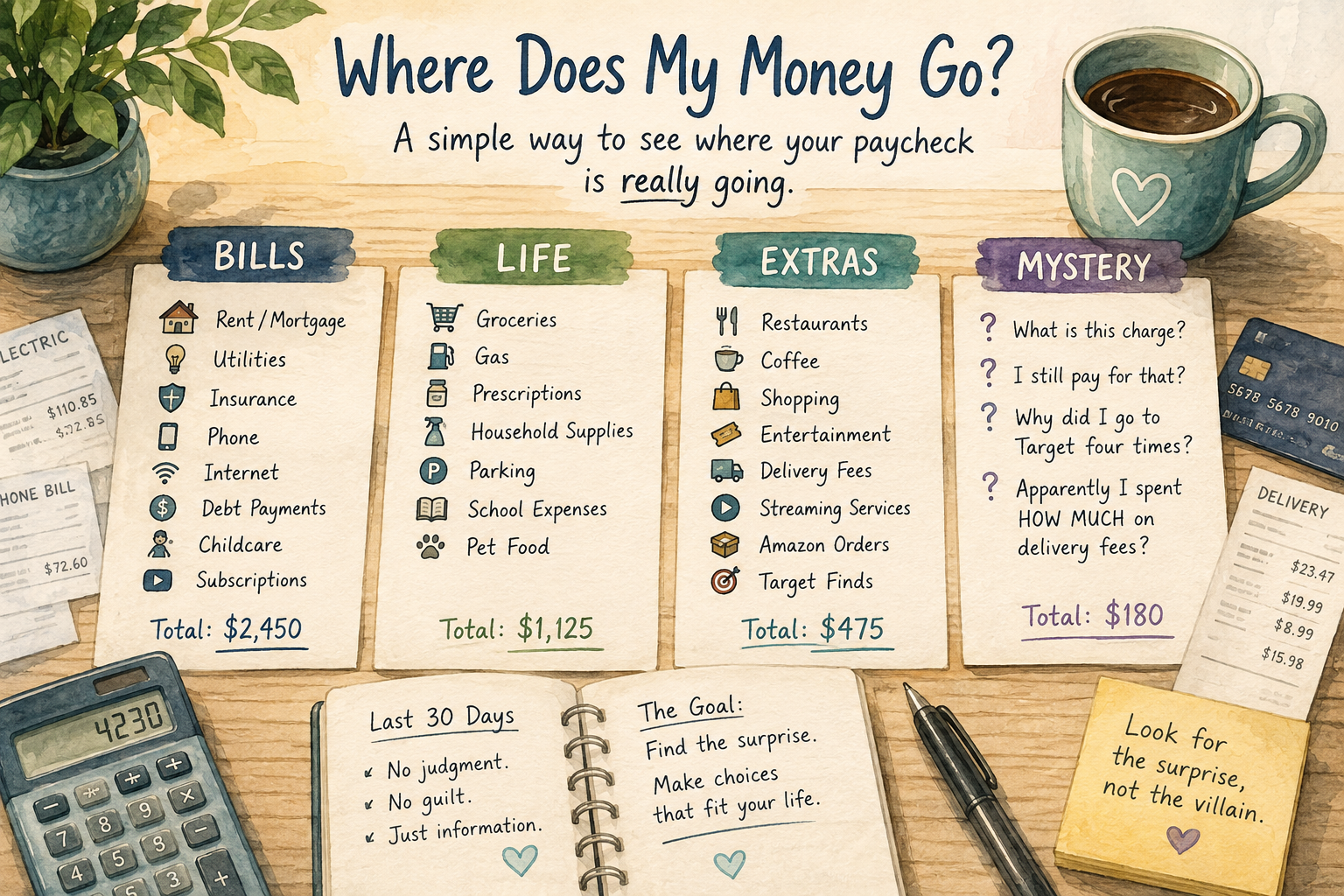
    Meet Bills, Life, Extras and Mystery

    We’re going to make this very complicated.

    Four categories.

    That’s it.

    Take the spending from the last month and sort it into:

    Bills

    These are the things that show up because life apparently requires a subscription fee.

    Rent or mortgage. Utilities. Insurance. Phone. Internet. Minimum debt payments. Childcare. Regular subscriptions.

    Anything you’re committed to paying on a recurring basis belongs here.

    Some of these amounts may change a little month to month. That’s fine.

    We’re looking for the basic cost of keeping your life running.

    Life

    This is the everyday stuff.

    Groceries. Gas. Prescriptions. Household supplies. Parking. School expenses. Pet food.

    The things you buy because people, cars, houses and apparently dogs require constant maintenance.

    These aren’t necessarily fixed bills, but they’re also not exactly optional.

    You have to eat. You may have to drive to work.

    The dog remains strangely unwilling to purchase his own food.

    Life costs money.

    Put it here.

    Extras

    Here’s where things get interesting.

    Restaurants. Coffee. Shopping. Entertainment. Delivery fees. Streaming services you could live without. Random Amazon orders.

    That thing Target convinced you was essential even though you went in for toothpaste.

    Extras aren’t bad.

    Let me say that again.

    Extras aren’t bad.

    Money is allowed to make your life enjoyable.

    We’re not creating a budget where you sit at home in the dark eating beans while congratulating yourself on your financial discipline.

    We just want to know how much is going here.

    Mystery

    You knew this category was coming.

    Mystery is:

    “What is this $27.43 charge?”

    “I still pay for that?”

    “Why did I go to Target four times?”

    “Apparently I spent how much on delivery fees?”

    These are the transactions you didn’t remember making, charges you don’t recognize immediately, subscriptions you’d forgotten about, and little purchases that somehow became a much bigger number when you added them together.

    Mystery is often where we learn something.

    Not necessarily something we wanted to learn.

    But something useful.

    Add Up Your Monthly Spending

    Once everything has a home, total each category.

    Let’s say you end up with:

    Bills: $2,450
    Life: $1,125
    Extras: $475
    Mystery: $180

    Now we’re getting somewhere.

    Maybe you expected Extras to be the problem and discover they really aren’t.

    Maybe Bills are eating far more of your income than you realized.

    Maybe groceries have quietly climbed by $200 a month.

    Maybe Mystery contains four subscriptions and $96 worth of fees you’d barely noticed.

    This is why we looked before we started cutting.

    You can’t fix a money problem very well when you’re guessing what the problem is.

    Look for the Surprise, Not the Villain

    Personal finance loves finding villains.

    Coffee. Avocado toast. Streaming services. Eating out.

    Whatever we’re all supposedly doing wrong this year.

    I’m less interested in finding something to blame.

    I want to find the surprise.

    What number made you stop and say:

    “Wait. Really?”

    Maybe it’s groceries.

    Maybe it’s insurance.

    Maybe it’s takeout.

    Maybe it’s a collection of $9.99 charges quietly having a party in your checking account.

    That’s where I’d look first.

    Because the biggest opportunity isn’t always where somebody on the internet told you it would be.

    It’s where your numbers say it is.

    Check the Small Stuff—But Don’t Obsess Over It

    Small purchases add up. They absolutely do.

    Five dollars here. Twelve dollars there. Do that often enough and eventually we’re talking about real money.

    But I don’t want you spending forty minutes feeling guilty about a $4 coffee while ignoring the $175 bill that might be worth investigating.

    I’d look at the big numbers first.

    Housing. Transportation. Insurance. Debt payments. Phone. Internet. Subscriptions. Groceries.

    Then look at the smaller stuff.

    If you’re spending $160 a month on something you barely use, that’s interesting.

    If you’re spending $18 a month on something you genuinely enjoy and can afford?

    Maybe we leave it alone.

    Not every expense needs to be optimized within an inch of its life.

    Look for Money That’s Leaving Automatically

    Automatic payments are wonderful.

    Until you forget about them.

    Go through your transactions and look specifically for recurring charges.

    Streaming services. Apps. Cloud storage. Memberships. Software. Subscriptions.

    Anything else that quietly renews while you’re busy doing something more interesting.

    Here are three questions I like:

    Do I still use this?

    Would I notice if it disappeared?

    Would I sign up for it again today at this price?

    That last one is my favorite.

    Something you happily paid $8 for three years ago might now cost $17.99.

    And apparently nobody thought to ask whether you were still enjoying yourself.

    If you’d happily buy it again, great.

    If you wouldn’t?

    That’s one worth looking at.

    Then Look at the Expenses You Can’t Just Cancel

    This part matters.

    Sometimes you go through everything and discover there really isn’t much nonsense.

    You’re not secretly spending $600 a month on lattes. You’re not paying for fourteen streaming services. You’re not ordering packages every afternoon.

    Your rent is high.

    Groceries are high.

    Insurance went up.

    Gas isn’t cheap.

    And your paycheck hasn’t kept up.

    Sometimes the numbers are tight because the numbers are tight.

    That’s useful information too.

    Instead of asking:

    “How do I stop wasting money?”

    we can start asking:

    “Which of these bigger expenses might actually be changeable?”

    Maybe insurance is worth shopping.

    Maybe it’s worth checking whether the phone or internet bill can be reduced.

    Maybe a debt payment needs a larger strategy.

    Maybe income is part of the problem.

    None of those is necessarily an easy fix.

    But at least we’re looking at the real problem instead of blaming a cup of coffee for something it didn’t do.

    Don’t Forget the Bills That Don’t Come Every Month

    Car registration. Birthdays. Annual subscriptions. Car maintenance. Vet visits.

    They don’t happen every month, but they still take money when they arrive.

    That’s why I like to remember:

    Not monthly doesn’t mean unexpected.

    For now, make note of the expenses you notice that come around occasionally.

    We’ll talk separately about how to plan for them instead of letting them surprise the budget every time.

    Now We Can Make a Budget

    This is where budgeting becomes useful.

    Because now we’re not inventing numbers.

    We know roughly what Bills cost. We know what Life costs. We’ve seen Extras. We’ve investigated Mystery.

    And we’ve started noticing expenses that don’t happen every month.

    Now you can decide what you want the next month to look like.

    Maybe you want to reduce takeout by $75.

    Maybe there are two subscriptions you no longer want.

    Maybe you’d like to set aside $50 for car maintenance or start putting $25 toward emergency savings.

    Whatever makes sense for your situation.

    If you use a budgeting worksheet or other budgeting tool, this is also where it becomes much more useful.

    Instead of staring at blank categories and guessing what numbers you’re supposed to put in them, you can start with what you just found:

    Real income. Real bills. Real spending.

    Then make adjustments from there.

    That’s a budget you actually have a chance of using.

    Don’t Try to Fix Everything at Once

    You’ve gone through the numbers.

    You’ve discovered six things you’d like to change.

    Excellent.

    Please don’t change all six tomorrow.

    Pick one or two places to start.

    Maybe you cancel something you don’t use. Maybe you try a different grocery target. Maybe you move $25 into savings on payday.

    Give yourself a chance to see whether the change actually works.

    Then adjust again.

    Money habits are much easier to change when we’re not trying to reinvent our entire financial life on a Sunday afternoon.

    Do This Again Next Month

    Not forever.

    I’m not asking you to spend the rest of your life categorizing every $6 purchase.

    Do it again next month.

    See what changed.

    Did Mystery get smaller?

    Did the grocery number surprise you again?

    Did you actually save the $75 you planned to save?

    Did something completely different happen?

    That’s how you turn a budget from something you wrote once into something that actually reflects your life.

    Eventually, you won’t need to investigate quite so much.

    You’ll know your numbers.

    So…Where Did Your Money Go?

    Maybe you spent more on Extras than you realized.

    Maybe your Bills have quietly climbed.

    Maybe Life simply costs more than it used to.

    Maybe Mystery was having a particularly good month.

    Or maybe you discover you’re actually doing a pretty decent job with the money you have.

    That’s worth knowing too.

    This isn’t about catching yourself doing something wrong.

    It’s about stopping the guessing.

    Pull the statements. Look at the last 30 days.

    Sort the spending into:

    Bills. Life. Extras. Mystery.

    Find the surprise.

    Then decide what you want to change.

    That’s when a budget starts becoming useful.

    Not because somebody handed you percentages and told you what your life should cost.

    Because you finally know what your life costs.

    And that’s a much better place to start.


    More Money conversations are coming to Talkin With Emma. We’ll keep working through this stuff one question at a time.

    This article is for general educational and informational purposes only and isn’t intended as individualized financial, investment, tax, or legal advice. Everyone’s financial situation is different. Consider your own circumstances and, when appropriate, consult a qualified financial or other professional before making significant financial decisions.

    Share This Conversation