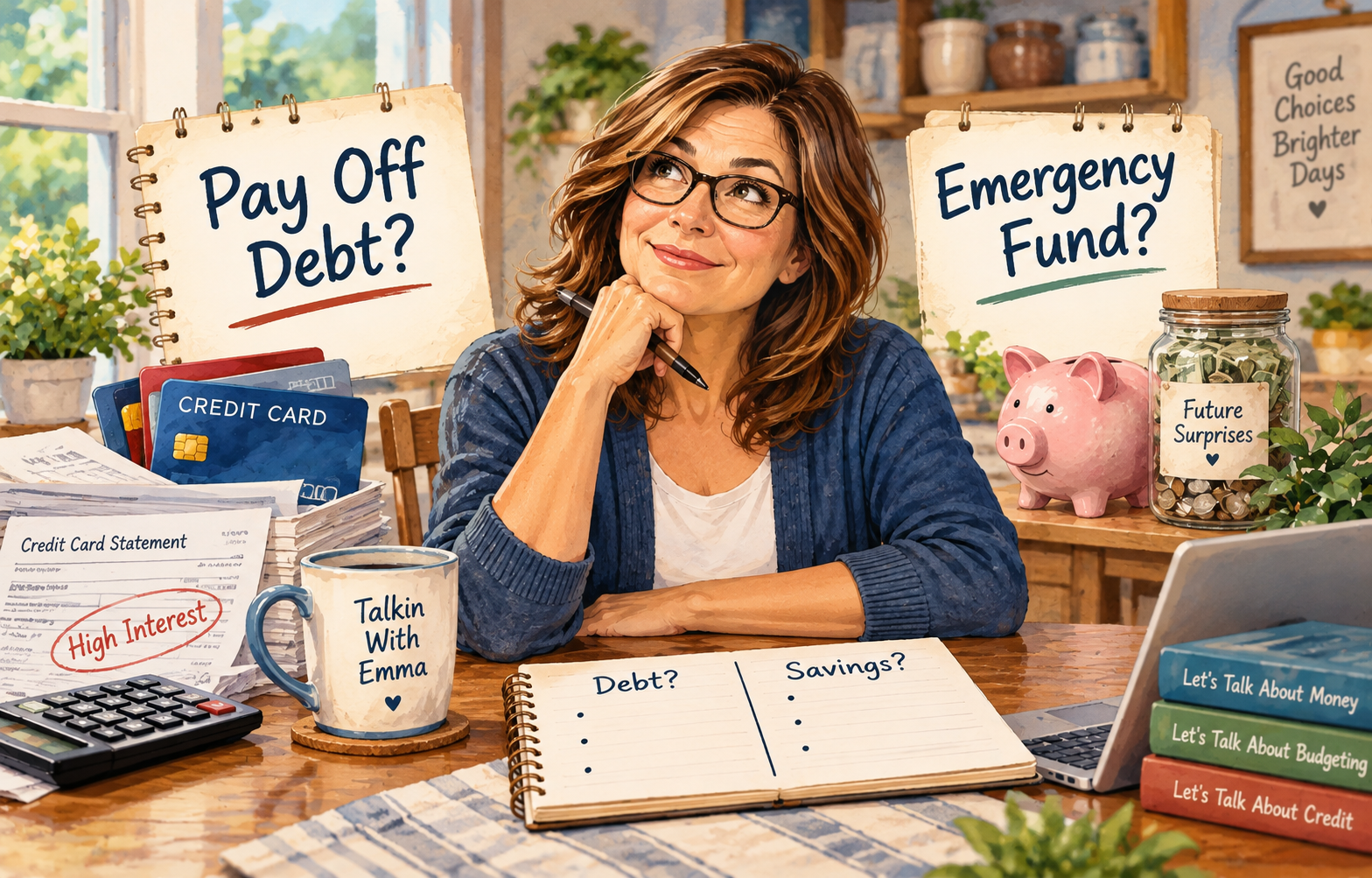
You have a little extra money. Should you put it toward your credit cards or save it for the next emergency? Let’s talk about how to decide.
If you have high-interest debt and little or no emergency savings, the best answer is often to do some of both. A small emergency fund can help keep an unexpected expense from becoming more debt, while paying extra toward high-interest balances can reduce the amount you spend on interest.
But how much should you save before focusing on debt? And does it make sense to keep money in savings when your credit card is charging 25% or 30% interest?
Those are good questions. Let’s work through them.
Why Is This Such a Difficult Decision?
Imagine you’ve managed to put aside an extra $500. That’s good news. You have a little breathing room, and now you want to make the most of it.
Your credit card has a $3,000 balance and charges 28% interest. You also have just $100 in savings.
You could put the entire $500 toward your credit card. That would reduce your balance and save you some interest. Or you could put the $500 in savings. That wouldn’t reduce your debt, but it would give you some cash if your car broke down or you needed an unexpected prescription.
Neither choice is unreasonable. The problem is that you’re trying to protect yourself from two different kinds of financial trouble. Your debt is costing you money right now. An emergency might cost you money tomorrow. The trick is finding a balance that helps with both.
Should I Build an Emergency Fund While I Still Have Credit Card Debt?
Usually, having at least a small amount of emergency savings is worthwhile, even when you’re paying off debt.
Suppose you put every available dollar toward your credit card. You’re making progress, and that feels good. Then your car needs a $400 repair. You don’t have the cash, so you put the repair on your credit card. Now some of the debt you just paid off is back.
That’s the problem an emergency fund helps prevent.
You don’t necessarily need three or six months of expenses saved before you begin paying down expensive debt. But having some cash available can keep a manageable surprise from turning into another borrowing decision.
If you’re starting with nothing, a first goal of $500 or $1,000 may be useful. Those are starting points, not universal requirements. Your actual target depends on your household, income, and likely emergencies.
Someone with a stable paycheck and few unexpected expenses may need a different starting cushion than someone whose income changes every month or who depends on an older vehicle to get to work.
But Doesn’t Saving Money Cost Me More in Credit Card Interest?
It can. And this is where the numbers matter.
Let’s use a simple example: a $3,000 credit card balance at 28% interest, $100 in emergency savings, and an extra $500 available.
If you put that $500 toward your credit card, you could avoid roughly $140 in interest over a year, assuming that $500 would otherwise remain outstanding for the entire year at the same rate.
If you put the $500 into a savings account earning 4%, it would earn approximately $20 over a year, assuming the rate stayed the same.
From a strictly mathematical standpoint, paying the credit card wins. But if you have no emergency savings and something goes wrong, you may have to borrow again. Depending on your available credit and circumstances, you might not even be able to borrow when you need to.
The goal isn’t just to pay the least interest possible. It’s to make your finances more stable so you can keep making progress.
What Should I Do First If I Have No Emergency Savings?
1. Can You Cover a Small Unexpected Expense?
Could you pay for a flat tire? A minor plumbing repair? A prescription? An urgent trip to help a family member? If even a relatively small expense would force you to borrow, building a starter emergency fund deserves attention.
2. How Expensive Is Your Debt?
A credit card charging 29% interest is very different from a promotional credit card charging 0%. If you have several debts, list their balances, interest rates, and minimum payments. That makes it easier to see which balances are costing you the most.
3. How Reliable Is Your Income?
If your income is predictable and your essential bills are manageable, you may feel comfortable keeping a smaller emergency cushion while paying down debt aggressively. If your hours change, your income is seasonal, or your job situation is uncertain, having more cash available may be especially important.
Should I Split My Extra Money Between Savings and Debt?
You can, especially while you’re building your first emergency cushion.
Let’s say you have an extra $200 each month after covering essential expenses and minimum debt payments. You might put $100 into savings and $100 toward your highest-interest credit card until you’ve built a starter emergency fund.
Once you’ve reached that first savings goal, you could direct most or all of the extra $200 toward expensive debt. Some households may need to build cash savings faster. Others may already have enough savings to focus entirely on debt repayment.
And remember, you still need to make at least the required minimum payments on your debts.
Can I Use a Credit Card or Line of Credit as My Emergency Fund?
If you have available credit, it may seem unnecessary to keep cash sitting in savings. Sometimes available credit can be a useful backup. But it isn’t the same as emergency savings.
A lender may reduce your credit limit, freeze an account, or change borrowing terms under the agreement. And borrowing to handle an emergency creates a payment obligation that may come with interest.
Cash savings don’t require approval, don’t add to your debt, and don’t create another monthly payment. I wouldn’t treat access to borrowed money as a complete replacement for money you already have.
What If I’m Already Behind on My Bills?
If you’re having trouble paying your mortgage, rent, utilities, insurance, or minimum debt payments, your priorities may need to change.
Before putting extra money toward a credit card, make sure you’re protecting essential needs and addressing urgent payment problems. A missed housing payment or interruption in essential services can have consequences that are more immediate than credit card interest.
If you can’t afford your credit card minimum, contact the issuer as soon as possible. You may be able to discuss a hardship arrangement or other payment options. This isn’t the time to follow a rigid savings percentage or debt payoff formula.
A Simple Way to Decide What to Do With Your Next $100
- Am I current on my essential bills and required debt payments? If not, start there.
- Do I have enough cash to handle a small emergency? If not, consider building a starter cushion.
- Am I paying a high interest rate on debt? If so, reducing that balance can save money.
- Would paying down debt leave me without cash for something I know is coming? If so, make room for that expense first.
You don’t have to make a perfect decision with every dollar. You need a decision that makes your next month a little more manageable.
What Happens After I Pay Off My High-Interest Debt?
Once you’ve reduced or eliminated expensive debt, you may be able to put more money toward a larger emergency fund.
A commonly suggested long-term goal is three to six months of essential living expenses, although the right amount depends on your circumstances. If essential expenses are $2,500 per month, that means $7,500 to $15,000.
You might start with $500, build toward $1,000, then work toward one month of expenses. From there, keep increasing your cushion as your budget allows.
And don’t forget expenses you know are coming. Annual insurance premiums, car maintenance, and holiday spending aren’t really emergencies. Setting money aside for them separately helps protect your emergency fund.
So, Should You Save or Pay Off Debt?
If you have no emergency savings, building a small cash cushion may be a sensible first step. If you already have enough cash for a small emergency and you’re carrying high-interest debt, directing extra money toward that debt may be the better next move.
If your income is uncertain, you may need a larger cushion. And if you’re struggling with essential bills, those needs come first.
You don’t have to choose between being responsible with your debt and protecting yourself from emergencies. You can work toward both, even if you have to do it a little at a time.
The important thing is to know what your money needs to do next. And once you’ve made that decision, you can stop second-guessing every dollar and start building a little more breathing room.
Keep Talking With Emma
If you’re working through debt, savings, or a budget that never seems to leave enough money, these resources can help:
- Why an Emergency Fund Matters Even When You Have Insurance
- Why Your Budget Keeps Failing Even When the Math Works
- Should I Pay My Credit Card Before the Statement Date or the Due Date?
- Does Paying Off a Credit Card Improve Your Credit Score Immediately?
Explore the Talkin With Emma books on money, budgeting, and credit, or sign up for Emma’s Mailbox on our homepage for more everyday answers.
Friendly conversations. Practical tools. Clear explanations.
This article is for general educational purposes and is not individualized financial advice.
Leave a Reply