
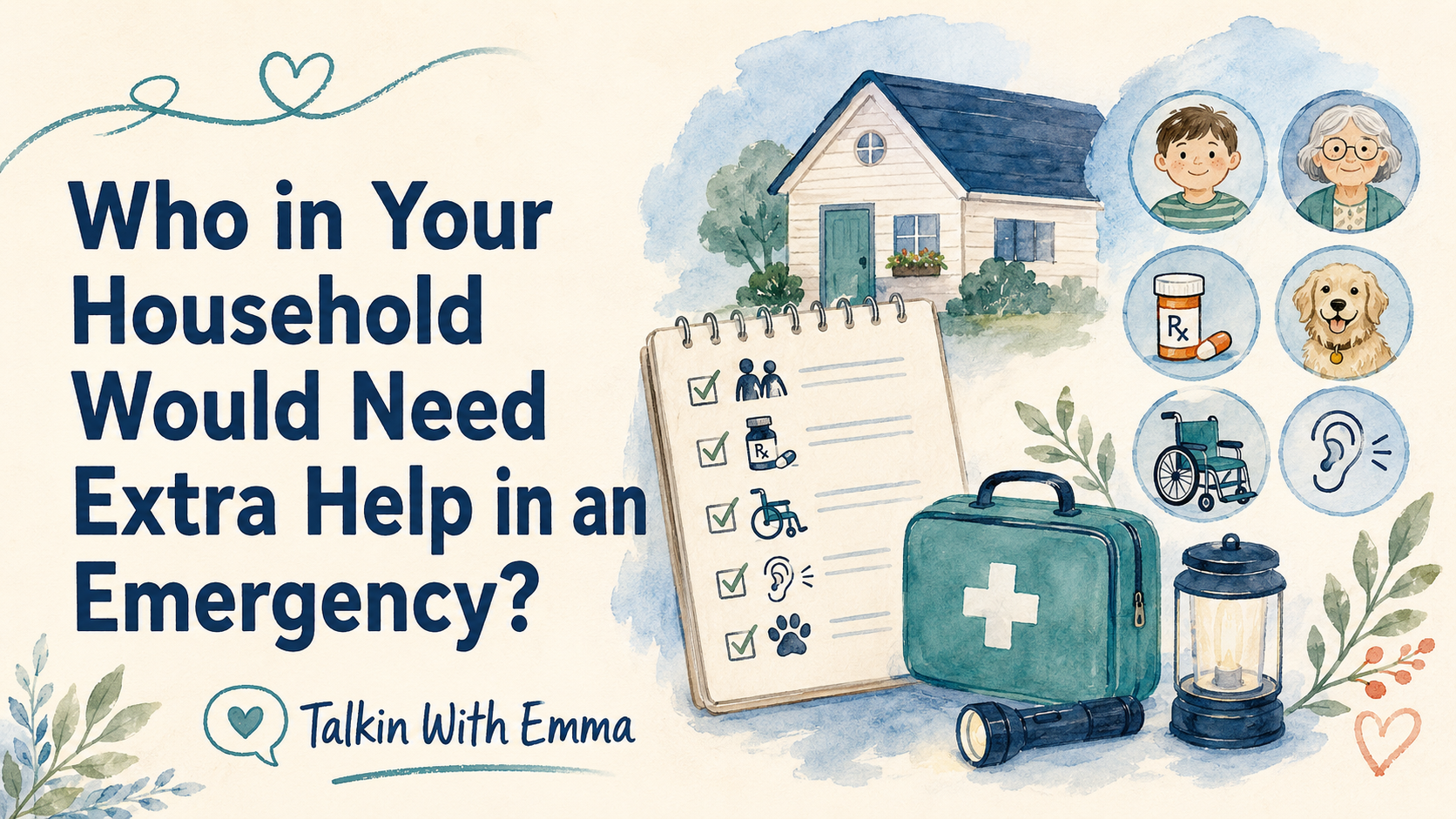
Here’s a question I think is worth asking before anything goes wrong:
If something happened at home tonight, who would need you first?
Not who is the most organized.
Not who has the emergency app.
Not who bought the flashlight with seventeen settings.
Who would actually need help?
Because emergency plans have a funny way of sounding very neat on paper.
Everybody hears the alarm.
Everybody knows where to go.
Everybody remembers the plan.
Everybody grabs what they need.
Real households are usually a little messier than that.
Someone is asleep.
Someone cannot find their shoes.
Someone is trying to get the dog out from under the bed.
Someone left their medication in the other room.
Someone is confused.
Someone is scared.
And somebody is standing there thinking, Okay. Who do I need to take care of first?
That is the part I want you thinking about.
Start with the people who may need more time
Think about the people who live with you.
Would anyone have a harder time moving quickly?
That might be a young child.
An older adult.
Someone who uses a cane, walker, wheelchair, or other mobility equipment.
Someone who would need help getting out of bed.
Someone who may not hear an alarm easily.
Someone who gets overwhelmed when things happen fast.
You do not need to turn this into a medical chart.
Just be realistic.
If getting everybody out of the house would take longer than getting yourself out of the house, that belongs in the plan.
Think about medication and equipment
This is one of those things that is easy to overlook because, most of the time, everything is sitting right where it belongs.
Then the power goes out.
Or you need to leave quickly.
Or you are away from home longer than expected.
Does anyone in your household rely on medication they may need to take with them?
Medical equipment?
A charger?
Batteries?
Supplies?
I am not saying you need to drag the medicine cabinet to the front door.
I am saying it helps to know what actually matters before you are trying to remember it under pressure.
Children need a plan they can understand
A five-year-old does not need a twelve-step emergency procedure.
Honestly, neither do most adults.
For kids, simple usually wins.
Where do we go?
Who do we stay with?
Who do we listen to?
What do we do if we cannot find Mom, Dad, Grandma, or whoever normally takes care of us?
You do not have to make the conversation scary.
You are just giving them a few familiar answers before they need them.
Do not forget the person who will not be home
This one gets missed a lot.
What if somebody in the household is at work?
At school?
At the store?
Driving home?
You may have a perfectly reasonable plan for the people inside the house and no idea what everyone else is supposed to do.
Pick a meeting place.
Pick an out-of-area contact if that makes sense for your household.
Make sure people know where to go if they cannot get back home right away.
Again, nothing fancy.
Just enough that everybody is not making up a different plan at the same time.
And yes, the pets count
I know.
The cat did not attend the household meeting.
The dog did not review the evacuation route.
They remain completely uncooperative members of the emergency-planning committee.
They still count.
If you have pets, think about what it would take to move them quickly.
Where is the leash?
Where is the carrier?
Do you have food, medication, or anything else they would need if you had to leave?
And if your pet tends to hide when something gets loud or strange, that is useful information too.
You already know your animal.
Plan for the animal you actually have, not the one who behaves beautifully in your imagination.
Roommates and other adults can still need a conversation
Adults are very good at assuming another adult knows the plan.
Sometimes nobody has actually talked about it.
If you live with roommates, adult children, parents, relatives, or anybody else, ask a few basic questions.
Where would we meet?
Who checks on the pets?
Who has the important numbers?
Does everybody know where the emergency supplies are?
You may discover that the “household plan” currently exists only inside your head.
That is useful to know now.
Here is the question I would use
You do not have to sit down tonight and build a full emergency plan.
Just walk through your household one person at a time and ask:
If something happened tonight, what would this person need from me?
Maybe the answer is nothing.
Great.
Maybe they need a little more time.
Maybe they need medication.
Maybe they need help moving.
Maybe they need instructions kept very simple.
Maybe they need you to remember the leash.
Write down what matters.
That is enough to start.
Because a useful emergency plan is not really about having the perfect checklist.
It is about the people who actually live in your house.
And those people are probably not going to react exactly the way a checklist says they should.
That is okay.
Plan for your real household.
You will be much better off.
I’ll be talking more about this next week when Let’s Talk About Emergencies arrives, because this is one of the big ideas behind the book:
A useful plan has to fit the people who actually live there.
— Emma
Leave a Reply