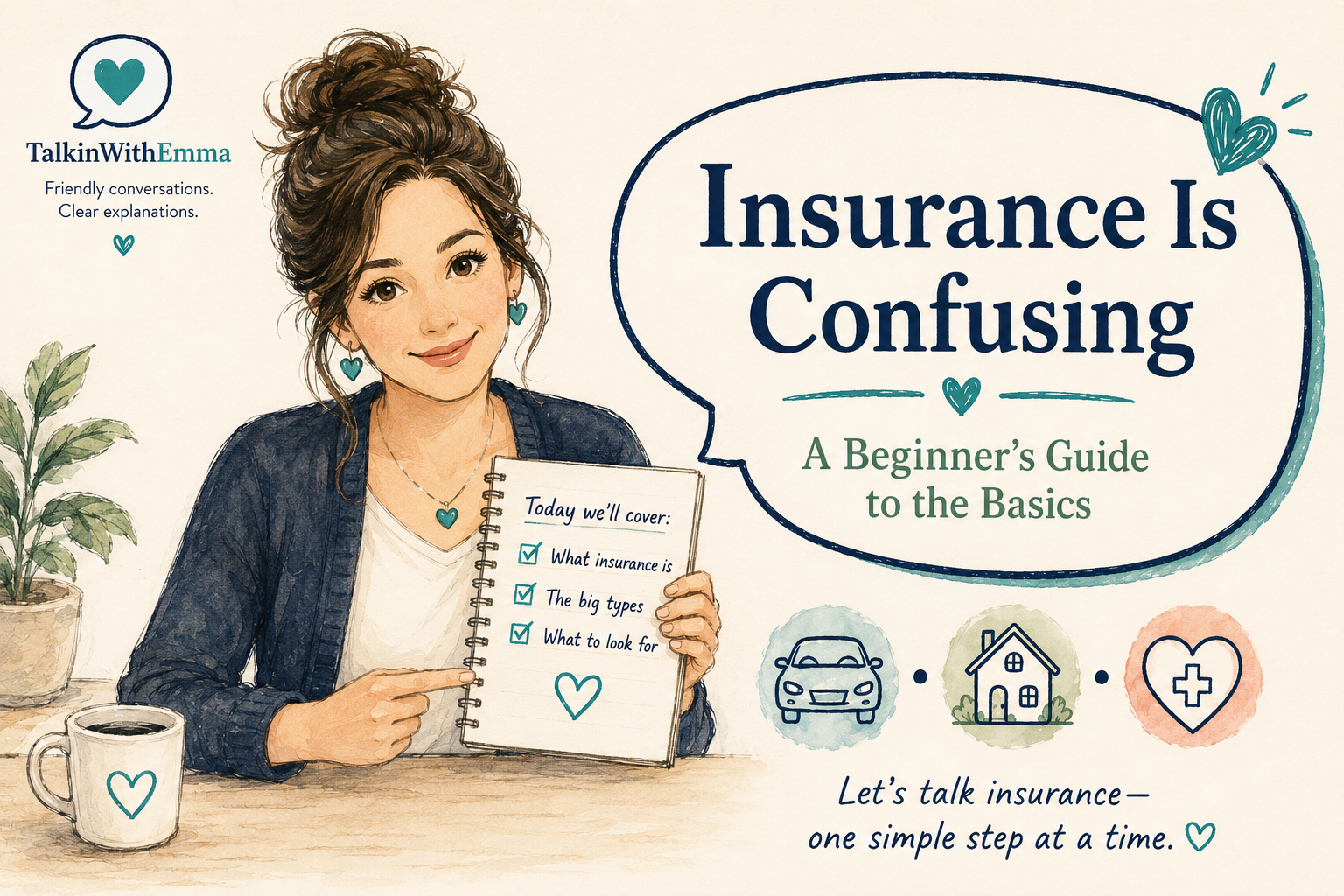
If you’ve ever looked at an insurance policy and thought, “Okay… I have no idea what any of this means,” you’re not alone.
Insurance has its own language—premiums, deductibles, coverage limits, exclusions, claims—and somehow you’re expected to understand it before deciding what you’re buying.
The good news? You don’t need to become an insurance expert.
You just need to understand a few insurance basics so you know what you’re looking at and what questions to ask.
Let’s make it easier.
So, What Is Insurance?
At its simplest, insurance is a way to help protect you from certain financial losses.
You pay an insurance company a premium for coverage. If something happens that your policy covers, the insurance company may help pay for the loss.
But that last part matters: the loss has to be covered under the terms of your policy.
Your policy tells you what is covered, what isn’t, how much the company may pay, and what you may have to pay yourself.
That’s why understanding the basics of your policy matters more than simply knowing what it costs.
5 Insurance Terms Worth Knowing
You don’t need to memorize an insurance dictionary.
Start with these five:
Premium: What you pay for your insurance coverage.
Deductible: The amount you generally pay toward a covered loss before certain insurance coverage pays its part.
Coverage: What your policy is designed to protect against.
Limit: The most your insurance company will pay for a particular covered loss or type of coverage.
Claim: A request you make to your insurance company for payment or coverage after something happens that may be covered by your policy.
You’ll run into plenty of other insurance words, but these five give you a good place to start.
Want something you can keep nearby? Grab the free Talkin With Emma Insurance Terms Cheat Sheet.
It can help when you’re reading a policy, reviewing your coverage, or comparing quotes.
What Are the Main Types of Insurance?
Different types of insurance protect against different kinds of financial risk.
Auto insurance can help protect you from certain financial losses involving your vehicle and your responsibility to other people.
Homeowners and renters insurance can help protect your home or belongings and may also include liability coverage.
Health insurance helps with certain healthcare costs according to the terms of your plan.
Life insurance can provide a death benefit to your beneficiaries when you die, subject to the policy’s terms.
Disability insurance can help replace part of your income if a covered disability prevents you from working.
That doesn’t mean everyone needs every type of insurance.
What makes sense for you depends on what you own, what you owe, who depends on you, and what kinds of losses would be difficult for you to handle yourself.
What Should You Look at Before Buying Insurance?
When you compare insurance policies, don’t look at the price alone.
Ask:
- What is covered?
- What isn’t covered?
- What are the deductibles?
- What are the coverage limits?
- Are there important exclusions?
- What could I have to pay myself if something happened?
Two policies can look almost identical at first and still have important differences.
That’s why the cheapest quote isn’t automatically the best choice—and the most expensive policy isn’t automatically better.
This is also where people can make some costly mistakes. If you’re reviewing your coverage, read 8 Common Insurance Mistakes That Can Cost You Thousands for a few things worth checking.
If you’re comparing several quotes, the Insurance Checkup and Quote Comparison Worksheet gives you one place to put the premiums, deductibles, limits, and coverage side by side so you can see what you’re actually comparing.
Why Did My Insurance Premium Change?
Even when your own situation hasn’t changed much, your insurance price can.
Companies may consider many factors when setting or renewing rates, and those factors can vary by insurer, policy, location, and type of insurance.
So if your renewal arrives and the price suddenly looks different, don’t assume you did something wrong.
Start by looking at what changed.
I walk through that question in more detail here: Why Did My Insurance Premium Go Up When Nothing Changed?
How Much Insurance Do You Need?
This is one of the questions I hear most often.
And unfortunately, there isn’t one magic number.
Your answer may depend on your income, savings, property, debts, and whether anyone else depends on you financially.
It can also depend on how much of a loss you could realistically handle yourself.
The goal isn’t necessarily to buy the most insurance you can afford.
It’s to understand what you’re trying to protect and what could happen financially if something went wrong.
If you’re wondering whether your current coverage still fits your life, Do You Have Enough Insurance? 7 Signs Your Coverage May Need a Second Look is a good next read.
You Don’t Have to Learn Insurance All at Once
Insurance can feel complicated when you’re first trying to understand it.
That’s okay.
Start with the insurance basics.
Learn a few important words. Look at the coverage you already have. Ask questions when something doesn’t make sense. And when you compare policies, look beyond the price.
You don’t need to know everything about insurance.
You just need enough information to understand what you’re buying and ask better questions.
You’ve got this. ♡
— Emma
Want a Little More Help?
If the terminology is the part slowing you down, keep a plain-English reference nearby and learn the rest one piece at a time.
Want a simple free tool to help with the next step?
Get the free Insurance Terms Cheat Sheet.
Want to go a little deeper?
Take a look at Let’s Talk About Insurance.
Want practical insurance, money, and everyday-life help in your inbox?
Join Emma’s Mailbox.
A Quick Note Before You Go
This article is for general educational information and isn’t personal insurance advice. Insurance rules, requirements, coverage, and policy terms can vary by state, company, and individual policy. Always review the actual policy and consider speaking with a licensed insurance professional about your situation.