
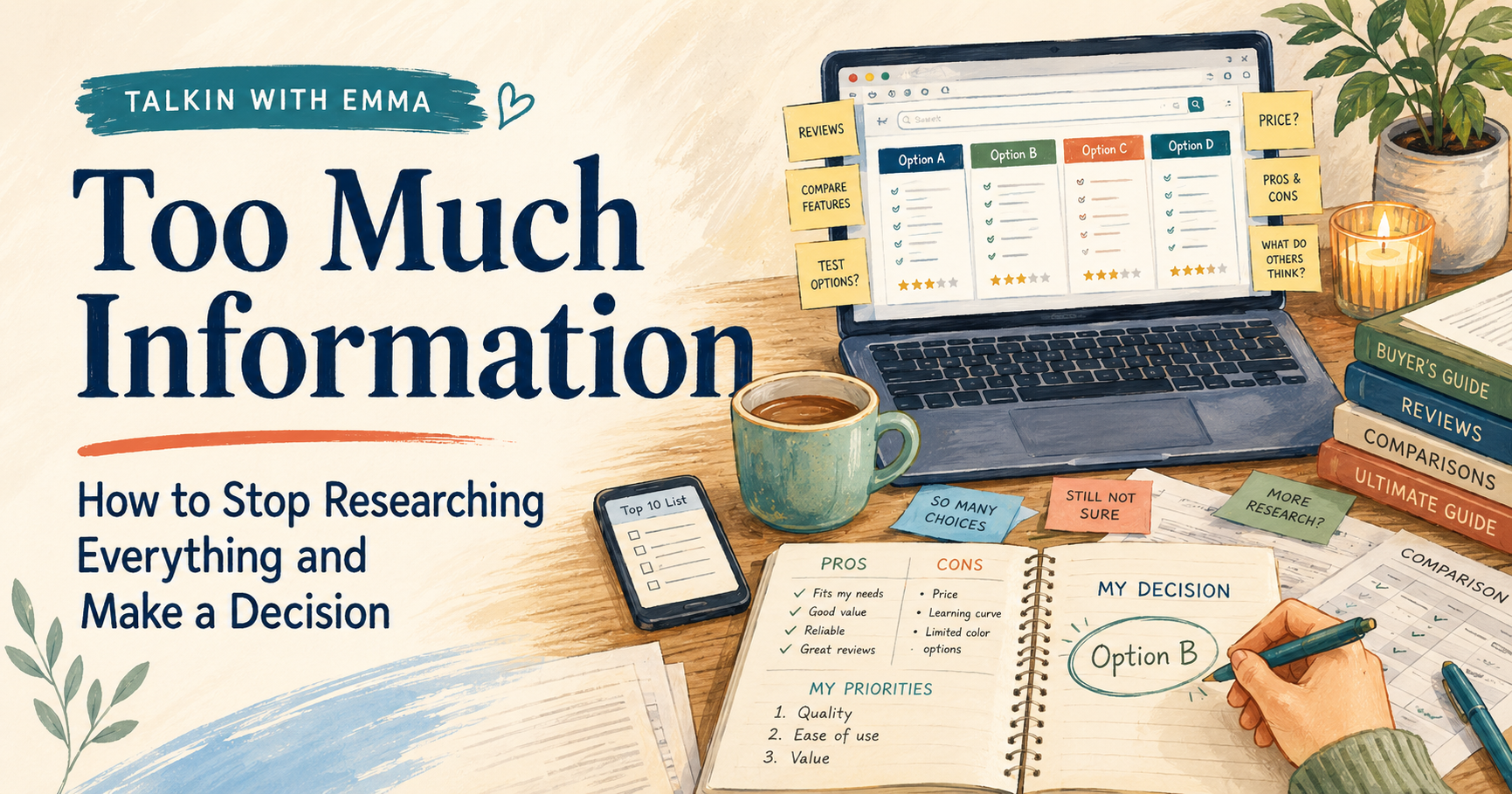
You need to make a decision.
Nothing dramatic.
Maybe you’re comparing insurance.
Buying a laptop.
Planning a vacation.
Or you just need a new vacuum cleaner.
So you do the responsible thing.
You research.
Twenty minutes later, you have nine browser tabs open.
An hour later, you’ve watched three videos, read four reviews, and discovered a Reddit thread written by people who apparently have very strong feelings about vacuum cleaners.
Now you know more.
You are also somehow less sure what to do.
That is the part nobody warns you about.
More Information Isn’t Always More Helpful
Having access to information is useful.
Want to know whether a hotel is clean? Read reviews.
Want to compare insurance companies? Look at quotes, coverage details, ratings, and complaint information.
Want to know which air fryer makes the crispiest chicken wings?
I promise you, someone has conducted this investigation.
The problem isn’t having information.
It’s knowing when the information has stopped helping.
There is a point where another article doesn’t make the decision clearer. It just gives you another opinion to sort through.
Then another.
And another.
Eventually, you’re not researching the decision anymore.
You’re postponing it.
Start With the Decision, Not the Research
Before you open another tab, ask yourself one question:
What am I actually trying to decide?
This sounds obvious.
It isn’t.
It’s easy to start with, “I need car insurance,” and somehow end up reading about claims ratings, state rules, six optional coverages, and a stranger’s terrible experience from seven years ago.
Some of that may matter.
Some of it probably does not matter to the decision you’re making today.
Make the question smaller.
Instead of:
“Which insurance company is best?”
Try:
“Which of these policies gives me the coverage I need at a price I can afford?”
Instead of:
“What’s the best laptop?”
Try:
“Which laptop in my price range will handle the things I actually use it for?”
A clear question gives your research somewhere to go.
Otherwise you’re just collecting information.
Decide What Matters Before You Compare
Pick the few things that matter most to this decision.
Not every possible feature.
Not every opinion you found online.
The things that actually matter to you.
Let’s say you’re booking a hotel. Maybe your priorities are location, cleanliness, and price.
Now you have a filter.
A hotel that’s $40 cheaper but 45 minutes from everything you want to do may not actually be the better choice.
One with a beautiful rooftop pool but a pile of recent reviews mentioning dirty rooms may not survive the cleanliness test.
The rooftop pool will survive without us.
Your priorities do not have to match somebody else’s.
That’s the point.
You’re making a decision for your life, not trying to win an imaginary contest for choosing the objectively perfect option.
Separate Facts, Assumptions, and Opinions
This is where a lot of decision confusion clears up.
A fact is something you can verify.
An opinion is somebody’s judgment or experience.
An assumption is something you’re treating as true even though you have not actually confirmed it.
Those three things can look surprisingly similar when they’re all sitting on the same screen.
Maybe a product page says a laptop has 16 GB of memory. That’s a fact you can verify.
A reviewer says the keyboard feels cheap. That’s an opinion.
You decide the cheaper model “probably won’t last as long” even though you have not found anything supporting that. That’s an assumption.
Opinions can still be useful. Assumptions can sometimes point to a question you need to answer.
Just don’t let either one quietly turn into a fact.
Give Yourself a Research Limit
Decide when you’re going to stop researching before you start.
Maybe it’s three quotes.
Five products.
Thirty minutes.
Three reliable sources.
The right limit depends on the decision, but having one matters.
Without an edge, the internet will happily let you keep going forever.
There is always another review, another comparison, another expert, and another person who bought the exact thing you’re considering and wants you to know it ruined their entire summer.
You don’t need every available piece of information.
You need enough useful information to make a reasonable decision.
Not Every Decision Deserves the Same Amount of Research
Some decisions deserve real time and careful comparison.
Insurance coverage. A mortgage. A car. A major medical decision. Something that could seriously affect your finances or your safety.
Those deserve more attention.
But we sometimes bring the same research habits to decisions where the stakes are much lower.
You don’t need a spreadsheet to choose paper towels.
You probably don’t need six comparison videos before buying a $22 toaster.
And if you’ve spent 45 minutes comparing $14 phone cases to save $3, we may have wandered off course.
Ask yourself:
What happens if I make the wrong choice?
If the answer is, “I’ll be mildly annoyed,” that’s probably not a three-hour research project.
Save your attention for decisions where getting it wrong actually matters.
Use Reviews for Patterns, Not Instructions
Reviews are useful.
I use them too.
But one review is one person’s experience.
If one person mentions a problem, I notice it.
If hundreds of people mention the same problem, I pay more attention.
Also look at what people are actually complaining about.
Someone may hate a hotel because it’s too quiet.
You may be specifically looking for quiet.
That review didn’t become wrong.
It just means something different for your decision.
Reviews aren’t instructions.
They’re information.
Watch for the Search for Certainty
Sometimes we keep researching because we think one more article will finally make us feel completely sure.
Most decisions do not work that way.
You can compare insurance policies carefully and still wonder whether another company might have been better.
You can read laptop reviews for hours and still find somebody who hates the one you chose.
Research can reduce uncertainty.
It usually cannot eliminate it.
At some point, the question changes from “Do I know everything?” to “Do I know enough to make a reasonable choice?”
That is a much more useful standard.
Try the Three-Question Stop Sign
When you feel yourself reaching for one more article, review, or video, stop and ask:
- Do I understand my main options?
- Do I know the important differences between them?
- Is more information likely to change my decision?
If the answer to the first two is yes and the third is no, you’re probably done.
Close the tabs.
I know.
All of them.
Stop Reopening a Decision You’ve Already Made
This one is sneaky.
You research.
You compare.
You decide.
Then two days later, you start researching again.
Maybe there’s a better option.
Maybe somebody posted a new review.
Maybe you should have picked the other one.
If nothing meaningful has changed, the decision does not automatically need to be reopened.
You made a reasonable choice with the information you had.
Let it be finished.
Otherwise every decision becomes permanent homework.
Nobody needs that.
Need Help Sorting the Decision Out?
If your problem isn’t that you need more information, but that you have too much of it floating around in your head, I made a simple worksheet for that.
My Decision Reset Sheet helps you name the decision, separate facts from assumptions, compare the options that actually matter, and choose a next step.
It is free.
Make a Good Decision, Not a Perfect One
Perfect decisions look wonderful in hindsight.
Unfortunately, we have to make decisions before hindsight arrives.
So work with what you know.
Figure out what matters.
Separate what you know from what you’re assuming.
Set a reasonable research limit.
Compare your best options.
Then choose.
Could another option turn out to be slightly better?
Sure.
Maybe the toaster you didn’t buy lasts eleven years and yours lasts nine.
We’ll find a way to carry on.
The goal isn’t to squeeze every possible ounce of perfection out of every decision.
It’s to make a good decision without letting the decision take over your life.
Sometimes the Best Thing You Can Do Is Close the Tabs
Information is supposed to help you.
When it stops helping, you’re allowed to stop looking.
You don’t need every opinion.
You don’t need to know every possibility.
Know what you’re deciding.
Know what matters.
Get enough reliable information to understand your choices.
Then make the call.
And close the tabs.
Seriously.
Your computer could probably use the break too.
This article is for general educational and informational purposes only and isn’t intended as mental health, medical, financial, legal, or other individualized professional advice. If feelings of overwhelm, anxiety, or difficulty making decisions are persistent, severe, or interfering with your daily life, consider talking with an appropriate qualified professional.