
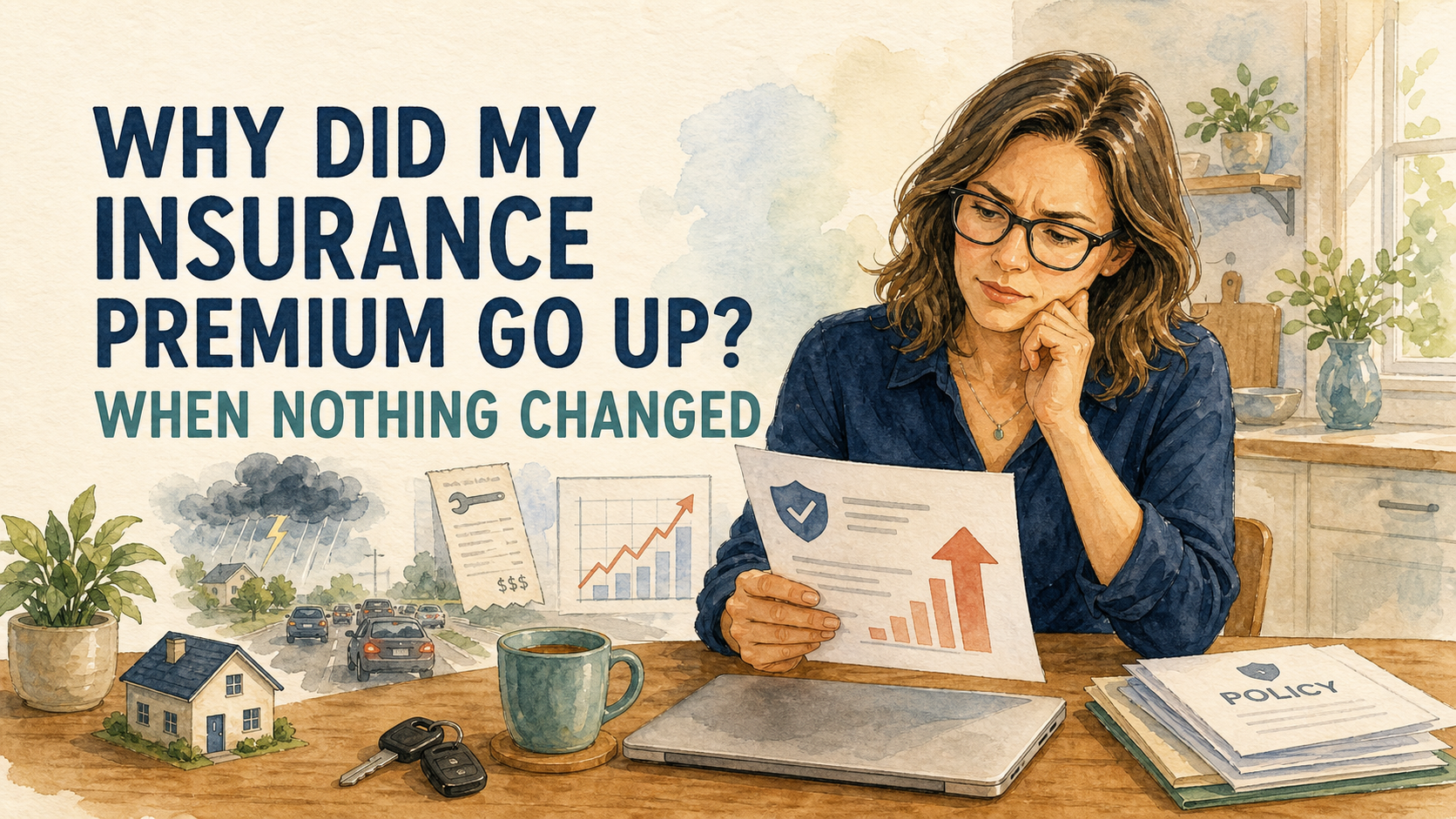
You open your insurance renewal.
And there it is.
A higher premium.
Again.
So you start running through the list.
No claims.
No tickets.
Same house.
Same car.
Same people.
You certainly didn’t call the insurance company and ask them to make anything more expensive.
So why did your insurance premium go up when nothing changed?
Here’s the frustrating answer:
Something probably did change.
It just may not have been you.
Your Insurance Price Isn’t Based Only on What You Do
This is probably one of the biggest misunderstandings about insurance pricing.
It feels personal because it’s your bill.
So when the price goes up, naturally you start looking at yourself.
Did I file a claim?
Get a ticket?
Change coverage?
Move?
Add a driver?
Those things can matter.
But your own history is only part of the picture.
Insurance companies are also looking at the cost of claims, the risks they’re insuring, and other pricing factors that can change even when your life looks exactly the same.
So:
“I didn’t do anything.”
and
“Nothing affecting my insurance price changed.”
aren’t always the same thing.
If insurance pricing already feels like another language, Insurance Is Confusing: Insurance Basics in Plain English is a good place to start.
Repairs May Cost More Than They Used To
Let’s start with something pretty ordinary.
Stuff gets more expensive.
Cars are a great example.
A bumper isn’t always just a bumper anymore.
There may be sensors.
Cameras.
Radar.
And other technology tucked into what still looks like a fairly ordinary piece of plastic.
That can make repairs more expensive.
Homes have the same problem.
Labor costs change.
Building materials change.
Replacement costs change.
If it costs insurers more to repair or replace damaged property, that can eventually show up in insurance pricing.
You didn’t change your car.
The cost of fixing your car may have changed.
Medical Costs Can Affect Insurance Prices Too
Not every insurance claim is about damaged property.
Some involve injuries.
And medical care can get expensive very quickly.
If the cost of treating injuries rises, the expected cost of certain claims can rise too.
Again:
You didn’t go to the doctor.
You didn’t have an accident.
But what a future claim might cost can still change.
Insurance pricing isn’t based only on what happened to you last year.
Insurers are also trying to estimate what future losses may cost.
There May Be More Insurance Claims Around You
Your own claim history can matter.
But broader claim patterns can matter too.
An area may be seeing more:
- Storm damage
- Theft
- Auto accidents
- Water losses
- Wildfires
- Other costly events
That doesn’t mean your insurer looks at your neighbor’s claim and sends you their bill.
It means broader patterns of losses and risk can affect insurance pricing.
Your house may still be sitting exactly where it was last year.
The cost or risk of insuring homes in that area may have changed.
Weather Doesn’t Need Your Permission
This is especially important with property insurance.
Severe weather can create enormous insured losses.
Hurricanes.
Hail.
Wind.
Wildfires.
Winter storms.
And other major weather events.
You may have gone years without filing a homeowners claim.
Wonderful.
That doesn’t mean insurers haven’t been paying large claims elsewhere.
You didn’t have the storm.
The insurance market did.
Your Insurance Company May Have Changed Its Rates
Insurance companies don’t necessarily charge the same rates forever.
Their pricing can change based on things such as claims experience, expected losses, expenses, market conditions, and other rating factors.
Rate rules and approval requirements can also vary by insurance type and state.
So your renewal may increase even when your personal information looks basically the same.
That’s why I don’t love:
“My insurance went up for no reason.”
There’s usually a reason.
The frustrating part is that the reason may not be obvious from looking at the new bill.
First, Make Sure Your Coverage Really Didn’t Change
Before blaming the entire insurance industry, though, let’s check the policy.
Pull out last year’s information and the new renewal.
Put them next to each other.
Did a coverage limit increase?
Did the insured value of your home change?
Did an endorsement change?
Did a deductible change?
Was something added?
Was something removed?
Some coverage amounts may also change over time.
With homeowners insurance, for example, an estimated rebuilding amount may change as construction costs change.
So you may genuinely be thinking:
“I didn’t change anything.”
while something inside the policy did.
Check.
And if you’re not sure what limits, deductibles, or coverage mean, go back to Insurance Basics in Plain English before you start comparing numbers.
Check Whether Any Insurance Discounts Changed
This one is easy to miss.
Maybe you had a discount last year.
Now you don’t.
Or maybe the amount changed.
Depending on the insurer, discounts can be connected to things such as:
- Bundling policies
- Claims history
- Driving history
- Good-student eligibility
- Telematics or usage-based programs
- Automatic payments
- Paperless billing
- Protective devices
- Other insurer-specific programs
Maybe a temporary discount ended.
Maybe you stopped qualifying for one.
Maybe you changed another policy that affected a bundle.
The base rate isn’t always the only thing moving.
Ask:
“Did any of my discounts change at renewal?”
That one question can clear up a lot.
And if you’re counting on a bundle discount, remember that a discount doesn’t automatically mean the final price is the lowest available. I walk through that in Does Bundling Insurance Actually Save Money?.
Something in Your Life May Have Changed Without Feeling Like an Insurance Change
Sometimes something really did change.
It just didn’t feel like an insurance event when it happened.
Maybe you:
- Moved
- Changed your commute
- Added a driver
- Bought another vehicle
- Started using your car differently
- Renovated your home
- Installed a new roof
- Started working from home
- Started a home-based business
- Bought something valuable
Some changes may raise the price.
Some may lower it.
Some may affect coverage more than price.
I wouldn’t try to guess.
I’d just make sure the insurer has accurate information.
Credit-Based Insurance Information May Matter in Some States
Depending on the state and type of insurance, an insurer may be allowed to use certain credit-based insurance information as one factor in pricing or underwriting.
The rules vary, and some states restrict or prohibit its use.
So don’t assume this applies to you.
If you’re trying to understand a premium increase, ask your insurer what factors affected the renewal and whether credit-based insurance information played a role where its use is permitted.
There’s no reason to guess when you can ask.
Your Agent May Not Be the Person Setting the Price
If you work with an insurance agent, it’s tempting to call and say:
“Why did you raise my insurance?”
Your agent may be able to explain the increase, review your coverage, and look for options.
But the agent may not personally set the insurance company’s rates.
I’d make the call more useful:
“My renewal increased even though I haven’t had any claims or major changes. Can you help me figure out what changed?”
Now we’re investigating.
Much better.
Find Out How Much Your Insurance Actually Increased
I know.
The bill is higher.
You noticed.
But get specific.
Last year:
$1,860
This year:
$2,070
Difference:
$210
That’s about an 11.3% increase.
Now we have something useful.
Because:
“My insurance went up!”
could mean $36 a year.
Or $936.
Those are very different conversations.
Look at both the dollar amount and the percentage increase.
Ask the Insurance Company What Changed
You don’t need a fancy script.
Try:
“My renewal premium increased from $1,860 to $2,070. I haven’t had any claims or major changes. Can you help me understand what changed?”
Then ask:
- Did my coverage change?
- Did any discounts change?
- Did any rating information change?
- Was there a general rate increase?
- Did I lose any discounts?
- Are there discounts I may now qualify for?
- Would changing my deductible affect the premium?
- Are there coverage options I should review?
That’s a productive phone call.
Don’t Cut Coverage Just to Get Back to the Old Price
This is where a higher premium can lead to a second problem.
Your insurance goes up $40 a month.
You want the $40 gone.
So you start cutting things.
Lower a limit.
Raise a deductible.
Drop coverage.
Done.
Maybe the bill is back where you want it.
But what did you give up?
That’s the question.
There’s nothing wrong with reviewing coverage when the premium changes.
You should.
Just don’t make:
“Get my bill back to $X.”
the only goal.
Make sure the insurance still does what you need it to do.
That’s also one of the common insurance mistakes that can cost you later: focusing on the price without checking what changed in the coverage.
Raising the Deductible May Help—But Check the Numbers
A higher deductible may lower the premium.
But don’t stop there.
Ask what the actual savings would be.
Then compare that with the additional amount you’d have to come up with after a covered loss.
If increasing your deductible by $1,000 saves you $4.17 a month, I’d want you to notice that before clicking Accept.
Numbers first.
Decision second.
Check Whether Bundling Is Still Saving You Money
Maybe you bundle home and auto.
Or renters and auto.
And your insurer tells you there’s a bundle discount.
Great.
But having a discount and having the lowest total cost are not the same thing.
If your premium increased enough to make you uncomfortable, compare the bundled price with other options.
Maybe the bundle still wins.
Maybe separate companies work better.
Does Bundling Insurance Actually Save Money? walks through how to compare that without looking at the discount percentage alone.
A Big Premium Increase May Be a Good Reason to Shop Around
You don’t need to change insurance companies every time your premium moves a few dollars.
But a meaningful renewal increase is a perfectly reasonable reason to see what else is available.
Just compare similar insurance.
Try to keep the same:
- Coverage types
- Limits
- Deductibles
- Drivers
- Property information
- Other important details
Otherwise, you may think you found a much cheaper quote when you actually found less insurance.
That’s exactly what the Insurance Checkup & Quote Comparison Workbook on the Talkin With Emma Tools page is designed to help with.
Compare the insurance first.
Then compare the price.
Another Insurance Company May Be Cheaper Today—Not Forever
Suppose you shop around.
Current insurer:
$2,070
New insurer:
$1,720
That’s $350 a year.
Interesting.
Maybe switching makes sense.
But don’t turn:
“This company is cheaper today.”
into:
“This company will always be cheaper.”
Rates can change.
Discounts can change.
Your life can change.
You make today’s decision with today’s information.
Then you review it again when you need to.
Loyalty Is Fine. Overpaying Out of Habit Isn’t Required.
Maybe you’ve been with the same insurer for 14 years.
You like them.
They handled a claim well.
Your agent is terrific.
Those things have value.
Price isn’t everything.
But being a longtime customer doesn’t mean you have to accept any renewal price without looking at it.
You can appreciate good service and still compare your options.
Maybe you stay.
Maybe you leave.
Either way, you made a decision.
You didn’t just let the renewal happen to you.
Don’t Cancel Your Old Insurance Until the New Policy Is Confirmed
If you find a better option, coordinate the switch carefully.
Make sure you know when the new policy actually starts before ending the old one.
You don’t want to respond to an annoying premium increase by accidentally creating a lapse in coverage.
That would be an impressive escalation.
Confirm the new policy.
Then deal with the old one.
So, Why Did Your Insurance Premium Go Up?
Maybe your coverage changed.
Maybe a discount changed.
Maybe your insurer changed its rates.
Maybe repairs cost more.
Maybe medical claims cost more.
Maybe losses increased in your area.
Maybe something in your own information changed.
Maybe several things happened at once.
A higher insurance premium doesn’t automatically mean you did something wrong.
And it doesn’t mean you have to quietly pay it without asking questions.
Start here:
- Compare your renewal with the previous policy.
- Check your coverage limits and deductibles.
- Check your discounts.
- Calculate the actual dollar and percentage increase.
- Ask your insurer or agent what changed.
- Decide whether the new price still makes sense.
And if it doesn’t?
Shop.
Not angrily.
Not randomly.
Just compare your options.
Sometimes the answer to:
“Why did my insurance premium go up?”
is understanding what changed.
And sometimes it’s understanding what changed…
then getting three new quotes anyway.
What?
If you want help understanding how premiums, deductibles, limits, and coverage fit together, visit the Talkin With Emma Books page and take a look at Let’s Talk About Insurance.
If you’re ready to compare your current policy with new quotes, the Insurance Checkup & Quote Comparison Workbook gives you one place to organize the numbers.
And if you need help with insurance rules or consumer questions where you live, you can find your state regulator through the NAIC State Insurance Department Directory.
— Emma
A Quick Note Before You Go
This article is for general educational and informational purposes only and isn’t individualized insurance, financial, legal, or tax advice. Insurance premiums, rating factors, discounts, underwriting practices, rate changes, and regulatory requirements vary by insurance type, insurer, policy, and state. Contact your insurer or a licensed insurance professional for information about your specific premium and coverage, and consult your state insurance regulator or another qualified professional when appropriate.