
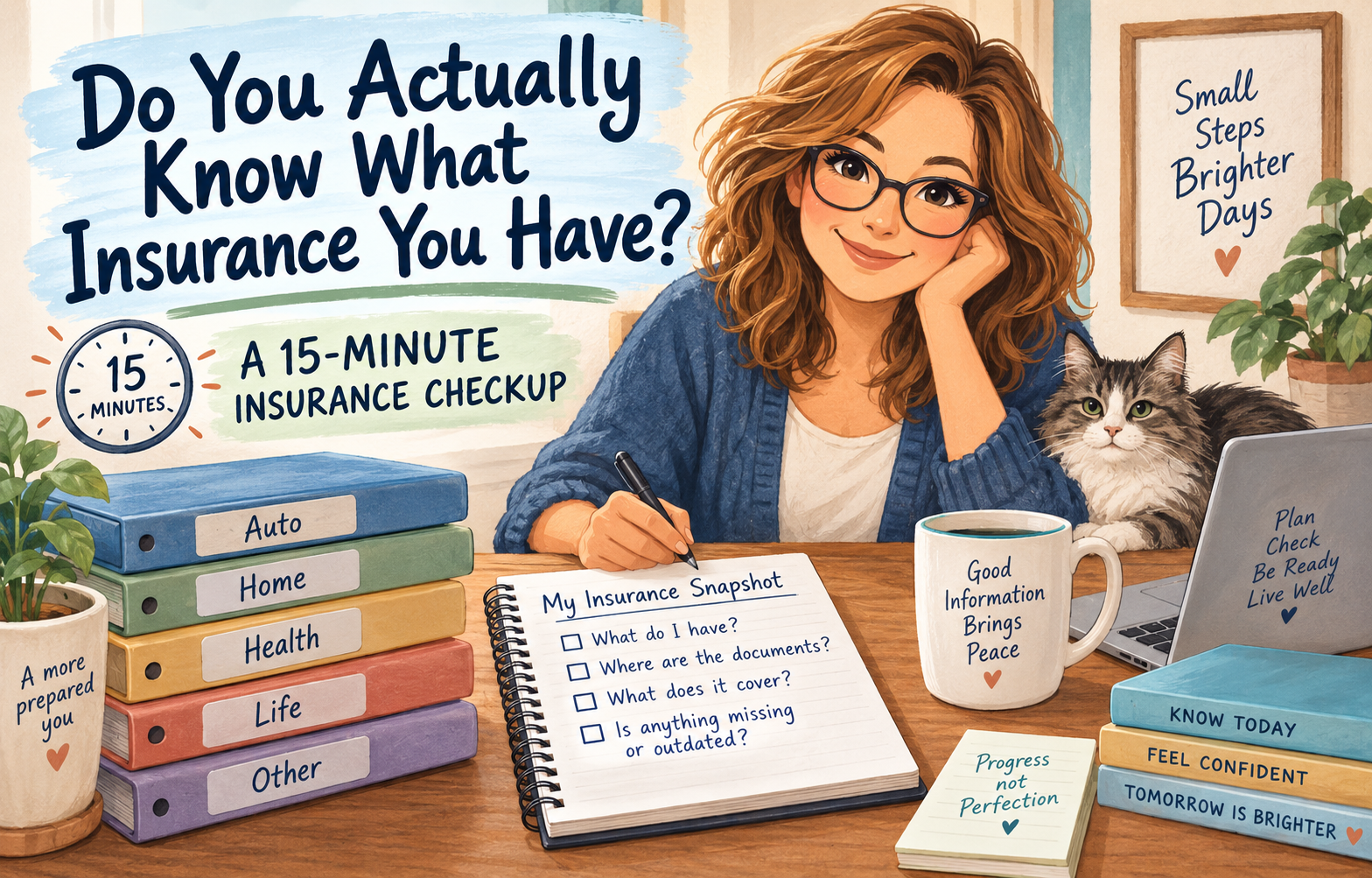
If I asked you right now what insurance you have, could you tell me?
Not just, “I have car insurance.”
Could you tell me who the company is? When the policy renews? What your deductible is? Where you would find the policy if you needed it tonight?
How about renters or homeowners insurance? Life insurance? Health insurance?
If your answer is somewhere between “mostly” and “I think so,” you’re in good company.
Insurance is one of those things we tend to set up and then stop thinking about. We pay the bill, renew the policy, and move on with our lives.
Until we actually need it.
So today, we’re not shopping for insurance. We’re not comparing quotes. And we’re definitely not spending hours reading policy documents.
We’re just figuring out what you already have.
Set a timer for 15 minutes.
Step 1: Make a Quick List
Start with the insurance policies you know you have.
Your list might include:
- Auto insurance
- Homeowners or renters insurance
- Health insurance
- Life insurance
- Disability insurance
- Dental or vision coverage
- Insurance through your employer
- Any other specialty coverage you carry
Don’t worry if you aren’t sure whether something belongs on the list. Write it down anyway.
The goal isn’t to create a perfect insurance inventory. It’s to get everything out of your head and into one place.
Step 2: Find the Policies
Now see how many of those policies you can actually locate.
That might mean finding a paper copy, opening an insurance company’s app, logging into an online account, checking your email, or looking through your employee benefits portal.
For each policy, try to find four basic things:
- Who is the insurance company?
- What is the policy number?
- When does the policy renew or end?
- Where can you find the full policy information if you need it?
You don’t need to memorize any of this. You just need to know where it is.
That’s a surprisingly important distinction.
If a tree falls on your house, your car gets hit in a parking lot, or someone in your family ends up in the emergency room, that’s not the moment you want to start searching old emails for an insurance policy you haven’t looked at in two years.
Step 3: Check the Big Numbers
If you still have a few minutes, look at the basic numbers on each policy.
Depending on the type of insurance, that could include:
- Coverage limits
- Deductibles
- Monthly or annual premiums
- Life insurance benefit amounts
- Health insurance copays or coinsurance
- Out-of-pocket maximums
You don’t need to understand every number yet. You’re simply taking inventory.
If you see something you don’t understand, make a note of it. That’s something you can investigate later.
Step 4: Look for the Obvious Gaps
Now ask yourself a few simple questions.
Has anything important changed since you bought these policies?
Maybe you moved. Bought a house. Got married or divorced. Had a child. Bought a new car. Started working from home. Changed jobs. Started a side business. Bought expensive electronics, jewelry, tools, collectibles, or other property.
Or maybe nothing dramatic happened—but you haven’t looked at your coverage in five years.
None of those things automatically mean you need different insurance. They simply mean it’s worth checking.
Step 5: Put Everything Somewhere You Can Find It
This may be the most useful part of the entire exercise.
Pick one place for your basic insurance information.
It could be a folder in a filing cabinet, a secure digital folder, a notes app, or another system that works for you.
You don’t necessarily need every giant policy document sitting together.
You do want to be able to answer:
What insurance do I have, who provides it, and where do I go when I need it?
That’s your insurance snapshot.
You’re Done
Really.
You don’t have to call three insurance companies today. You don’t have to request quotes. You don’t have to become an insurance expert.
You spent 15 minutes figuring out what you already have.
And now you have something much more useful than a vague feeling that you’re probably insured.
You have a starting point.
From there, you can decide whether anything deserves a closer look.
Maybe your coverage is perfectly fine. Maybe you discover a policy you’ve been meaning to update. Maybe you find a deductible you didn’t realize was so high. Or maybe you discover one question you want to ask your insurance company or agent.
That’s progress.
Insurance gets much easier to deal with when you stop trying to understand everything at once.
Start with what you have. Then take the next step when you’re ready.
This article is for general educational purposes and isn’t individualized insurance, financial, legal, or tax advice. Coverage, policy terms, and insurance requirements vary.