
Tag: deductibles

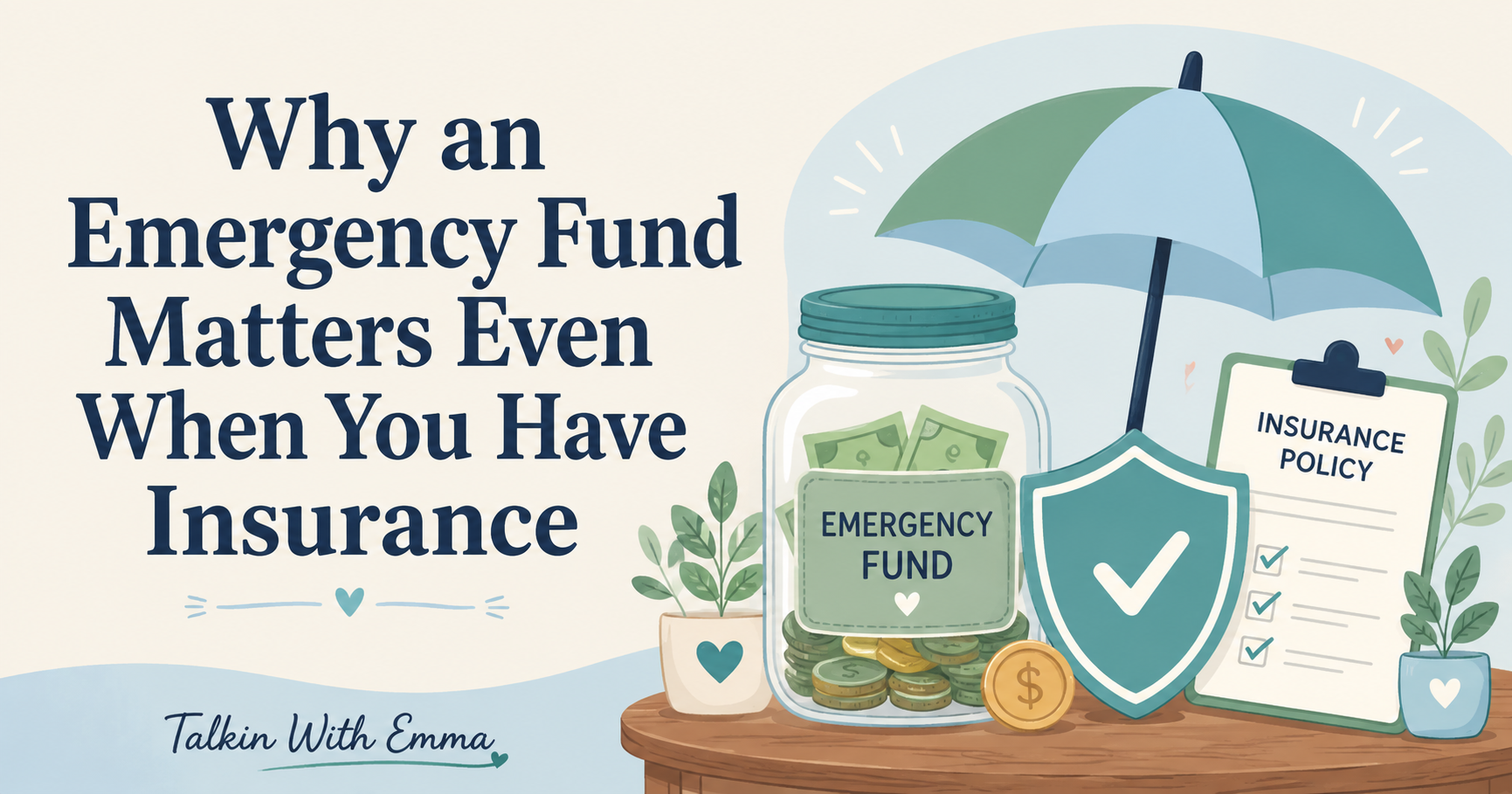
  • Why an Emergency Fund Matters Even When You Have Insurance

    Why an Emergency Fund Matters Even When You Have Insurance

    Insurance can protect you from some very expensive problems.

    So if you have insurance, do you really need an emergency fund too?

    Yes.

    Not because your insurance isn’t doing its job. The two simply have different jobs.

    Insurance can help with certain covered losses. An emergency fund gives you money you can reach when life creates an expense right now.

    And sometimes those two things meet in the same afternoon.

    You might have a car accident and discover that your policy has a deductible. A storm might damage your home, but you still need to buy supplies before a claim is settled. You may have a covered loss and still have expenses that aren’t part of the claim at all.

    That’s where having some cash set aside can make a hard day a little easier.

    Insurance Doesn’t Mean You Never Pay Anything

    This is one of those ideas that sounds obvious once somebody says it, but it’s easy to overlook.

    Having insurance doesn’t mean every unexpected expense becomes the insurance company’s expense.

    Depending on the policy and what happened, you may still be responsible for things like:

    • a deductible
    • expenses above a coverage limit
    • something your policy doesn’t cover
    • temporary costs while you’re dealing with the problem
    • regular repairs or maintenance that aren’t insurance claims

    And even when insurance does cover something, you may have expenses before everything is sorted out.

    That’s why I like to think of insurance and emergency savings as two different layers of protection.

    Insurance helps transfer some financial risk.

    Emergency savings gives you some room to handle the part that still belongs to you.

    You usually want both.

    Think About Your Deductible for a Minute

    Grab one of your insurance policies.

    Your auto policy is a good place to start.

    If you have collision or comprehensive coverage, look at the deductible.

    Maybe it’s $500. Maybe it’s $1,000. Maybe yours is different.

    Now ask yourself a very simple question:

    If I needed to pay that deductible this week, where would the money come from?

    Not eventually.

    This week.

    Would it come from savings?

    A credit card?

    Money you needed for rent or groceries?

    Would you have to borrow it?

    There isn’t any judgment hiding in that question. You’re simply finding out how prepared your current financial setup is for the coverage you’ve chosen.

    Your insurance policy and your bank account don’t live in separate worlds.

    They meet when something happens.

    A Lower Premium Can Mean More Risk in Your Pocket

    Here’s another place insurance and emergency savings connect.

    Sometimes choosing a higher deductible can lower an insurance premium.

    That can be useful.

    But there’s a tradeoff.

    You’re agreeing to take responsibility for more of a covered loss before the applicable insurance coverage begins paying.

    So don’t look at the premium by itself.

    Ask:

    Could I actually afford the deductible I’ve chosen?

    Saving a few dollars on a premium isn’t much help if the deductible becomes a financial crisis when you need to use the coverage.

    That doesn’t automatically mean you should choose the lowest deductible available, either.

    It means the deductible should make sense with the rest of your finances.

    Your Emergency Fund Doesn’t Have to Appear Overnight

    This is where people can get discouraged.

    They hear emergency fund and picture a giant savings account they don’t have.

    So they decide they’re already behind.

    I’d rather make the first goal smaller.

    If your emergency savings is currently $0, then getting it to $100 is progress.

    Then maybe $250.

    Then $500.

    Keep building.

    You don’t have to solve every possible financial emergency before your emergency fund becomes useful.

    A smaller cushion can still help keep a relatively small problem from landing immediately on a credit card or disrupting the rest of your monthly bills.

    The important part is to start giving unexpected expenses somewhere else to go.

    What Should You Be Saving For?

    You don’t need to predict exactly what will happen.

    Life is far too creative for that.

    Instead, look at the expenses you already know you’re responsible for.

    Start with questions like these:

    What are my insurance deductibles?

    Look at auto, renters or homeowners coverage, health insurance, and any other policies where you may have out-of-pocket costs.

    What would happen if my car needed an unexpected repair?

    Not every car problem is an insurance claim.

    What if I had to miss work or change my normal routine for a few days?

    Would that create extra transportation, food, childcare, or other costs?

    What household expense would be difficult for me to absorb today?

    That answer gives you something practical to work toward.

    You aren’t trying to save for every disaster imaginable.

    You’re building breathing room.

    Insurance Is Still Important

    I don’t want the lesson here to become, “Just save money instead.”

    That’s not what I’m saying.

    Some financial losses are far larger than most households could reasonably handle from savings alone.

    That’s one reason insurance exists.

    The goal isn’t to choose between insurance and savings.

    It’s to understand what each one is supposed to do.

    Your insurance protects against certain risks according to the terms, limits, deductibles, exclusions, and other provisions of your policy.

    Your emergency fund helps you handle some of the expenses that remain yours.

    They work better together.

    Try This: Connect Your Coverage to Your Savings

    Take ten minutes and make a short list.

    Write down:

    1. Your current emergency savings balance.
    2. Your auto insurance deductibles.
    3. Any homeowners or renters insurance deductible you have.
    4. A health insurance out-of-pocket amount you would want to be prepared for.
    5. One non-insurance emergency expense that could realistically happen in your household.

    Now look at the list.

    You don’t need to fix everything today.

    Just choose your first target.

    Maybe your first goal is $250.

    Maybe it’s enough to cover your auto deductible.

    Maybe you already have that and you’re ready for the next level.

    The right starting point is the one that moves you from “I hope nothing happens” toward “If something happens, I have a plan.”

    That’s a much more useful place to be.

    Want Help Planning Your Emergency Fund?

    I made a free Emergency Fund Planner to help you choose a starter target, estimate the expenses you want your savings to handle, and decide what to work toward next.

    Want to Keep Going?

    If some of the insurance terms in this conversation still feel unfamiliar, visit Free Stuff for free Talkin With Emma resources that can help you make sense of the basics.

    If you’re ready to take a closer look at the policies you already have, visit Tools for practical resources designed to help you review and compare your coverage.

    And if you’d like a beginner-friendly explanation of how insurance works before getting deeper into individual policies, visit Books and take a look at Let’s Talk About Insurance.

    You can also find more everyday conversations about insurance, money, and life on the Talkin With Emma Blog.

    You don’t have to get your insurance and your finances perfect all at once.

    Understand one piece.

    Make one decision.

    Build one little bit of breathing room.

    Then keep going.

    Friendly conversations. Practical tools. Clear explanations.
    Share This Conversation
  • My Car Insurance Went Up and Nothing Changed. What Should I Do?

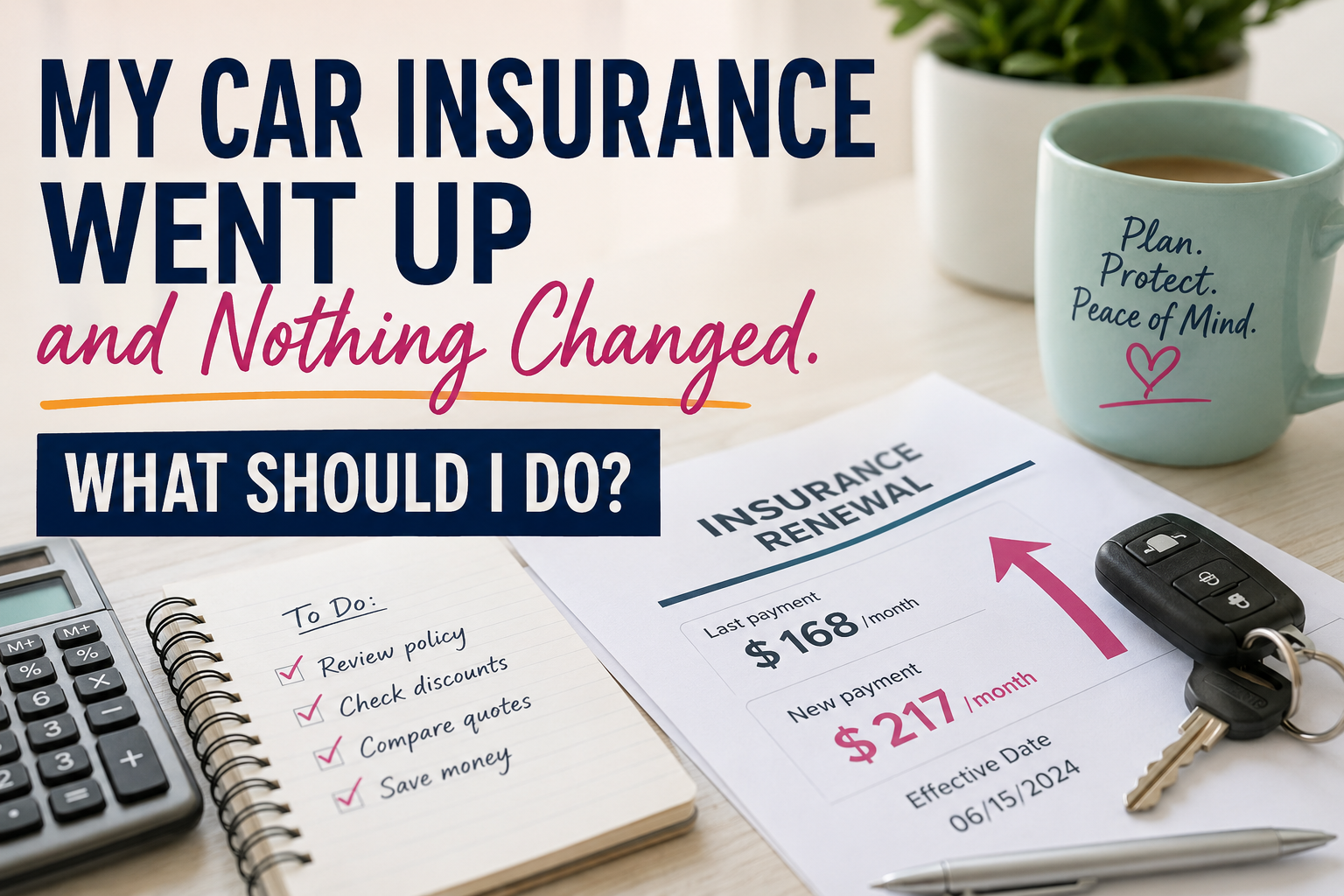
    My Car Insurance Went Up and Nothing Changed. What Should I Do?

    Your car insurance renewal showed up.

    Last time: $168 a month.

    New price: $217.

    Okay.

    That’s not a rounding error.

    So naturally, you start going through the list.

    Accident? No.

    Ticket? No.

    New car? No.

    New driver? No.

    Moved? Nope.

    Same car. Same house. Same person who was apparently perfectly acceptable to insure six months ago.

    So why are you suddenly paying more?

    Here’s the frustrating answer:

    You may not have done anything.

    But before you get mad, cancel the policy, or spend the afternoon collecting twelve different quotes, let’s figure out what actually changed.

    Start With the Renewal—Not Just the Price

    The new premium is obviously the part that got your attention.

    But don’t stop there.

    Pull out your current policy information and the renewal. We’re going to compare them side by side.

    Look at:

    • Vehicles
    • Drivers
    • Coverage limits
    • Deductibles
    • Discounts
    • Vehicle use or mileage, if shown
    • Address or garaging information
    • Optional coverages
    • And, finally, the premium

    If some of those terms aren’t familiar yet, the Insurance Terms Cheat Sheet can help while you work through the policy.

    We’re trying to answer one question:

    Did your price change because something on your policy changed, or did the price change even though the policy basically stayed the same?

    Those are two different conversations.

    Make Sure Nothing Actually Did Change

    I know.

    You already said nothing changed.

    Check anyway.

    Insurance companies use more information than simply whether you crashed the car or got a ticket.

    Maybe a discount disappeared.

    Maybe the estimated mileage changed.

    Maybe a driver is classified differently.

    Maybe something about the vehicle information changed.

    Maybe a discount expired.

    Maybe the way you pay changed.

    Or maybe there’s simply an error.

    That’s why I’d look at the policy before calling anyone.

    You want to be able to say:

    “I’m comparing my old policy with the renewal, and I don’t see any meaningful change in my coverage or information. Can you explain what’s causing the increase?”

    That’s a much more useful question than:

    “Why did my insurance go up?”

    Check Your Discounts

    This one deserves its own stop.

    Look at the discounts on the old policy.

    Now look at the renewal.

    Are they all still there?

    You might see things like a safe-driver discount, multi-policy discount, multi-car discount, low-mileage discount, good-student discount, automatic-payment discount, or something else offered by your insurer.

    Discounts vary by company and state, so we’re not assuming you should have any particular one.

    We’re checking whether something you already had disappeared.

    And while you’re at it, ask:

    “Are there any discounts I’m eligible for that aren’t currently applied?”

    Simple question.

    Worth asking.

    Now Call the Insurance Company or Agent

    This is where we find out what’s going on.

    Have the renewal in front of you and ask:

    “Can you walk me through why my premium increased?”

    You don’t need to know all the insurance terminology.

    You don’t need to argue.

    You just want an explanation.

    If the answer is, “Rates increased in your area,” okay.

    Then ask whether there were any changes specific to your policy.

    If they mention a driver, vehicle, claim, mileage, or another factor, make sure the information is accurate.

    If something is wrong, ask what they need from you to correct it.

    And if everything is right and the rate simply increased?

    Well, now we know what problem we’re actually solving.

    We may not like the answer.

    But at least we have one.

    Yes, Your Rate Can Go Up Even If You Didn’t Have an Accident

    This is one of the things that frustrates people most about insurance.

    You can drive carefully, avoid tickets, file no claims—and still get a higher renewal.

    Why?

    Because your premium isn’t based only on what happened to you personally.

    Insurance companies are also estimating the cost of future claims. If vehicles become more expensive to repair, parts and labor cost more, medical claims become more expensive, theft patterns change, or losses increase in an area, those costs can eventually affect premiums.

    That doesn’t mean every increase automatically makes sense for your situation.

    And it certainly doesn’t mean you shouldn’t shop around.

    It just means:

    “But I didn’t have an accident” isn’t the only thing affecting the price.

    Don’t Immediately Start Cutting Coverage

    Your premium went up $50 a month.

    You want that $50 back.

    Understandable.

    So maybe you start looking at the policy and thinking:

    Higher deductible?

    Lower liability limit?

    Drop rental reimbursement?

    Remove collision?

    Hold on.

    We can review all of those things.

    But don’t start removing coverage simply because you’re angry about the price.

    Every change has another side.

    Raise the deductible?

    Your premium may go down, but you’re agreeing to take on more of the cost after certain claims.

    Lower a limit?

    You may be keeping more of the financial risk yourself.

    Remove a coverage?

    Make sure you understand what problem that coverage was handling before you decide you no longer want it.

    The goal isn’t:

    Make the premium number smaller at any cost.

    The goal is:

    Pay a reasonable amount for coverage that still makes sense for you.

    Now Look for Ways to Lower the Bill

    Once you know the policy information is correct, start with the easier possibilities.

    Ask about discounts.

    Review how many miles you’re driving.

    Make sure the vehicle-use information is accurate.

    Look at optional coverages.

    Ask what changing your deductibles would do to the premium.

    If you have more than one policy, ask whether bundling changes anything.

    But whenever you’re offered a change, ask one more question:

    “What am I giving up to save this money?”

    Sometimes the answer is:

    Nothing. You found a discount.

    Wonderful.

    Sometimes the answer is:

    You’re taking on another $500 of deductible.

    That’s different.

    Savings aren’t really savings until you understand the tradeoff.

    And Yes, This May Be the Time to Shop

    Sometimes you do everything above and reach a very simple conclusion.

    Your insurer wants $217 a month.

    You’d like to know whether somebody else wants less.

    Fair enough.

    Get some quotes.

    But please don’t compare only this:

    Company A: $217
    Company B: $181
    Company C: $159

    Looks like Company C wins.

    Maybe.

    Before we hand them the trophy, we need to know what they’re actually quoting.

    Compare the Coverage Before You Compare the Price

    This is where insurance shopping can get messy.

    One quote might have higher liability limits.

    Another might have lower limits.

    One might have a $500 deductible.

    Another has $1,000.

    One includes rental reimbursement.

    Another doesn’t.

    One includes a coverage you had before.

    Another leaves it out.

    Suddenly, $159 versus $217 isn’t really a comparison.

    It’s two different products with two different prices.

    That’s exactly why we created the Insurance Checkup & Quote Comparison Tool.

    Put the quotes next to each other and compare:

    • Limits
    • Deductibles
    • Coverages
    • Options
    • Then price

    You don’t have to choose the quote with the most coverage.

    And you don’t automatically have to choose the cheapest one.

    You just need to understand what you’re choosing.

    Be Careful About Raising Your Deductible Just to Lower the Premium

    Raising a deductible is a common way to reduce the price.

    And sometimes it makes perfect sense.

    Suppose changing your collision deductible from $500 to $1,000 saves you money.

    Great.

    But I want you to ask yourself something else:

    If you had a covered collision next Tuesday, could you reasonably handle that $1,000 deductible?

    If the answer is yes, maybe that tradeoff deserves consideration.

    If the answer is:

    “I’d have to put the deductible on a credit card,”

    then we should think a little harder.

    The cheapest insurance decision today can become an expensive problem later.

    Don’t Cancel the Old Policy Too Early

    You found another insurer.

    The coverage looks good.

    The price is better.

    Excellent.

    Before cancelling your current policy, make sure the new coverage is actually set to begin.

    Check the effective date.

    Make sure you’ve completed everything the new insurer requires.

    Then coordinate the cancellation of the old policy.

    We do not want:

    Old policy ends Friday.

    New policy begins Monday.

    Saturday and Sunday suddenly become extremely exciting.

    Avoid the lapse.

    What If the Other Quotes Aren’t Any Better?

    That can happen too.

    You get three quotes.

    Maybe four.

    And they’re all expensive.

    That’s useful information.

    It suggests your current insurer may not be uniquely expensive.

    At that point, we have to look at the bigger picture.

    Can you comfortably handle the premium?

    Are there reasonable changes available?

    Could you increase a deductible without creating another financial problem?

    Are there expenses elsewhere that could be adjusted?

    This is where auto insurance stops being only an insurance question and starts becoming a money question.

    You need the coverage.

    But you also have to be able to afford it.

    Don’t Shop Yourself Into Worse Insurance

    This is the part I really want you to remember.

    A lower premium feels like a win.

    And it can be.

    But saving $38 a month isn’t much of a victory if you accidentally gave up something you would have wanted after a serious accident.

    So slow down.

    You don’t have to understand every sentence in an insurance contract before you can shop intelligently.

    You do need to understand the major choices you’re making.

    That’s one of the reasons we’re putting together Let’s Talk About Auto Insurance.

    The book goes much deeper into what the different coverages actually do, how limits and deductibles work, why premiums change, and what to think about when you’re deciding what protection makes sense for you.

    But you don’t need the whole book to deal with today’s renewal.

    Today, you need a plan.

    So Your Car Insurance Went Up. Now What?

    Don’t panic.

    Don’t immediately cancel.

    And don’t start randomly removing coverage.

    Do this instead:

    1. Compare the old policy with the renewal.
    2. Make sure the drivers, vehicles, and other information are correct.
    3. Check your discounts.
    4. Ask why the premium changed.
    5. Ask what options might lower it.
    6. Understand the tradeoffs before changing coverage.
    7. Get a few comparable quotes if the price still doesn’t make sense.
    8. Use the Insurance Checkup & Quote Comparison Tool so you’re comparing the same things.
    9. Then decide whether staying or switching makes more sense.

    Maybe you find a much better price.

    Maybe you discover a missing discount.

    Maybe you make a reasonable adjustment.

    Maybe you decide your current policy is still the best option available.

    Any of those can be a good outcome.

    Because the goal wasn’t simply to get a cheaper number.

    The goal was to understand why the number changed and make a deliberate decision about what to do next.

    That’s a much better response than staring at the renewal and wondering:

    What did I do?

    Maybe nothing.

    Now let’s see what you can actually do about it.


    This article is for general educational and informational purposes only and isn’t intended as individualized insurance, financial, legal, or tax advice. Insurance coverage, pricing, requirements, and policy terms vary by insurer, policy, and state. Review your own policy and circumstances, and contact your insurance company, licensed insurance professional, state insurance regulator, or another qualified professional when appropriate.

    Share This Conversation