
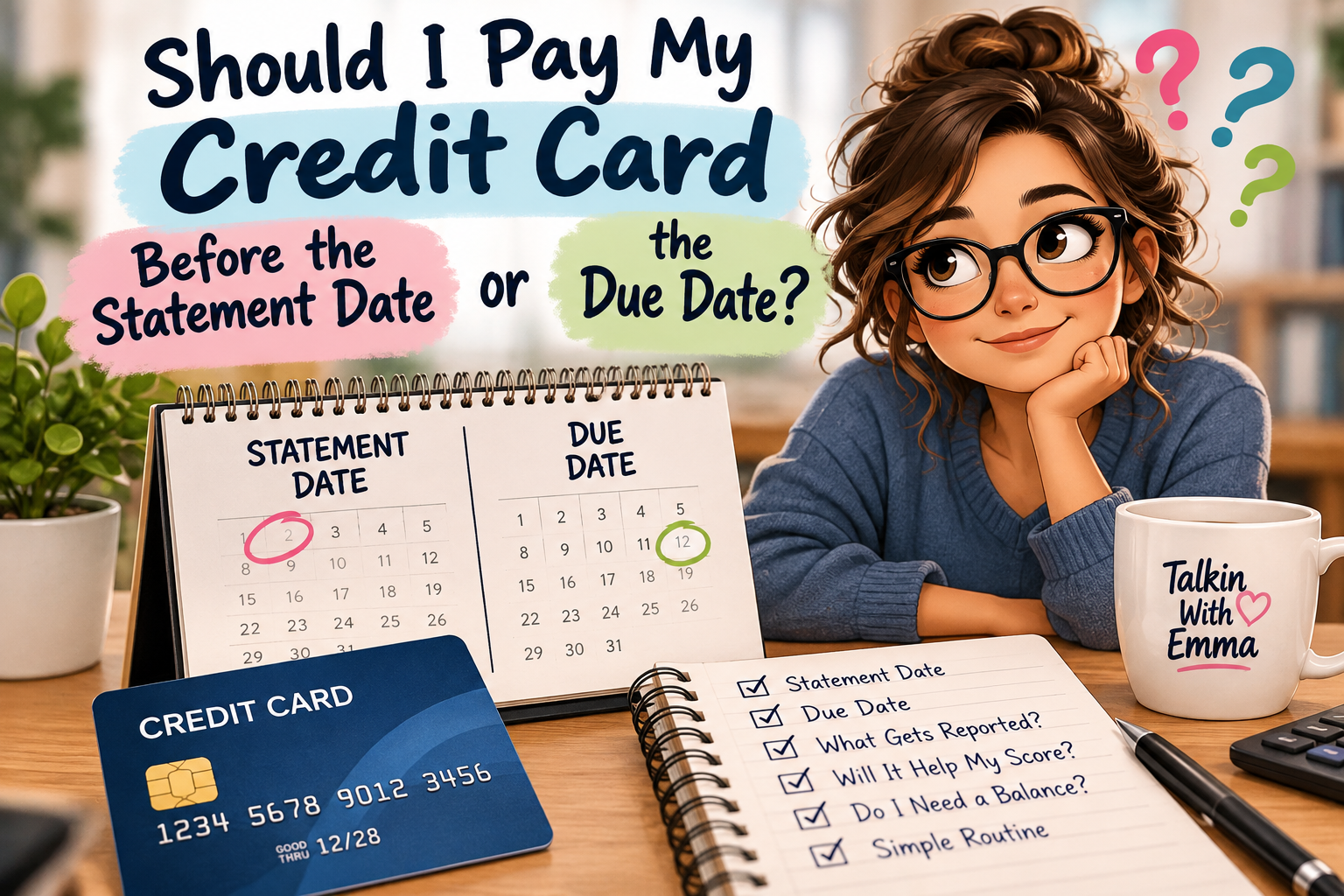
If you have ever tried to figure out the “right” day to pay a credit card, the internet can make a simple bill feel like a strategy game.
Pay before the statement date. Pay on the due date. Pay twice a month. Leave a tiny balance. Never leave a balance.
That is a lot of rules for something that should be much easier.
Here is the short answer: If your goal is to make an on-time payment and, when your card has an applicable grace period, avoid interest on purchases, focus on paying the amount required by your card agreement by the due date. If you are trying to lower the balance that may appear on your credit reports, making a payment before the statement closes may help because many issuers report account information around the end of a billing cycle. You do not need to carry a balance or pay interest to build credit.
First, What Is the Statement Date?
Your credit card runs on billing cycles. At the end of a cycle, the card company creates a statement showing what happened during that period.
That statement usually includes your statement balance, minimum payment, payment due date, interest and fees, credit limit, and a list of transactions.
Think of the statement closing date as the point when the card company takes a snapshot of that billing cycle and prepares your bill.
Then What Is the Due Date?
The due date is the deadline for the payment shown on your statement.
At minimum, you need to make the required minimum payment by the due date to keep the payment from being late. Federal rules generally require card issuers to deliver or mail statements at least 21 days before the payment is due.
If your card provides a grace period on purchases and you meet its terms, paying the applicable statement balance in full by the due date can generally let you avoid interest on those purchases. Check your own card agreement because grace periods are not required and their terms can differ.
So Why Would Anyone Pay Before the Statement Closes?
This is where credit utilization enters the conversation.
Credit utilization is basically how much of your available revolving credit you are using. If you have a $1,000 limit and a $500 reported balance, that card is showing 50% utilization.
Credit scoring models can consider utilization. The balance that appears on a credit report is not necessarily the balance sitting in your account on the exact day someone checks your credit. Credit card companies periodically report account information to the credit bureaus, and the timing can vary by issuer.
That means a person who pays a card in full every month can still have a balance reported.
For example, imagine you have a $1,000 limit. You spend $600 during the month. Your statement closes showing $600, and then you pay that $600 in full before the due date.
You did not do anything wrong. You paid your bill as agreed. But if the issuer reported the $600 balance, your credit report may temporarily show relatively high utilization on that card.
If you had paid $400 before the statement closed, the statement might instead close with $200, depending on when the payment posted and when the issuer reports. That could mean a lower reported balance.
That is the practical reason some people make an early payment. It is not because paying on the due date is automatically bad.
Do I Need to Leave a Balance to Build Credit?
No.
This is one of those credit myths that refuses to go away.
You do not need to carry debt from one billing cycle to the next and pay interest just to prove that you can use credit. On-time account history can help build credit without deliberately paying interest.
If you can pay your statement balance in full and your card’s grace-period terms apply, paying it by the due date is usually the less expensive approach.
What Is the Difference Between the Minimum Payment and the Statement Balance?
This distinction matters much more than memorizing a special payment trick.
The minimum payment is the smallest amount your issuer says you must pay by the due date to satisfy that month’s required payment.
The statement balance is the balance shown when that billing cycle closed.
If you pay only the minimum, the rest does not disappear. You may pay interest on the unpaid amount, and paying a debt down can take much longer.
If money is tight and you cannot pay the full statement balance, do not let “I can’t pay it all” turn into “so I won’t pay anything.” Making at least the required minimum payment on time is important. Then look at what you can realistically pay above it.
Is It Bad to Pay My Credit Card More Than Once a Month?
No. You can generally make more than one payment during a billing cycle.
For some people, that is useful. Maybe you get paid every two weeks and prefer paying part of the card each payday. Maybe making an early payment helps keep your reported balance lower. Maybe smaller payments simply make the household budget easier to manage.
Those are practical reasons.
What you do not need is a complicated schedule because someone online promised that paying on two magic days will automatically boost your score.
Please Don’t Turn This Into Another Credit-Score Game
Once people learn that reported balances can affect utilization, it is easy to start micromanaging every purchase and payment.
You probably do not need to do that.
Credit scores can matter, especially when you are preparing to apply for a mortgage, auto loan, apartment, or another product where your credit will be reviewed. In that situation, paying balances down before they are reported may be useful if utilization is high.
But for everyday credit management, the bigger habits are much less exciting:
- Know your due date.
- Make at least the required payment on time.
- Pay the statement balance in full when you reasonably can and when that fits your card’s terms.
- Keep an eye on how much of your available credit you are using.
- Read your statements.
- Do not spend money just because credit is available.
Those habits are not flashy enough for a viral “credit hack,” but they are much more useful.
A Simple Credit Card Routine
If you want to keep this simple, try this:
- Check your statement every month. Make sure the transactions look right and note the statement balance, minimum payment, and due date.
- Set up a reminder or autopay. At the very least, protect yourself from accidentally missing the required payment.
- Pay the statement balance in full when you can. If your card has an applicable grace period and you meet its conditions, this can help you avoid purchase interest.
- If your reported balance is high, consider paying earlier. An extra payment before the statement closes may reduce the balance that gets reported, depending on your issuer’s reporting schedule.
- If you cannot pay in full, make a plan instead of avoiding the bill. Pay at least the required minimum on time, then decide how much extra you can put toward the balance.
That is enough. You do not need to turn paying a credit card into a part-time job.
Quick Questions
Does paying before the statement date help my credit score?
It can help lower the balance that may be reported to the credit bureaus, which may lower your reported utilization. Whether that changes a particular score depends on the information in your credit report and the scoring model being used.
When do credit card companies report balances?
Reporting schedules vary. Many issuers report periodically around the end of a billing cycle, but you should not assume every issuer reports on the same day. You can check your credit reports to see what balance is appearing and ask your issuer about its reporting practices.
Should I leave a small balance on my card?
You do not need to carry a balance from month to month or pay interest in order to build credit.
Should I pay on the statement date or due date?
You do not have to wait for either date to make a payment. The due date is the important deadline for making the required payment on time. Paying earlier can be useful for budgeting or for reducing the balance that may be reported.
What if I cannot afford the statement balance?
Pay at least the required minimum by the due date if you can, then pay as much additional principal as your budget reasonably allows. If you are struggling to make even the minimum payment, contact the card issuer as soon as possible rather than waiting until after you miss it.
The Bottom Line
The statement date and the due date do two different jobs.
The statement date closes out a billing cycle and helps determine what appears on that month’s statement. The due date tells you when the required payment must be received.
If you want the simplest rule, start here: pay on time, pay the statement balance in full when you reasonably can, and do not carry debt just because someone told you it helps your credit.
Once you understand what the dates and numbers actually mean, credit gets a lot less mysterious.
Friendly conversations. Practical tools. Clear explanations.
Want a Little More Help?
If you’re trying to make credit-card payments fit more comfortably into the rest of your month, it can help to look at the whole money picture instead of one due date at a time.
Want a simple free tool to help with the next step?
Get the free Monthly Money Check-In.
Want a clearer, beginner-friendly way to work through your money?
Take a look at Let’s Talk About Money.
Want practical insurance, money, and everyday-life help in your inbox?
Join Emma’s Mailbox.