
You found the car.
You drove it.
You like it.
The numbers are starting to look acceptable.
And then somebody at the dealership asks:
“Do you have proof of insurance?”
Right.
Insurance.
One more thing.
If you’re buying a car soon, I would not leave this part until you’re sitting at the dealership with paperwork spread across the desk and somebody waiting for an answer.
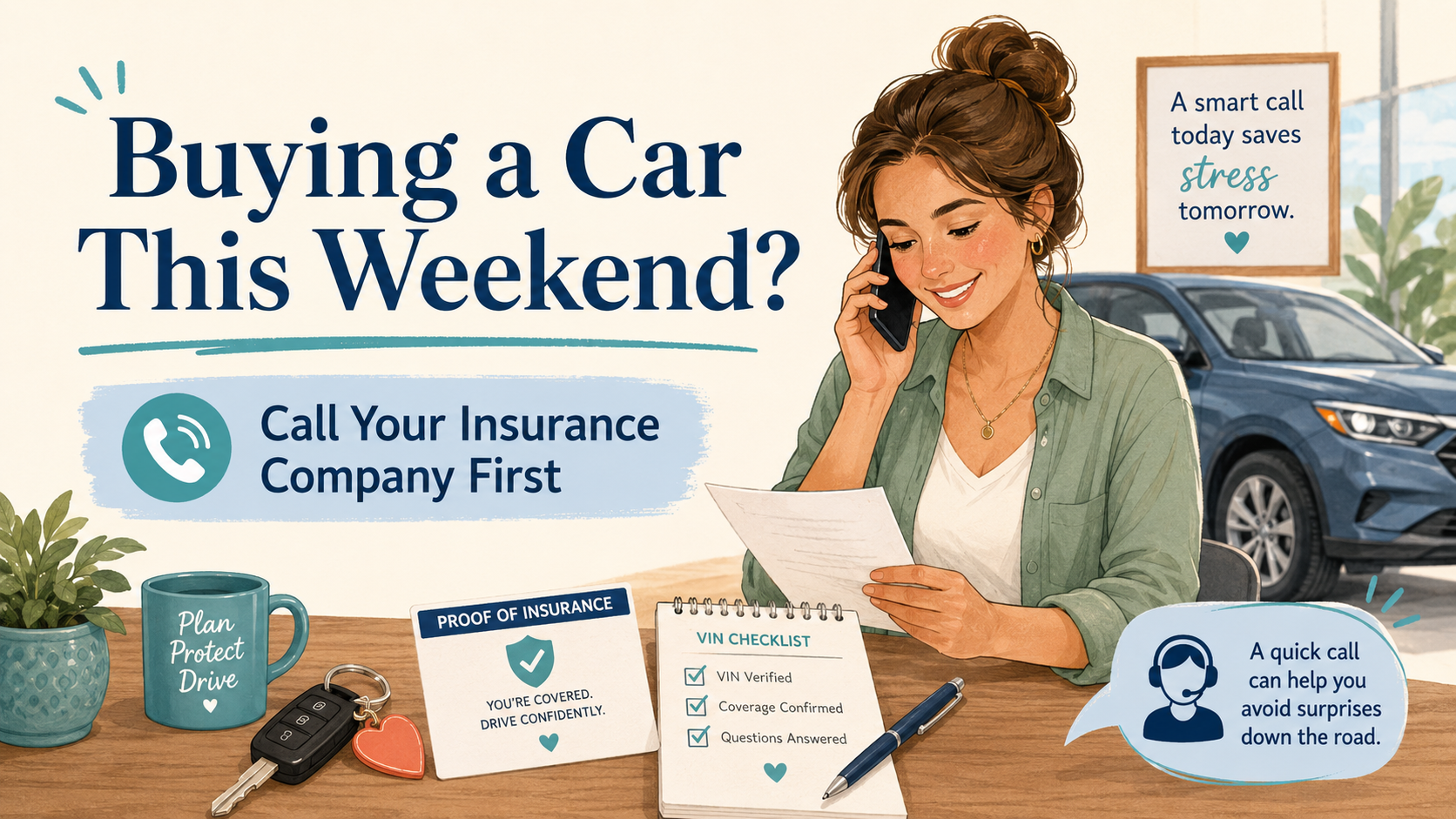
Call your insurance company before you buy the car.
Preferably before you fall completely in love with it.
There are a few reasons for that.
Call Before You Sign, Not After You Drive Away
If you already have auto insurance, your current policy may provide some temporary coverage for a newly acquired vehicle.
Or it may not work the way you think it does.
How much coverage applies, what kind of coverage applies, how long it lasts, and what you need to do next can depend on your policy, insurer, and state.
So instead of relying on:
“I think my insurance automatically covers a new car for a few days.”
Call and ask.
Try:
“I’m considering buying another vehicle. What happens to my coverage when I take ownership, and what do you need from me before I drive it home?”
Now you know.
Much better than finding out in the dealership parking lot.
Get the Insurance Price Before You Buy the Car
This part matters.
The car payment is not the only monthly cost of the car.
Insurance counts too.
A vehicle that looks affordable at the dealership can feel a lot less affordable once you add the insurance bill.
Different vehicles can cost very different amounts to insure.
Repair costs can matter.
Vehicle value can matter.
The type of vehicle can matter.
Safety and loss history can matter.
And your own rating factors still matter too.
So if you’re seriously considering a car, get the VIN and ask your insurer—or several insurers—what it would cost to insure.
Do that before you sign if you can.
You may still buy the car.
At least you’ll be buying it with the real number in front of you.
The VIN Is Your Friend
If you’re getting an actual insurance quote for a specific car, the VIN helps your insurer identify exactly what you’re looking at.
Ask the dealer for it.
Then be ready with things like:
- The VIN
- Year, make, and model
- Who will drive the vehicle
- How you’ll use it
- Where it will normally be kept
- Approximate annual mileage, if asked
- Whether you’re financing, leasing, or paying cash
Your insurer may need a few other things too.
The goal is to avoid:
“It’s some kind of blue Honda SUV.”
We’re aiming for slightly more precision.
Financing or Leasing? The Lender Gets a Say Too
This is where buying the car and insuring the car start bumping into each other.
If you’re financing or leasing, the lender or leasing company may require certain coverage on the vehicle.
Collision and comprehensive are commonly part of that conversation.
That doesn’t mean the lender chooses every part of your auto policy.
But it may mean you cannot simply carry the minimum liability coverage and call it done.
Ask what the lender requires.
Then make sure the insurance quote you’re considering actually meets those requirements.
And if collision, comprehensive, liability limits, deductibles, rental reimbursement, and uninsured motorist coverage are starting to blur together, Let’s Talk About Auto Insurance walks through what those coverages do and why they matter.
Don’t Automatically Copy the Coverage From Your Old Car
Let’s say you’ve been driving a 12-year-old car that’s fully paid off.
You may have made certain insurance choices because of that car’s age, value, or how you used it.
Now you’re buying a much newer car with a loan.
Different car.
Different situation.
Simply copying every choice from the old car may not make sense.
Maybe the lender requires coverage you did not carry before.
Maybe you want to look at the deductible again.
Maybe rental reimbursement matters more now because being without the car would create a bigger transportation problem.
Maybe nothing needs changing except the vehicle itself.
Fine.
Just look at it.
“Whatever I had before” is convenient.
It isn’t always a decision.
Ask What Happens to the Old Car
Are you trading it in?
Selling it?
Keeping it?
Giving it to someone else?
Don’t forget that part.
If you’re replacing the old vehicle, ask your insurer how and when it should come off the policy.
If you’re keeping both cars, you’re adding a vehicle rather than replacing one.
And don’t remove coverage too early if you still own or drive the old car.
The timing matters.
We’re trying to avoid a coverage gap—or a car sitting in the driveway that everybody somehow forgot was still part of the plan.
Don’t Forget GAP If You’re Financing
GAP is another term you may hear while you’re sitting at the dealership.
It deals with a fairly specific problem:
You owe more on the vehicle loan than the vehicle is worth for purposes of an insurance settlement after a total loss.
Suppose you owe $32,000.
The car is totaled.
The applicable insurance settlement is based on a lower vehicle value.
You may still owe money on the loan after the auto insurance payment.
GAP may help with that difference, depending on the product and its terms.
You may be offered GAP through the dealer or lender. It may also be available elsewhere.
So don’t assume the first version put in front of you is the only option.
Ask:
- What does it cost?
- What exactly does it cover?
- Are there limits or exclusions?
- Do I already have anything similar?
- Can I get similar protection somewhere else?
You do not need to become a GAP expert in the finance office.
You do need to understand what you’re paying for.
Ask for the New Premium in Actual Dollars
Don’t just ask:
“Will my insurance go up?”
Ask:
“What will my new premium be?”
Those are not the same question.
“Probably a little” is not a budgeting number.
Maybe the increase is $18 a month.
Maybe it’s $90.
Maybe the premium goes down.
Find out.
If you’re choosing between several vehicles, insurance cost may even affect which one makes more sense.
Car A and Car B might have almost identical payments.
But if Car A costs another $70 a month to insure?
They’re not quite as identical anymore.
If You’re Shopping for Insurance Too, Compare Carefully
Buying a car can also be a good time to compare insurance companies.
Just make sure you’re comparing similar things.
Don’t get one quote using your current limits and another using much lower limits and then decide the second company is cheaper.
Of course it’s cheaper.
You changed the thing you’re buying.
Try to keep the major pieces reasonably consistent:
- Coverage choices
- Limits
- Deductibles
Then compare the price.
That’s where the Insurance Checkup & Quote Comparison Workbook can help you keep the numbers straight.
The dealership is already giving your brain enough numbers to manage.
Put the insurance numbers somewhere else.
What About the Dealer’s Insurance Products?
Dealerships may offer other insurance-related products or protections.
Some may be useful.
Some may duplicate something you already have.
Some may solve one very specific problem.
Don’t feel like you have to say yes simply because you’ve already signed seventeen other pieces of paper.
Ask what the product does.
Ask what it costs.
Ask whether it’s insurance, a waiver, a service contract, or something else.
Ask whether you’re required to buy it.
Ask whether you can buy similar protection somewhere else.
And read before you sign.
Being tired of paperwork is not the same thing as understanding the paperwork.
Unfortunately.
What Should You Ask Your Insurer Before You Go?
Keep this part simple.
Tell them you’re considering buying a specific vehicle.
Then ask:
- What would it cost to insure this car?
- What coverage would apply when I take ownership?
- Do I need to contact you before I leave the dealership?
- What information do you need from me?
- If I’m financing or leasing, does this quote meet the lender’s requirements?
- What happens to my current vehicle if I’m trading it in?
- When will the new premium take effect?
- How will I get proof of insurance?
Those answers should eliminate most of the last-minute scrambling.
What If You’re Buying on a Saturday?
Think about this before Saturday gets here.
If your agent or insurer has limited weekend hours, don’t assume somebody will be available when you’re sitting at the dealership.
Some companies offer 24-hour phone or online service.
Some don’t.
Find out ahead of time.
If you’re buying outside normal business hours, ask how you’re supposed to add the vehicle and get proof of coverage.
Again:
We’re not trying to memorize insurance rules.
We’re trying to keep Future You from standing in the dealership saying:
“Um…I think I’m covered?”
Before You Drive Away
Take a minute.
Make sure the insurance part is actually finished.
You should know:
- Which vehicle is insured
- When coverage starts
- What major coverages and deductibles you selected
- Whether lender requirements have been handled
- What the premium is
- What happens to the old vehicle
- How to access your proof of insurance
If you don’t know one of those things?
Ask.
The new car will still be exciting in ten minutes.
Buying the Car Is the Fun Part
Insurance is rarely the part anybody is excited about.
Nobody posts:
“NEW CAR!!! And you should see my declarations page!”
That’s okay.
The goal isn’t to make insurance exciting.
It’s to keep the insurance part from becoming a problem later.
So if you’re buying a car this weekend, make one call before you go.
Get the VIN.
Get the insurance price.
Find out when coverage starts.
Ask what your insurer needs.
Then go buy the car knowing the number on the dealership paperwork isn’t the only number coming home with you.
And if you’re still not sure what the coverages actually do—or why you might choose one option over another—Let’s Talk About Auto Insurance takes that conversation further.
For today, though?
Don’t let the first insurance conversation happen after you’ve already bought the car.
That’s one surprise we can avoid.
This article is for general educational and informational purposes only and isn’t intended as individualized insurance, financial, legal, or tax advice. Auto insurance requirements, newly acquired vehicle provisions, coverage timing, lender requirements, policy terms, and any grace periods vary by insurer, policy, and state. Confirm your coverage directly with your insurer or licensed insurance professional before relying on coverage for a newly purchased vehicle.