
Category: Auto Insurance

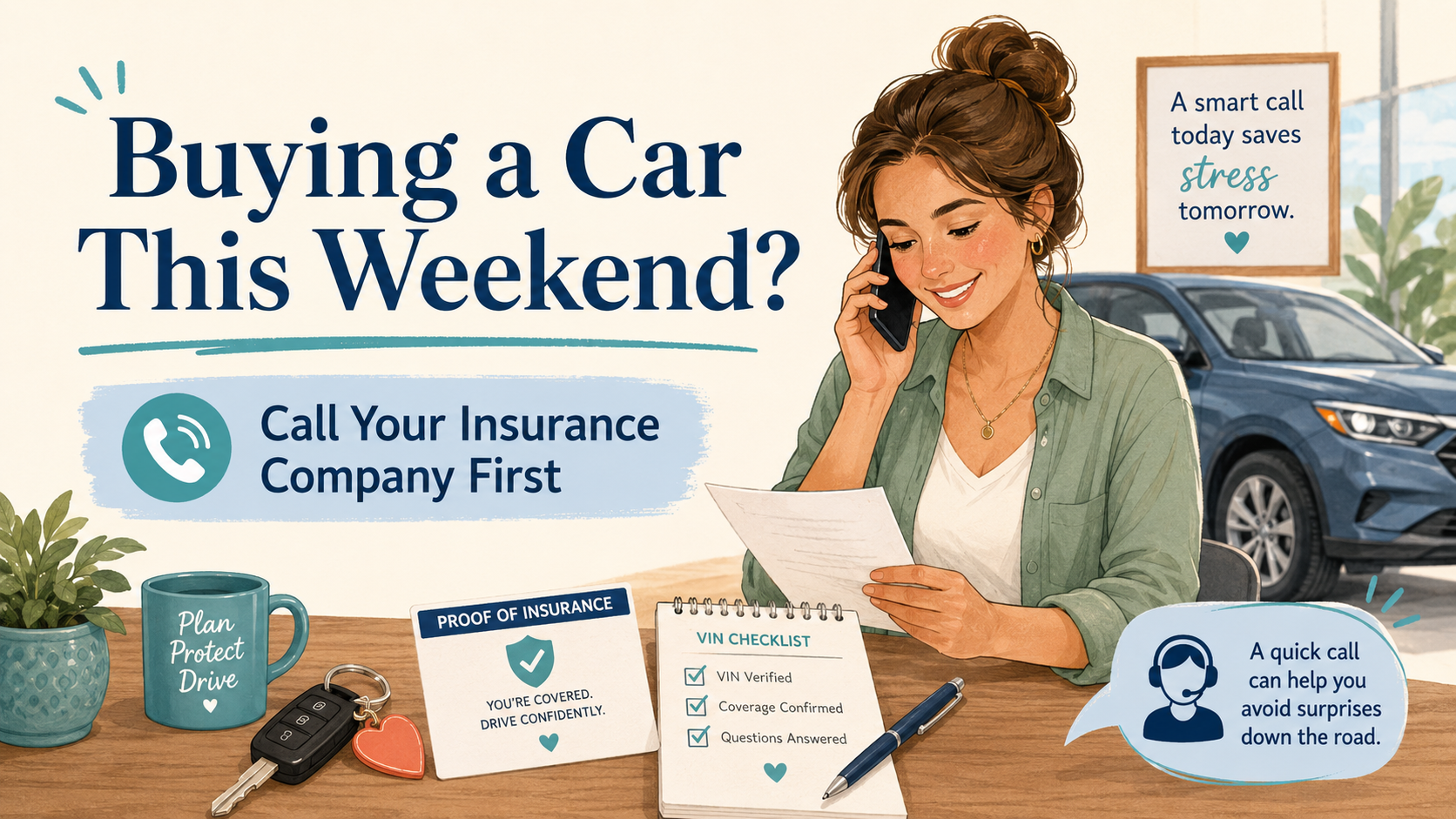
  • Buying a Car This Weekend? When to Call Your Insurance Company

    Buying a Car This Weekend? When to Call Your Insurance Company

    You found the car.

    You drove it.

    You like it.

    The numbers are starting to look acceptable.

    And then somebody at the dealership asks:

    “Do you have proof of insurance?”

    Right.

    Insurance.

    One more thing.

    If you’re buying a car soon, I would not leave this part until you’re sitting at the dealership with paperwork spread across the desk and somebody waiting for an answer.

    Call your insurance company before you buy the car.

    Preferably before you fall completely in love with it.

    There are a few reasons for that.

    Call Before You Sign, Not After You Drive Away

    If you already have auto insurance, your current policy may provide some temporary coverage for a newly acquired vehicle.

    Or it may not work the way you think it does.

    How much coverage applies, what kind of coverage applies, how long it lasts, and what you need to do next can depend on your policy, insurer, and state.

    So instead of relying on:

    “I think my insurance automatically covers a new car for a few days.”

    Call and ask.

    Try:

    “I’m considering buying another vehicle. What happens to my coverage when I take ownership, and what do you need from me before I drive it home?”

    Now you know.

    Much better than finding out in the dealership parking lot.

    Get the Insurance Price Before You Buy the Car

    This part matters.

    The car payment is not the only monthly cost of the car.

    Insurance counts too.

    A vehicle that looks affordable at the dealership can feel a lot less affordable once you add the insurance bill.

    Different vehicles can cost very different amounts to insure.

    Repair costs can matter.

    Vehicle value can matter.

    The type of vehicle can matter.

    Safety and loss history can matter.

    And your own rating factors still matter too.

    So if you’re seriously considering a car, get the VIN and ask your insurer—or several insurers—what it would cost to insure.

    Do that before you sign if you can.

    You may still buy the car.

    At least you’ll be buying it with the real number in front of you.

    The VIN Is Your Friend

    If you’re getting an actual insurance quote for a specific car, the VIN helps your insurer identify exactly what you’re looking at.

    Ask the dealer for it.

    Then be ready with things like:

    • The VIN
    • Year, make, and model
    • Who will drive the vehicle
    • How you’ll use it
    • Where it will normally be kept
    • Approximate annual mileage, if asked
    • Whether you’re financing, leasing, or paying cash

    Your insurer may need a few other things too.

    The goal is to avoid:

    “It’s some kind of blue Honda SUV.”

    We’re aiming for slightly more precision.

    Financing or Leasing? The Lender Gets a Say Too

    This is where buying the car and insuring the car start bumping into each other.

    If you’re financing or leasing, the lender or leasing company may require certain coverage on the vehicle.

    Collision and comprehensive are commonly part of that conversation.

    That doesn’t mean the lender chooses every part of your auto policy.

    But it may mean you cannot simply carry the minimum liability coverage and call it done.

    Ask what the lender requires.

    Then make sure the insurance quote you’re considering actually meets those requirements.

    And if collision, comprehensive, liability limits, deductibles, rental reimbursement, and uninsured motorist coverage are starting to blur together, Let’s Talk About Auto Insurance walks through what those coverages do and why they matter.

    Don’t Automatically Copy the Coverage From Your Old Car

    Let’s say you’ve been driving a 12-year-old car that’s fully paid off.

    You may have made certain insurance choices because of that car’s age, value, or how you used it.

    Now you’re buying a much newer car with a loan.

    Different car.

    Different situation.

    Simply copying every choice from the old car may not make sense.

    Maybe the lender requires coverage you did not carry before.

    Maybe you want to look at the deductible again.

    Maybe rental reimbursement matters more now because being without the car would create a bigger transportation problem.

    Maybe nothing needs changing except the vehicle itself.

    Fine.

    Just look at it.

    “Whatever I had before” is convenient.

    It isn’t always a decision.

    Ask What Happens to the Old Car

    Are you trading it in?

    Selling it?

    Keeping it?

    Giving it to someone else?

    Don’t forget that part.

    If you’re replacing the old vehicle, ask your insurer how and when it should come off the policy.

    If you’re keeping both cars, you’re adding a vehicle rather than replacing one.

    And don’t remove coverage too early if you still own or drive the old car.

    The timing matters.

    We’re trying to avoid a coverage gap—or a car sitting in the driveway that everybody somehow forgot was still part of the plan.

    Don’t Forget GAP If You’re Financing

    GAP is another term you may hear while you’re sitting at the dealership.

    It deals with a fairly specific problem:

    You owe more on the vehicle loan than the vehicle is worth for purposes of an insurance settlement after a total loss.

    Suppose you owe $32,000.

    The car is totaled.

    The applicable insurance settlement is based on a lower vehicle value.

    You may still owe money on the loan after the auto insurance payment.

    GAP may help with that difference, depending on the product and its terms.

    You may be offered GAP through the dealer or lender. It may also be available elsewhere.

    So don’t assume the first version put in front of you is the only option.

    Ask:

    • What does it cost?
    • What exactly does it cover?
    • Are there limits or exclusions?
    • Do I already have anything similar?
    • Can I get similar protection somewhere else?

    You do not need to become a GAP expert in the finance office.

    You do need to understand what you’re paying for.

    Ask for the New Premium in Actual Dollars

    Don’t just ask:

    “Will my insurance go up?”

    Ask:

    “What will my new premium be?”

    Those are not the same question.

    “Probably a little” is not a budgeting number.

    Maybe the increase is $18 a month.

    Maybe it’s $90.

    Maybe the premium goes down.

    Find out.

    If you’re choosing between several vehicles, insurance cost may even affect which one makes more sense.

    Car A and Car B might have almost identical payments.

    But if Car A costs another $70 a month to insure?

    They’re not quite as identical anymore.

    If You’re Shopping for Insurance Too, Compare Carefully

    Buying a car can also be a good time to compare insurance companies.

    Just make sure you’re comparing similar things.

    Don’t get one quote using your current limits and another using much lower limits and then decide the second company is cheaper.

    Of course it’s cheaper.

    You changed the thing you’re buying.

    Try to keep the major pieces reasonably consistent:

    • Coverage choices
    • Limits
    • Deductibles

    Then compare the price.

    That’s where the Insurance Checkup & Quote Comparison Workbook can help you keep the numbers straight.

    The dealership is already giving your brain enough numbers to manage.

    Put the insurance numbers somewhere else.

    What About the Dealer’s Insurance Products?

    Dealerships may offer other insurance-related products or protections.

    Some may be useful.

    Some may duplicate something you already have.

    Some may solve one very specific problem.

    Don’t feel like you have to say yes simply because you’ve already signed seventeen other pieces of paper.

    Ask what the product does.

    Ask what it costs.

    Ask whether it’s insurance, a waiver, a service contract, or something else.

    Ask whether you’re required to buy it.

    Ask whether you can buy similar protection somewhere else.

    And read before you sign.

    Being tired of paperwork is not the same thing as understanding the paperwork.

    Unfortunately.

    What Should You Ask Your Insurer Before You Go?

    Keep this part simple.

    Tell them you’re considering buying a specific vehicle.

    Then ask:

    • What would it cost to insure this car?
    • What coverage would apply when I take ownership?
    • Do I need to contact you before I leave the dealership?
    • What information do you need from me?
    • If I’m financing or leasing, does this quote meet the lender’s requirements?
    • What happens to my current vehicle if I’m trading it in?
    • When will the new premium take effect?
    • How will I get proof of insurance?

    Those answers should eliminate most of the last-minute scrambling.

    What If You’re Buying on a Saturday?

    Think about this before Saturday gets here.

    If your agent or insurer has limited weekend hours, don’t assume somebody will be available when you’re sitting at the dealership.

    Some companies offer 24-hour phone or online service.

    Some don’t.

    Find out ahead of time.

    If you’re buying outside normal business hours, ask how you’re supposed to add the vehicle and get proof of coverage.

    Again:

    We’re not trying to memorize insurance rules.

    We’re trying to keep Future You from standing in the dealership saying:

    “Um…I think I’m covered?”

    Before You Drive Away

    Take a minute.

    Make sure the insurance part is actually finished.

    You should know:

    • Which vehicle is insured
    • When coverage starts
    • What major coverages and deductibles you selected
    • Whether lender requirements have been handled
    • What the premium is
    • What happens to the old vehicle
    • How to access your proof of insurance

    If you don’t know one of those things?

    Ask.

    The new car will still be exciting in ten minutes.

    Buying the Car Is the Fun Part

    Insurance is rarely the part anybody is excited about.

    Nobody posts:

    “NEW CAR!!! And you should see my declarations page!”

    That’s okay.

    The goal isn’t to make insurance exciting.

    It’s to keep the insurance part from becoming a problem later.

    So if you’re buying a car this weekend, make one call before you go.

    Get the VIN.

    Get the insurance price.

    Find out when coverage starts.

    Ask what your insurer needs.

    Then go buy the car knowing the number on the dealership paperwork isn’t the only number coming home with you.

    And if you’re still not sure what the coverages actually do—or why you might choose one option over another—Let’s Talk About Auto Insurance takes that conversation further.

    For today, though?

    Don’t let the first insurance conversation happen after you’ve already bought the car.

    That’s one surprise we can avoid.


    This article is for general educational and informational purposes only and isn’t intended as individualized insurance, financial, legal, or tax advice. Auto insurance requirements, newly acquired vehicle provisions, coverage timing, lender requirements, policy terms, and any grace periods vary by insurer, policy, and state. Confirm your coverage directly with your insurer or licensed insurance professional before relying on coverage for a newly purchased vehicle.
    Share This Conversation
  • Someone Hit My Parked Car. What Do I Do About Insurance?

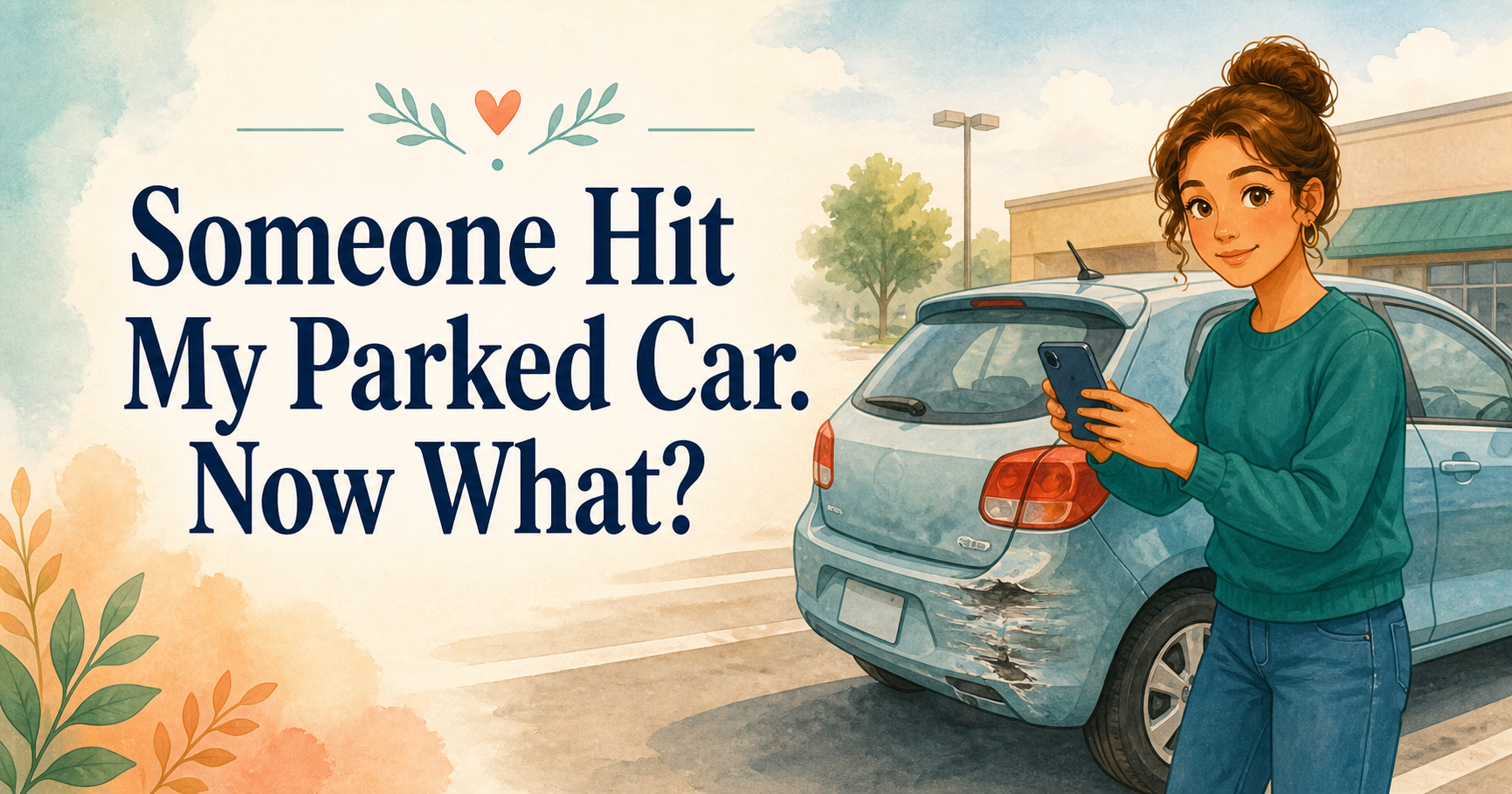
    Someone Hit My Parked Car. What Do I Do About Insurance?

    You walk back to your car.

    Something looks wrong.

    Very wrong.

    There’s a dent that wasn’t there before. Maybe a broken light. Scraped paint. A bumper hanging at an angle bumpers generally aren’t supposed to hang at.

    And you weren’t even in the car.

    Wonderful.

    So now what?

    The answer depends partly on whether the person who hit you is still there—or at least had the decency to leave useful information.

    Either way, don’t start with the insurance company.

    Start with the car.

    First, Take a Look Around

    Before moving anything, take a minute if it’s safe to leave the car where it is.

    Look at the damage and the area around it.

    Is there another damaged vehicle nearby? A note on your windshield? Broken pieces on the ground? Cameras on a nearby building? Anyone who may have seen what happened?

    Then get your phone out.

    Take pictures. A lot of them.

    Get:

    • The whole car
    • Close-ups of the damage
    • The area around the vehicle
    • Where the car was parked
    • Any debris
    • Nearby signs or markings
    • Any note left on the car

    If another vehicle is involved and the driver is there, photograph that damage too if you can do so safely.

    We’re preserving what everything looked like before people move on with their day.

    If the Driver Is Still There

    Good.

    Well—not good that they hit your car. But much better than disappearing.

    Exchange information. Get their:

    • Name and contact information
    • Driver’s license information where appropriate
    • License plate number
    • Insurance company
    • Policy or insurance-card information
    • Vehicle details

    Also get contact information from anyone who saw what happened.

    Give the other driver the information you’re required to provide, too.

    Keep the conversation simple. You don’t need a parking-lot debate about fault. Collect the facts and let the claims process handle the rest.

    If you’re unsure what to ask for, the free Insurance Questions Checklist can help you organize your questions before you make the calls.

    If They Left a Note

    Take a picture of it before doing anything else.

    Paper has a long history of disappearing at exactly the wrong moment.

    Then check what’s actually on it. Ideally, you have enough information to identify the driver and contact their insurer.

    If the note says:

    Sorry about your car. —Mike

    Mike has left us emotionally richer and practically nowhere.

    Save what you have anyway. Then look for witnesses or nearby cameras that might help identify the vehicle.

    If Nobody Is There

    Now we may be dealing with a hit-and-run.

    Document the damage and surrounding area before leaving if it’s safe. Then contact the police or appropriate local law-enforcement agency and ask how property-damage hit-and-run reports are handled in your area.

    You may receive an incident or report number. Save it. Your insurer may ask for it.

    Reporting procedures vary, so don’t assume what your city, county, or state requires. Ask.

    Look for Cameras—but Don’t Become a Detective

    Parking garage? Store parking lot? Apartment complex? Office building?

    Someone may have video.

    If you see cameras nearby, ask the property owner, manager, or security office whether footage may exist. Do it fairly quickly. Video isn’t always kept for long.

    But don’t spend three days conducting your own investigation. Check the obvious sources, preserve what you can, and let the appropriate people handle the rest.

    Now Call Your Insurance Company

    Once you’ve documented the scene and handled any appropriate police reporting, contact your insurer.

    Tell them:

    • Your vehicle was parked
    • You weren’t in it
    • You found damage
    • Whether the other driver is known
    • Whether insurance information was left
    • Whether you have a police or incident report

    Then ask what your options are.

    Depending on the circumstances, your coverage, and state rules, the claim might involve the other driver’s property-damage liability coverage, your collision coverage, or uninsured-motorist property-damage coverage where available and applicable.

    Don’t guess which one applies. Ask the insurer to explain it based on the facts and your policy.

    If insurance terminology starts getting in the way, keep the free Insurance Terms Cheat Sheet nearby while you talk.

    If You Know Who Hit You

    If the other driver is identified and insured, their property-damage liability coverage may respond if they’re responsible for the accident.

    You may be able to pursue the claim through their insurer. Depending on your coverage and circumstances, you may also have the option to use your own insurer and let the companies sort out reimbursement later.

    Ask what the practical differences are:

    • Will a deductible apply if I use my own coverage?
    • How will the repairs be handled?
    • What happens while the other insurer is deciding responsibility?
    • Do I have rental reimbursement or another transportation option?
    • What documents do you need from me?

    You don’t need to decide everything while standing beside the car. Get the options first.

    What If You Have No Idea Who Did It?

    This is where your own coverage becomes more important.

    Collision coverage generally applies to physical damage caused by a collision with another vehicle or object, subject to the policy and deductible. Uninsured-motorist property-damage coverage may apply to some hit-and-run losses in some states, but availability, definitions, and requirements vary.

    That means:

    I wasn’t driving.

    doesn’t automatically mean:

    My insurance can’t help.

    But it doesn’t mean every policy handles parked-car damage the same way, either.

    Ask this:

    What coverage on my policy could apply to damage from an unknown driver hitting my parked car?

    That’s the question.

    Your Deductible May Matter

    Suppose the repair costs $1,800 and the applicable deductible is $1,000.

    Depending on which coverage handles the claim, you may be responsible for that $1,000.

    Now suppose the damage is $700.

    A claim under coverage with a $1,000 deductible looks very different.

    Before deciding what to do, understand:

    • The approximate repair cost
    • Which coverage might apply
    • The deductible
    • What the insurer needs from you

    Calling to ask questions and proceeding with a claim may not be the same decision. Be clear about what the insurer is opening or recording when you call.

    Get a Repair Estimate

    That scrape may be cosmetic.

    Or it may become an expensive lesson in what modern bumpers, sensors, cameras, and paint cost.

    A repair estimate gives you something concrete. If the damage is near or below your deductible, that may affect your decision. If the repair is substantial, insurance becomes more relevant.

    Initial estimates can also change when a shop finds hidden damage after taking the vehicle apart.

    Keep the estimate and ask how supplements or additional damage are handled if repairs begin.

    What If You Were Parked Illegally?

    Maybe you were double-parked. In a loading zone. Partially blocking something.

    That can complicate the facts, but we’re not deciding liability here. Responsibility may depend on the details and applicable state law.

    Tell the truth about where the vehicle was and what happened. Let the insurers—and, when necessary, the appropriate authorities—evaluate fault.

    Don’t rewrite the scene because you’re worried something makes you look bad. Accurate information is easier to evaluate than a story that changes later.

    Does a Parking Lot Change Anything?

    People often ask whether insurance works differently because an accident happened on private property.

    Don’t assume a parking lot makes insurance disappear.

    What may become harder is determining what happened and who was responsible. Parking lots have cars backing out, unusual traffic patterns, pedestrians, limited witnesses, and sometimes no police response for minor damage.

    That’s why the pictures, notes, witness information, and camera questions matter.

    Document what happened. Then let the claim be evaluated using the actual facts.

    Should You Call the Other Driver’s Insurer Yourself?

    If you have the other driver’s insurance information, you may be able to report the claim directly to that company.

    It can still be useful to notify your own insurer, especially if the damage is substantial or responsibility is unclear. Your company can explain the options available under your policy.

    You aren’t bothering them.

    This is quite literally why you have an insurance company.

    What About a Rental Car?

    If the other insurer accepts responsibility, rental or loss-of-use expenses may become part of the claim depending on the circumstances and applicable rules.

    If you use your own policy, rental reimbursement generally requires that you bought that optional coverage. It usually has daily and total limits.

    So don’t assume:

    My car is in the shop, therefore insurance pays for a rental.

    Check first.

    Before you rent the luxury SUV.

    Please.

    Will a Parked-Car Claim Raise Your Rate?

    Maybe.

    I know. Unsatisfying.

    The effect can depend on state rules, insurer practices, the coverage involved, your claims history, and other rating factors.

    Don’t avoid reporting serious damage solely because someone online said every claim raises your rate. Don’t assume a claim can never affect anything, either.

    Ask how claims are handled under your policy and in your state. Then make the decision using information that applies to you.

    For more plain-language insurance guidance, visit the TalkinWithEmma blog.

    If the Damage Is Small, Do You Have to File a Claim?

    Not necessarily.

    Maybe someone scraped the bumper. The repair is $300. Your deductible is $1,000. The other driver is unknown.

    You may decide to handle it yourself.

    First, make sure the damage really is small. Sensors and other equipment can hide behind parts that look ordinary. What appears to be a minor scrape may cost more than expected.

    Get enough information to make the decision. Don’t make it from the parking lot while you’re still angry.

    Don’t Repair It Before You Document It

    If the vehicle needs immediate work for safety, that’s different.

    Otherwise, give the insurer a chance to explain what documentation or inspection it needs before repairs erase the evidence.

    Keep:

    • Photos and videos
    • Repair estimates
    • Receipts
    • The police or incident-report number
    • The other driver’s note
    • Witness information
    • Notes from calls with insurers and repair shops

    Future You shouldn’t have to reconstruct the whole thing from memory.

    If you want a simple place to organize policy and quote details, see the resources on the TalkinWithEmma Tools page.

    Someone Hit Your Parked Car. Now What?

    Start with the scene.

    Take pictures. Look for a note, witnesses, or obvious cameras. Exchange information if the driver is there. If the driver left and can’t be identified, ask the appropriate police agency about a hit-and-run report.

    Then contact your insurer.

    Find out what coverage might apply, whether a deductible applies, and what documentation is needed. Get a repair estimate before assuming the damage is tiny—or enormous.

    You weren’t driving. The car was minding its own business.

    Apparently someone else’s car was not.

    Now document what happened, find out which insurance may apply, and work through it from there.

    One step at a time.


    This article is for general educational and informational purposes only and isn’t intended as individualized insurance, financial, legal, or repair advice. Insurance coverage, deductibles, fault rules, hit-and-run procedures, reporting requirements, and claims practices vary by policy, insurer, and state. Contact your insurer, licensed insurance professional, appropriate law-enforcement agency, state insurance regulator, or another qualified professional when needed.

    Share This Conversation
  • My Car Insurance Went Up and Nothing Changed. What Should I Do?

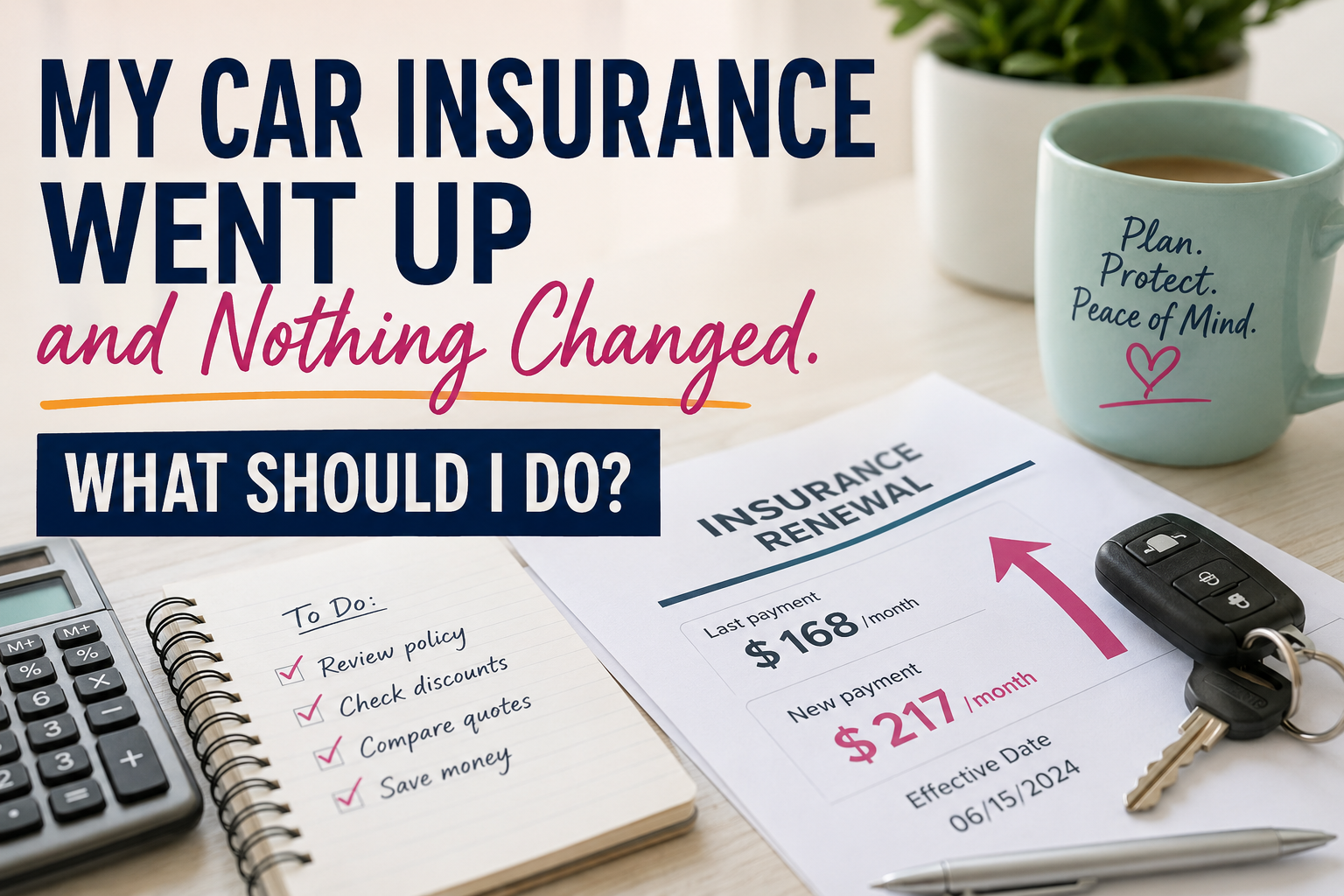
    My Car Insurance Went Up and Nothing Changed. What Should I Do?

    Your car insurance renewal showed up.

    Last time: $168 a month.

    New price: $217.

    Okay.

    That’s not a rounding error.

    So naturally, you start going through the list.

    Accident? No.

    Ticket? No.

    New car? No.

    New driver? No.

    Moved? Nope.

    Same car. Same house. Same person who was apparently perfectly acceptable to insure six months ago.

    So why are you suddenly paying more?

    Here’s the frustrating answer:

    You may not have done anything.

    But before you get mad, cancel the policy, or spend the afternoon collecting twelve different quotes, let’s figure out what actually changed.

    Start With the Renewal—Not Just the Price

    The new premium is obviously the part that got your attention.

    But don’t stop there.

    Pull out your current policy information and the renewal. We’re going to compare them side by side.

    Look at:

    • Vehicles
    • Drivers
    • Coverage limits
    • Deductibles
    • Discounts
    • Vehicle use or mileage, if shown
    • Address or garaging information
    • Optional coverages
    • And, finally, the premium

    If some of those terms aren’t familiar yet, the Insurance Terms Cheat Sheet can help while you work through the policy.

    We’re trying to answer one question:

    Did your price change because something on your policy changed, or did the price change even though the policy basically stayed the same?

    Those are two different conversations.

    Make Sure Nothing Actually Did Change

    I know.

    You already said nothing changed.

    Check anyway.

    Insurance companies use more information than simply whether you crashed the car or got a ticket.

    Maybe a discount disappeared.

    Maybe the estimated mileage changed.

    Maybe a driver is classified differently.

    Maybe something about the vehicle information changed.

    Maybe a discount expired.

    Maybe the way you pay changed.

    Or maybe there’s simply an error.

    That’s why I’d look at the policy before calling anyone.

    You want to be able to say:

    “I’m comparing my old policy with the renewal, and I don’t see any meaningful change in my coverage or information. Can you explain what’s causing the increase?”

    That’s a much more useful question than:

    “Why did my insurance go up?”

    Check Your Discounts

    This one deserves its own stop.

    Look at the discounts on the old policy.

    Now look at the renewal.

    Are they all still there?

    You might see things like a safe-driver discount, multi-policy discount, multi-car discount, low-mileage discount, good-student discount, automatic-payment discount, or something else offered by your insurer.

    Discounts vary by company and state, so we’re not assuming you should have any particular one.

    We’re checking whether something you already had disappeared.

    And while you’re at it, ask:

    “Are there any discounts I’m eligible for that aren’t currently applied?”

    Simple question.

    Worth asking.

    Now Call the Insurance Company or Agent

    This is where we find out what’s going on.

    Have the renewal in front of you and ask:

    “Can you walk me through why my premium increased?”

    You don’t need to know all the insurance terminology.

    You don’t need to argue.

    You just want an explanation.

    If the answer is, “Rates increased in your area,” okay.

    Then ask whether there were any changes specific to your policy.

    If they mention a driver, vehicle, claim, mileage, or another factor, make sure the information is accurate.

    If something is wrong, ask what they need from you to correct it.

    And if everything is right and the rate simply increased?

    Well, now we know what problem we’re actually solving.

    We may not like the answer.

    But at least we have one.

    Yes, Your Rate Can Go Up Even If You Didn’t Have an Accident

    This is one of the things that frustrates people most about insurance.

    You can drive carefully, avoid tickets, file no claims—and still get a higher renewal.

    Why?

    Because your premium isn’t based only on what happened to you personally.

    Insurance companies are also estimating the cost of future claims. If vehicles become more expensive to repair, parts and labor cost more, medical claims become more expensive, theft patterns change, or losses increase in an area, those costs can eventually affect premiums.

    That doesn’t mean every increase automatically makes sense for your situation.

    And it certainly doesn’t mean you shouldn’t shop around.

    It just means:

    “But I didn’t have an accident” isn’t the only thing affecting the price.

    Don’t Immediately Start Cutting Coverage

    Your premium went up $50 a month.

    You want that $50 back.

    Understandable.

    So maybe you start looking at the policy and thinking:

    Higher deductible?

    Lower liability limit?

    Drop rental reimbursement?

    Remove collision?

    Hold on.

    We can review all of those things.

    But don’t start removing coverage simply because you’re angry about the price.

    Every change has another side.

    Raise the deductible?

    Your premium may go down, but you’re agreeing to take on more of the cost after certain claims.

    Lower a limit?

    You may be keeping more of the financial risk yourself.

    Remove a coverage?

    Make sure you understand what problem that coverage was handling before you decide you no longer want it.

    The goal isn’t:

    Make the premium number smaller at any cost.

    The goal is:

    Pay a reasonable amount for coverage that still makes sense for you.

    Now Look for Ways to Lower the Bill

    Once you know the policy information is correct, start with the easier possibilities.

    Ask about discounts.

    Review how many miles you’re driving.

    Make sure the vehicle-use information is accurate.

    Look at optional coverages.

    Ask what changing your deductibles would do to the premium.

    If you have more than one policy, ask whether bundling changes anything.

    But whenever you’re offered a change, ask one more question:

    “What am I giving up to save this money?”

    Sometimes the answer is:

    Nothing. You found a discount.

    Wonderful.

    Sometimes the answer is:

    You’re taking on another $500 of deductible.

    That’s different.

    Savings aren’t really savings until you understand the tradeoff.

    And Yes, This May Be the Time to Shop

    Sometimes you do everything above and reach a very simple conclusion.

    Your insurer wants $217 a month.

    You’d like to know whether somebody else wants less.

    Fair enough.

    Get some quotes.

    But please don’t compare only this:

    Company A: $217
    Company B: $181
    Company C: $159

    Looks like Company C wins.

    Maybe.

    Before we hand them the trophy, we need to know what they’re actually quoting.

    Compare the Coverage Before You Compare the Price

    This is where insurance shopping can get messy.

    One quote might have higher liability limits.

    Another might have lower limits.

    One might have a $500 deductible.

    Another has $1,000.

    One includes rental reimbursement.

    Another doesn’t.

    One includes a coverage you had before.

    Another leaves it out.

    Suddenly, $159 versus $217 isn’t really a comparison.

    It’s two different products with two different prices.

    That’s exactly why we created the Insurance Checkup & Quote Comparison Tool.

    Put the quotes next to each other and compare:

    • Limits
    • Deductibles
    • Coverages
    • Options
    • Then price

    You don’t have to choose the quote with the most coverage.

    And you don’t automatically have to choose the cheapest one.

    You just need to understand what you’re choosing.

    Be Careful About Raising Your Deductible Just to Lower the Premium

    Raising a deductible is a common way to reduce the price.

    And sometimes it makes perfect sense.

    Suppose changing your collision deductible from $500 to $1,000 saves you money.

    Great.

    But I want you to ask yourself something else:

    If you had a covered collision next Tuesday, could you reasonably handle that $1,000 deductible?

    If the answer is yes, maybe that tradeoff deserves consideration.

    If the answer is:

    “I’d have to put the deductible on a credit card,”

    then we should think a little harder.

    The cheapest insurance decision today can become an expensive problem later.

    Don’t Cancel the Old Policy Too Early

    You found another insurer.

    The coverage looks good.

    The price is better.

    Excellent.

    Before cancelling your current policy, make sure the new coverage is actually set to begin.

    Check the effective date.

    Make sure you’ve completed everything the new insurer requires.

    Then coordinate the cancellation of the old policy.

    We do not want:

    Old policy ends Friday.

    New policy begins Monday.

    Saturday and Sunday suddenly become extremely exciting.

    Avoid the lapse.

    What If the Other Quotes Aren’t Any Better?

    That can happen too.

    You get three quotes.

    Maybe four.

    And they’re all expensive.

    That’s useful information.

    It suggests your current insurer may not be uniquely expensive.

    At that point, we have to look at the bigger picture.

    Can you comfortably handle the premium?

    Are there reasonable changes available?

    Could you increase a deductible without creating another financial problem?

    Are there expenses elsewhere that could be adjusted?

    This is where auto insurance stops being only an insurance question and starts becoming a money question.

    You need the coverage.

    But you also have to be able to afford it.

    Don’t Shop Yourself Into Worse Insurance

    This is the part I really want you to remember.

    A lower premium feels like a win.

    And it can be.

    But saving $38 a month isn’t much of a victory if you accidentally gave up something you would have wanted after a serious accident.

    So slow down.

    You don’t have to understand every sentence in an insurance contract before you can shop intelligently.

    You do need to understand the major choices you’re making.

    That’s one of the reasons we’re putting together Let’s Talk About Auto Insurance.

    The book goes much deeper into what the different coverages actually do, how limits and deductibles work, why premiums change, and what to think about when you’re deciding what protection makes sense for you.

    But you don’t need the whole book to deal with today’s renewal.

    Today, you need a plan.

    So Your Car Insurance Went Up. Now What?

    Don’t panic.

    Don’t immediately cancel.

    And don’t start randomly removing coverage.

    Do this instead:

    1. Compare the old policy with the renewal.
    2. Make sure the drivers, vehicles, and other information are correct.
    3. Check your discounts.
    4. Ask why the premium changed.
    5. Ask what options might lower it.
    6. Understand the tradeoffs before changing coverage.
    7. Get a few comparable quotes if the price still doesn’t make sense.
    8. Use the Insurance Checkup & Quote Comparison Tool so you’re comparing the same things.
    9. Then decide whether staying or switching makes more sense.

    Maybe you find a much better price.

    Maybe you discover a missing discount.

    Maybe you make a reasonable adjustment.

    Maybe you decide your current policy is still the best option available.

    Any of those can be a good outcome.

    Because the goal wasn’t simply to get a cheaper number.

    The goal was to understand why the number changed and make a deliberate decision about what to do next.

    That’s a much better response than staring at the renewal and wondering:

    What did I do?

    Maybe nothing.

    Now let’s see what you can actually do about it.


    This article is for general educational and informational purposes only and isn’t intended as individualized insurance, financial, legal, or tax advice. Insurance coverage, pricing, requirements, and policy terms vary by insurer, policy, and state. Review your own policy and circumstances, and contact your insurance company, licensed insurance professional, state insurance regulator, or another qualified professional when appropriate.

    Share This Conversation